Public health
Mosquito population rises 40pc in just 1 month
It was 10:30 pm last Wednesday. Standing on the balcony of a five-storey building in Adabor, Dhaka, private-sector employee Rashedul Islam was waving his hands and feet in a futile attempt to ward off mosquitoes. A mosquito repellent coil was burning inside the room, aerosol had been sprayed in the drawing room—yet nothing seemed to work.
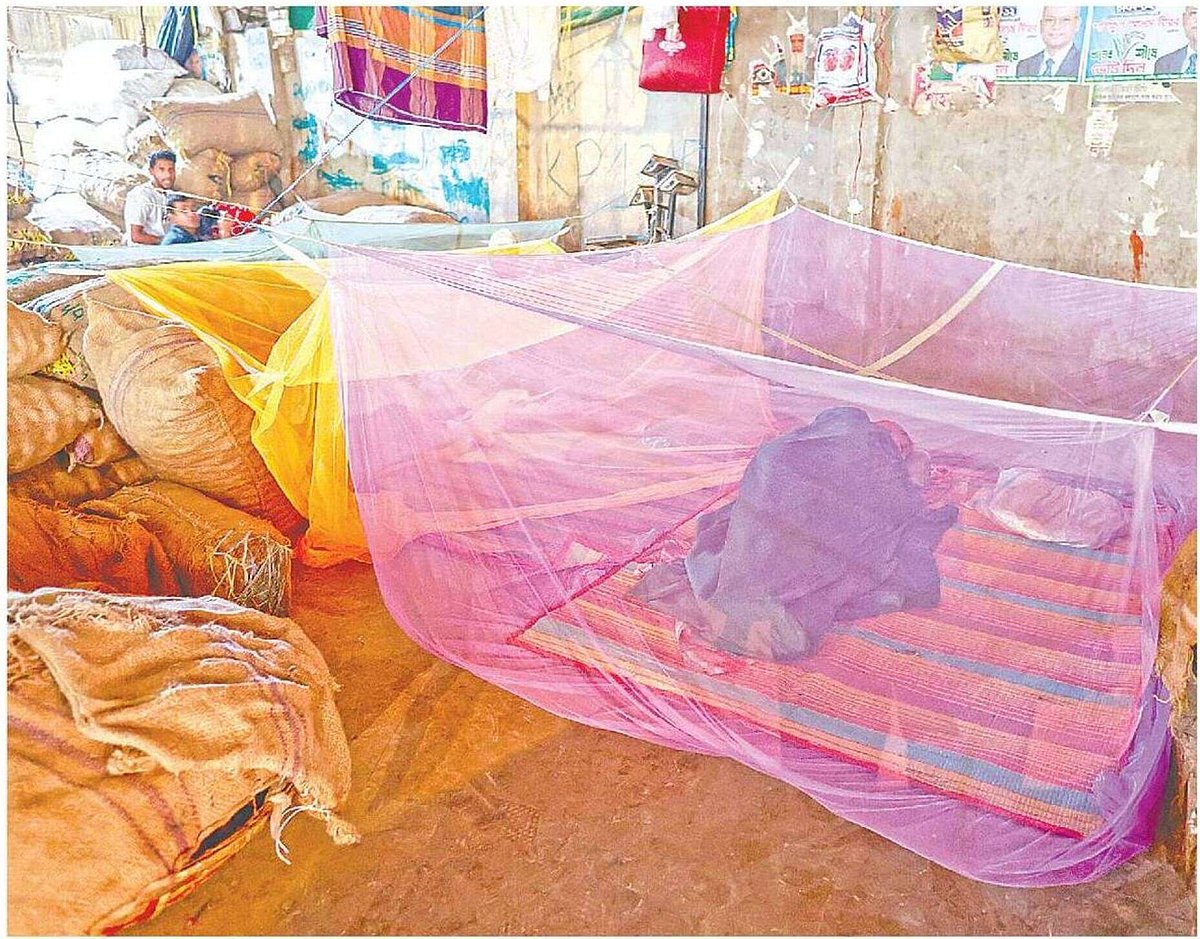
“I come home after a full day at work hoping to relax, but that’s impossible,” Rashedul said. “It feels like a swarm of mosquitoes is waiting the moment I enter the house. They even get inside the mosquito net at night.”
His eight-year-old son has small sores on his arms and legs from repeated scratching. “He doesn’t even realise when he’s bitten. Later we see the area swollen and red,” said the child’s mother. The family believes many households across the capital are facing the same problem.
A recent study suggests that the mosquito infestation in Dhaka is not only increasing but has reached alarming levels. Research led by Professor Kabirul Bashar of the Zoology Department at Jahangirnagar University found that mosquito numbers in February have risen by more than 40 per cent compared to January. About 90 per cent of the mosquitoes are of Culex species. Experts warn that the situation may worsen further in March.
Three main mosquito species are commonly found in Bangladesh—Culex, Aedes, and Anopheles.
Culex is the most widespread. It can transmit filariasis and Japanese encephalitis, though these diseases are not highly prevalent in Bangladesh. Aedes mosquitoes transmit dengue, while Anopheles mosquitoes are responsible for malaria.
Scientist Mohammad Shafiul Alam of the International Centre for Diarrhoeal Disease Research, Bangladesh (Icddr,b) told Prothom Alo that Japanese encephalitis has an estimated fatality rate of 25 per cent.
Although deaths have occurred in Rajshahi, Rangpur, and the hill tracts in the past, the disease is relatively uncommon in Bangladesh, partly because pig farming—an important transmission factor—is limited.
Researchers attribute the spike in mosquito populations to three main reasons: this winter was milder than usual and ended earlier than normal, pollution in drains and water bodies has not been adequately controlled, and the absence of elected representatives in the two Dhaka city corporations has slowed mosquito control programmes.
Alarming Research Findings
Professor Kabirul Bashar has been researching on mosquitoes for 26 years. In his latest survey, his team assessed the situation in two ways—by measuring larval density in water samples and by counting adult mosquito bites.
For larvae, researchers collected 250 millilitres of water from various water bodies and counted the larvae present. In January, water samples from Dhaka and Savar contained an average of 850 larvae. In February, the average rose to 1,250.
The adult mosquito counting method is equally striking. With a person’s legs (up to the knee) and arms exposed, researchers counted how many mosquitoes attempted to bite within one hour. In January, the figure ranged from 400 to 600. In February, it climbed to an average of 850.
Professor Bashar warned that if five mosquito bites per hour are considered high by global standards, then 850 is not just a number—it is a danger signal.
In collaboration with the Zoology Department of Jahangirnagar University, the Dhaka North City Corporation monitored mosquito populations in five areas using 24-hour traps. A total of 17,159 mosquitoes were collected between 16 and 20 January, while from 30 January to 3 February, the number increased to 22,362.
The five locations were Uttara Sector 4 Park, the DNCC warehouse office in Mirpur-2, the old warehouse office in Gulshan-1, Ward 10 Community Centre in Mirpur-1, and the DNCC regional office in Mohammadpur.
Where Are Mosquitoes Most Concentrated?
The study found uneven distribution across the capital. Areas such as Kamrangirchar, Lalbagh, Shyampur, Rayerbazar, Uttara, and nearby Savar recorded higher larval and adult mosquito densities. In contrast, central areas like Shahbagh and Paribagh showed relatively lower levels.
Residents echo the findings. Sumona Haque of Nikunja residential area said, “You can’t even stand on the balcony. The attack begins in the afternoon.” A university student in Kalabagan said, “As soon as I sit at my study table, mosquitoes surround me. Aerosol works briefly, then it’s back to the same situation.”
Why is culex increasing?
Experts cite weather and pollution as key factors.
Professor GM Saifur Rahman of the Zoology Department at the National University said that in previous years, Culex infestation typically rose from mid-March, but this year it began increasing from February and may continue until early summer.
He explained that the shorter winter and early onset of heat have created favourable conditions. During colder temperatures, hormonal and enzymatic activity in mosquitoes slows down, hindering larval growth and reducing female mosquitoes’ blood-feeding behaviour.
As temperatures rise, their life cycle accelerates, and female mosquitoes feed more frequently to accumulate protein for egg production, thereby increasing reproduction rates.
According to the Meteorological Department, January’s maximum temperature was 1.2°C above normal, the minimum was 0.4°C above normal, and the average temperature was 0.8°C higher than usual. Experts say this temperature rise has created favourable breeding conditions for Culex.
Pollution is another major driver. Garbage, stagnant water bodies, and clogged drains are prime breeding grounds for Culex mosquitoes.
Management Challenges
The DNCC area contains nearly 8,000 bighas of water bodies, many of which serve as mosquito breeding sites. DNCC Chief Health Officer Brigadier General Imrul Kayes Chowdhury said that even after cleaning, water bodies quickly become clogged with waste again, making management extremely complex.
He noted that open drains, persistent waterlogging, and lack of designated waste disposal sites make it difficult to control Culex breeding. Additionally, the absence of elected city representatives has hindered effective mosquito control efforts.
“In many water bodies, fish farming takes place, and the city corporation is not allowed to intervene,” he said.
He added that elected representatives usually know local residents and can persuade them during crises. While government officials are making efforts, they are not always able to effectively mobilise public cooperation.