Prothom Alo investigation
DSCC: Drivers draw salaries, others drive garbage trucks, costing lives
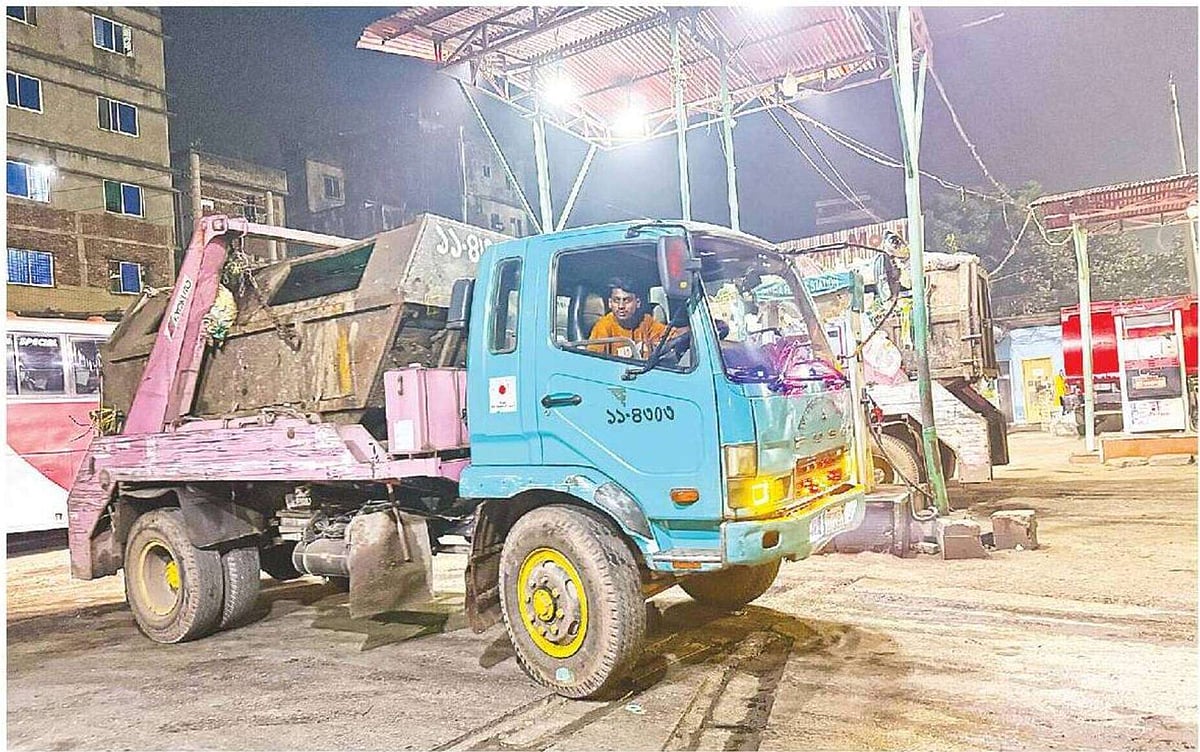
It was around 12:45 am on 4 October. A garbage truck belonging to Dhaka South City Corporation (DSCC) arrived at the municipal filling station in Sayedabad to refuel. This correspondent went closer and found that the young man sitting in the driver's seat was not the driver listed in the records. The vehicle had been assigned to Sardar Humayun Kabir but was being driven by Saju Ahmed. He is an outsider, not an employee of the corporation. He works as an assistant for Tk 10,000 a month. Although he had driven the heavy vehicle to the filling station, he claimed to have a licence for light vehicles.
When asked where the assigned driver was, Saju initially said he was nearby. Asked again, he said his uncle was chatting at Golapbagh intersection. A little later, he drove away without refuelling. He also alerted other drivers about the presence of a journalist. I then waited at the filling station for nearly two hours, but no other DSCC vehicle arrived to refuel.
Nearly five years ago, Notre Dame College student Naim Hasan was killed after being run over by a DSCC garbage truck. That vehicle, too, was being driven by someone other than its assigned driver. Despite student protests, the occupation of Nagar Bhaban, investigations and the suspension of the driver, the practice of handing over vehicle keys to others has not stopped. Similar irregularities were also found in the deaths of school student Mahin Ahmed and laundry shop employee Iqbal Hossain.
In an investigation into the waste transport vehicles of DSCC, Prothom Alo found that 22 vehicles were being driven by people other than their assigned drivers. According to relevant sources, the actual number of such vehicles is at least 56. Some of the drivers to whom the vehicles have been assigned are drawing salaries without driving them themselves. Their assistants or outsiders are driving the vehicles instead. There are also allegations that the drivers do not collect the full amount of fuel allocated to them and share the money equivalent to the remaining fuel.
The investigation found that at least 16 people had died in 15 fatal accidents involving DSCC garbage trucks between 2018 and 4 October this year. Two more people were killed in an accident in Basabo the previous year. In total, at least 18 people have died in 16 accidents since 2017. In at least three of these incidents, the vehicles were being driven by people other than their assigned drivers.
Shah Alam Talukder, president of the DSCC Transport Drivers, Workers and Employees Union, did not completely deny the irregularities.
He told Prothom Alo that others are sometimes allowed to drive the vehicles. In his words, “I cannot say that everything is absolutely fine. There are certainly mistakes.”
However, he said that after journalists began investigating, they had also started monitoring the situation themselves and assistants were no longer being allowed to drive the vehicles.
DSCC Administrator Md Abdus Salam told Prothom Alo that one accident had occurred since he took charge. However, questioning why even one person should die in such an accident, he said he had instructed officials not to allow anyone without a driving licence to operate the vehicles.
If an assistant is allowed to drive a vehicle, action will be taken against both the assigned driver and the official responsible for supervising them, he added.
Assigned driver chatting, assistant behind the wheel
To verify reports that outsiders were driving garbage trucks, this correspondent went to the municipal filling station in Sayedabad around 11:00 pm on 4 October. The corporation's vehicles refuel at this pump, which it owns, although outside vehicles can also buy fuel there. This correspondent waited at the station to match vehicle registration numbers with the identities of their assigned drivers. At around 12:45 am, 5 October a vehicle bearing registration number 11-4303 arrived.
According to the corporation's records, the vehicle was assigned to heavy vehicle driver Sardar Humayun Kabir. Saju Ahmed, who was sitting in the driver's seat, said he was not an employee of the corporation. He receives Tk 10,000 a month as an assistant. He said his uncle drives the vehicle, but his uncle was not in it at the time. Asked about his driving licence, Saju said he had a licence for light vehicles.
After Saju left, a filling station official and several local people approached me and asked what I was working on. One of them described how drivers collect less fuel than their allocated amount but take the full amount of money. While standing at the filling station, I phoned the assigned driver, Sardar Humayun Kabir, several times on his mobile phone. He did not answer. As a result, I could not obtain his explanation at the time for allowing someone else to drive the vehicle.
A local later said that vehicles began arriving at the filling station again about half an hour after I left that night. Asked whether Humayun Kabir held any position in the union, its president Shah Alam Talukder said he was not on the committee.
However, he said Kabir was close to him and often stayed with him. When questioned about allowing others to drive the vehicles, the union president spoke about the long hours drivers have to work. He claimed that drivers sometimes have to work 15 to 17 hours. However, DSCC sources said drivers operate vehicles for seven to eight hours in total, covering both day and night shifts.
At around 10:30 pm the following day, 5 October, I went to another garage where the corporation parks its vehicles, beside the Sayedabad bus terminal. The site, near the railway line leading towards the Padma Bridge, previously housed Wonderland Park. Vehicles were leaving the garage one after another to collect waste. However, two vehicles bearing registration numbers 11-4270 and 11-4307 were not leaving.
These two vehicles were among those identified in the investigation as being driven by people other than their assigned drivers. I stayed there for about an hour and a half. At one point, news of a journalist's presence spread, and at least 35 drivers gathered around me to ask what I was investigating. Eventually, I left following the intervention of a senior corporation official. I could not speak to the drivers of the two vehicles that day.
The driver of another vehicle, bearing registration number 11-4278, could not be located the previous night either. The vehicle remained parked beside the Sayedabad bus terminal from 11:00 pm on 4 October to 2:30 am on 5 October. Earlier information had also indicated that this vehicle was being driven by people other than its assigned driver. Despite waiting for a long time, I could not locate the driver to verify his identity that night.
Others also take the driver's seat amid driver shortage
DSCC has a total of 608 vehicles and pieces of equipment, including excavators, road rollers and bulldozers. Against this, it has 252 permanent drivers. This figure includes not only waste transport vehicles but also other vehicles and equipment owned by the corporation. To address the shortage of drivers, employees in other positions, including cleaners and mosquito control workers, are also assigned driving duties.
Union President Shah Alam Talukder confirmed that the corporation has 252 permanent drivers. According to him, employees in other positions who have driving licences and the necessary skills are assigned driving duties after being tested by officials.
However, the investigation found that in the cases of the vehicles identified, the assigned drivers themselves were allowing others to drive them at their own discretion. Officials concerned said many obtain such opportunities through arrangements with transport workers' leaders.
Regarding the shortage of drivers, Administrator Abdus Salam said he had recruited some drivers after taking charge and that more would be recruited. Proposals outlining staffing requirements in different departments had been sent to the ministry. However, he said the corporation also had to consider its ability to pay salaries before increasing its workforce.
Allocated fuel sold at the filling station
Household waste from the 75 DSCC wards is first brought to secondary transfer stations (STSs). From there, it is transported by vehicles to the Matuail landfill. A total of 237 vehicles and pieces of equipment are used for waste transportation and landfill management. These include both waste transport vehicles and equipment used at the landfill.
Vehicles with capacities of 3, 5, 10, 15 and 20 tonnes are used to transport waste. Sources concerned said these vehicles travel between the STSs and Matuail three to four times every night. However, union president Shah Alam Talukder claimed that at least four trips are required to clear the waste, while some vehicles make as many as five trips.
According to sources concerned, the fuel allocation ranges from eight to 14 litres per trip, depending on the vehicle and route. There are allegations that fuel is siphoned off by taking advantage of allocations that are three to four litres higher per trip than necessary. Instead of filling the vehicles with the entire allocated amount, the remaining fuel is sold at a lower price at the filling station. An official working at the pump told Prothom Alo, on condition of anonymity, that everyone knows DSCC drivers sell some of their allocated fuel at a slightly lower price. There is nothing to hide about it.
At the municipal filling station, this correspondent spoke to a local man. Describing the transactions, he said that if 12 litres of fuel were allocated for a trip, the driver would take only eight or nine litres. The money for the remaining fuel would be kept on account. Pump employees record the transactions in writing, and the money is handed over to the assigned driver around the middle or at the end of the month. According to his account, even when someone else drives a vehicle, the financial records remain under the name of its assigned driver.
Sources concerned alleged that some drivers, union leaders and officials concerned receive shares of this money. However, no details could be obtained about how much money each person received.
Shah Alam Talukder, president of the Transport Drivers, Workers and Employees Union, denied allegations that he received commissions from fuel sales. He said he was employed, received a salary and lived on that income. He said he did not have specific records of how much fuel each vehicle consumed.
According to him, the engines of some vehicles have to remain running to operate their hydraulic systems. Therefore, fuel consumption cannot be calculated uniformly for all vehicles based solely on the distance travelled.
According to estimates by sources concerned, an average of 5,842 trips are made every month. If three litres of fuel are siphoned off per trip, the total amounts to 17,526 litres a month. At the government's October retail price of Tk 135 per litre, the market value of this diesel stands at Tk 2.37 million. If the practice continues at the same rate for a year and prices remain unchanged, the amount would be approximately Tk 28.4 million.
Regarding allegations of fuel sales and the protection provided by union leaders, DSCC Administrator Abdus Salam said forming trade unions is a workers' right and he could not curtail that right. However, he said he would investigate if specific allegations were brought to his attention. If anyone's involvement is proven, various disciplinary measures, including dismissal from service, would be taken.
Deaths, suspensions, yet same irregularities persist
On 24 November 2021, Notre Dame College student Naim Hasan was run over by a DSCC garbage transport truck while crossing the road in Gulistan. The following day, police said the vehicle was being driven by Russell Khan, who was not a regular employee of the corporation and did not have a driving licence. According to the police, he had become involved in cleaning work through a relative and subsequently got the opportunity to drive the vehicle.
The corporation's investigation into the incident uncovered several stages through which responsibility for the vehicle had changed hands. The vehicle was assigned to Iran Mia. It was handed over to Harun from the transport pool, and Harun then allowed Russell to drive it. In other words, the keys passed through several hands from the driver officially listed in the records before reaching an unlicensed person.
Following Naim's death, students staged protests in Gulistan. On 25 November, they surrounded Nagar Bhaban, demanding justice and safer roads. The then DSCC mayor, Sheikh Fazle Noor Taposh, came out and addressed them. In December 2022, police submitted a charge sheet to the court against three people in the case filed by Naim's father. Those accused included suspended driver Iran Mia, Harun and Russell. An arrest warrant was also issued against Iran Mia at the time.
However, despite the filing of cases and investigations into these incidents, the families have yet to receive justice. Asked about the matter, Naim Hasan's father, Shah Alam Dewan, told Prothom Alo over the phone yesterday, Friday, “Everything ended after the case was filed. No one followed up afterwards. I struggled so hard to get my son into Notre Dame College, but everything came to an end.”
Expressing his frustration, he said, “A culture of impunity has persisted for many years. What more can I say about it!”
On 8 December 2021, nine drivers were suspended following Naim's death. The allegation was that they had allowed others to drive the vehicles assigned to them instead of driving them themselves. Seven of them were garbage truck drivers and two drove light vehicles. Transport Supervisor Faruk Ahmed was also dismissed over allegations that he had allowed someone else to drive a vehicle assigned to another person. However, he was later reinstated.
About two and a half years later, on 25 April 2024, Mahin Ahmed, a seventh gradef at Motijheel Ideal School, was killed after being hit by a garbage truck in Medinabagh, Mugda. According to a corporation order, Kamal, the driver of vehicle number 11-4281, had assigned Rubel to drive it instead of driving it himself. Neither the driver nor the two cleaners assigned to the vehicle were present in it at the time of the accident. All three were dismissed for negligence of duty.
On 23 October 2025, laundry shop employee Iqbal Hossain was killed in Kalapatty, Jatrabari. A garbage truck hit him while he was returning home after work. According to police, the vehicle was being driven by the driver's assistant. He was detained and the vehicle was seized. Naim, followed by Mahin and then Iqbal — in all three cases, someone other than the assigned driver was behind the wheel.
At least 18 deaths in 9 years
According to accident records uncovered by the investigation, two people named Rimon and Sharin were killed after being run over by a garbage truck in front of the Basabo Buddhist Temple in September 2017. Two more people died in two separate accidents in 2018. Badsha Mia was killed at Dainik Bangla intersection on 12 May, while motorcyclist Nurjahan Pushan died in Bakshibazar on 23 November. Her husband was also injured.
Information was found on six incidents in 2021 in which six people died. Khalid, an employee of the state-run Bangladesh Sangbad Sangstha (BSS), was killed in Dayaganj on 20 January; rickshaw puller Mostafa died in Jatrabari on 16 April; and bank employee Swapan Ahmed Dipu was killed in Titipara in May. Garment worker Faruk Hossain died in Dolaipar on the night of 9 August. Naim was killed on 24 November, followed by Swapan Kumar Sarkar in Wari on 23 December.
Nasrin Khanam was killed in Khilgaon on 1 April 2022, and Nazma Begum died in Titipara on 31 May. On 5 August 2023, another woman, Nazma Begum, was killed in the Bhanga Press area of Jatrabari. At the time, the corporation denied that its vehicle was involved in the incident. However, a subsequent investigation confirmed that the vehicle belonged to Dhaka South City Corporation.
Following Mahin's death in 2024, three people were killed in two separate incidents in 2025. Besides Iqbal, university students Gazi Iram Ridwan and Tahsin Tapu were killed in Demra on 12 December. On 4 April this year, businessman Sajedul Islam lost his life in South Banasree. By this count, 18 people have been killed in 16 accidents since 2017.
Regarding the accidents, DSCC Administrator Abdus Salam said that following an accident after he took charge, he instructed officials not to allow anyone without a driving licence to operate the vehicles. He claimed that no such incident had occurred since the instruction was issued.
When informed about the incident at the municipal filling station involving a relative of the assigned driver, he asked for the specific details to be submitted to him. He said he would take disciplinary action if the information was provided.
Asked why officials were not supervising the drivers, the administrator said it was not possible to make sweeping statements about incidents that had not come to his attention.
The DSCC added that action would also be taken against officials responsible for supervising the drivers if they allowed others to operate the vehicles in this way.
City corporation must take responsibility
Former BUET professor and transport expert Shamsul Haque told Prothom Alo that although city corporation administrators are currently taking various bold initiatives, an unbiased approach is essential in this regard. Before disciplining or controlling others, they must first put their own house in order; otherwise, such efforts amount to nothing more than an assertion of authority.
He questioned whether the city corporation's garbage trucks were actually roadworthy, whether their drivers held valid licences and whether people other than the authorised drivers were operating the vehicles.
He said the city corporation itself must bear the primary responsibility for the deaths of ordinary people caused by its garbage trucks, rather than holding only the drivers accountable. Sustainable solutions will be possible only when reforms begin within the organisation itself, and the initiatives taken will then earn public trust.