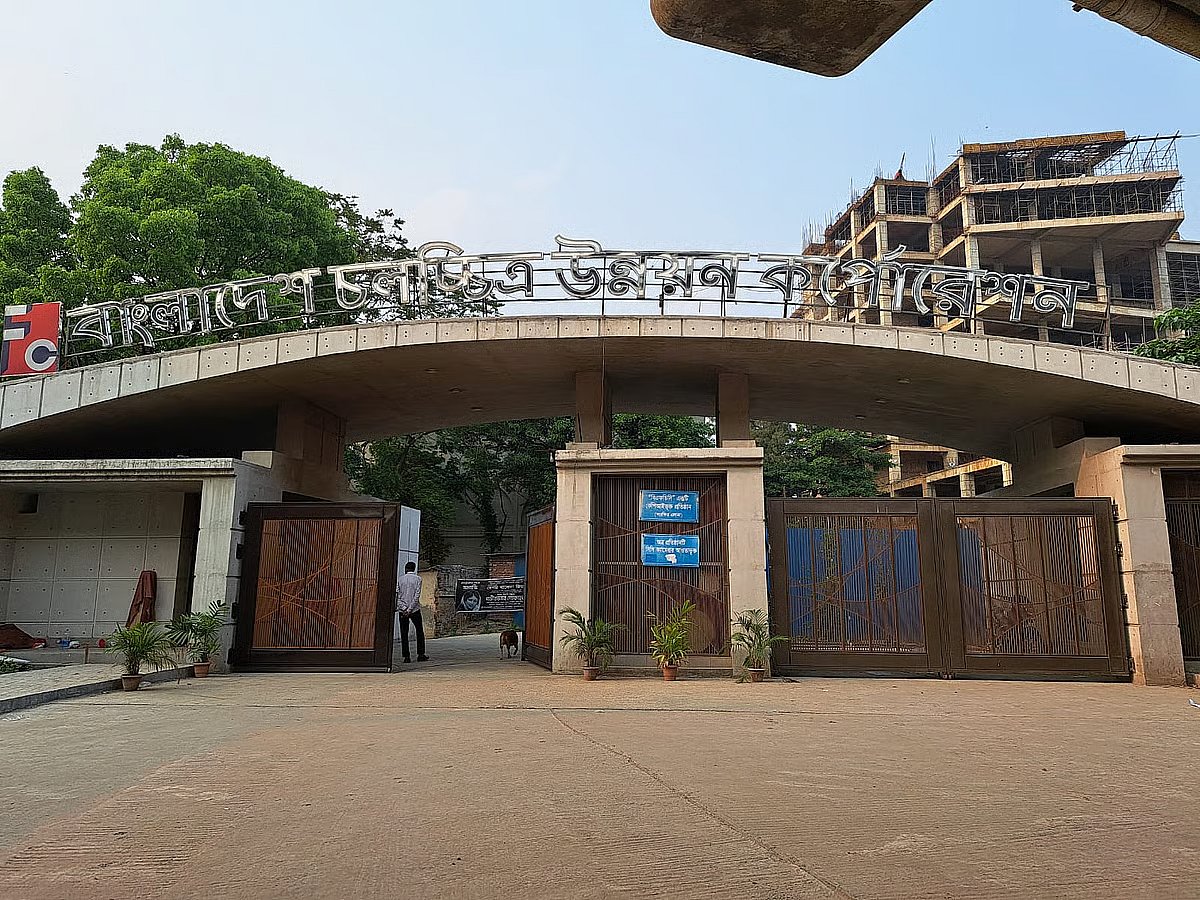
BFDC complex: Four-year project drags into seventh year, half the work done
Asked when the work will be completed, Zahid Hasan replied, “It cannot be said at this moment.” He is an official of the contracting firm Biswas Trading and Construction, which is carrying out the construction of the BFDC Complex. He is serving as the project manager on behalf of the company.
BFDC managing director Masuma Rahman also does not know when the project will be completed. She expressed frustration and indicated that the project deadline may need to be extended again.
The project to construct the Bangladesh Film Development Corporation (BFDC) Complex was undertaken in 2018. At the time of approval, it was stated that the work would be completed by December 2021. However, construction only began in 2022, and the foundation stone of the complex was formally laid in August 2023.
After several extensions, the latest deadline was set for June 2026. But a review conducted two months before that shows that only 50.66 per cent of the work has been completed. This means the project will not be finished within the stipulated timeframe.
Of the 12-storey main building, work on 11 floors has been completed. BFDC officials say that at the current pace, the project will not be finished even by June 2027, let alone June this year.
The project was undertaken in 2018. At the time of approval, it was stated that the work would be completed by December 2021. However, construction only began in 2022. After several extensions, the latest deadline was set for June 2026. But a review conducted two months before that shows that only 50.66 per cent of the work has been completed.
BFDC, the heart of the country’s film industry, is now struggling. Yet, the project’s feasibility study had projected that once implemented, it would generate annual revenue of Tk 520 million (52 crore).
At the time of its approval by the Executive Committee of the National Economic Council (ECNEC) on 2 October 2018, it was said that once the complex “stood tall”, it would resolve BFDC’s financial crisis and other problems.
Speaking to Prothom Alo last week, managing director Masuma Rahman said that the organisation’s income would increase once construction was completed. However, the reality is that the building work itself remains unfinished.
Expressing frustration, she said, “We have been unfortunate. Three floors were demolished to build this complex, which has further reduced the organisation’s income. We are having to provide salaries and bonuses to employees by taking loans from the government. Forget making BFDC film-friendly—we are not even able stand on our own feet.”
Due to the ongoing construction, normal activities at BFDC have largely come to a halt. Initiatives have been taken to encourage filming there by reducing rental charges, but that too has had little impact. Masuma Rahman added that no new equipment has been purchased since 2016, and filmmakers are unwilling to rent outdated equipment.
We have been unfortunate. Three floors were demolished to build this complex, which has further reduced the organisation’s income. We are having to provide salaries and bonuses to employees by taking loans from the government. Forget making BFDC film-friendly—we are not even able stand on our own feet.Masuma Rahman, managing director, BFDC
Facilities included in the project
The Bangladesh Film Development Corporation (BFDC), located in Tejgaon area of the capital, is the main hub of the Dhaka-based film industry. The BFDC Complex is being constructed under a modernisation project.
The complex is to include a cineplex with three screens or halls. It will also feature shooting floors, make-up rooms, separate entry lobbies and reception areas for film professionals and the general public, a souvenir shop, food court, swimming pool, museum and library, dancing floor, theatre stage, a childcare centre for those in the film industry, a corner for children with special needs and intellectual disabilities, a gymnasium, and a ballroom or multipurpose hall.
It is also supposed to house modern post-production facilities including a VFX studio, a residential hotel for local and foreign filmmakers, artistes as well as tourists, meeting rooms, juice and coffee bars, restaurants, exhibition space, fountains, a children’s play area, a space for elderly visitors to socialise, a seminar hall, gardens and various other amenities.
In addition, parking space for around 300 vehicles will be provided in the basement and ground floor of the complex. The complex is intended to function as a one-stop service centre, and different sections can be rented out to commercial entities.
The project, taken under the Ministry of Information, is being implemented by BFDC. At the time of approval, the cost was estimated at Tk 3.22 billion (3,227,786,000). After several revisions, the cost has increased to Tk 3.65 billion (3,655,153,000).
Work on the building’s three basements and the roof casting of the tenth floor was completed on 19 October last year. Then casting of 38 out of 63 columns on the 11th floor was completed later. The progress stalled after that.
Due to the slow pace of work, BFDC issued letters urging the contractor to expedite progress, along with a show-cause notice. Visiting BFDC on 25 March it was found that some construction work has resumed.
The main objectives of the project are to expand and strengthen the film industry, make BFDC financially self-reliant, broaden the scope of entertainment by adding commercial and technical facilities, and create new sources of income to reinforce the foundation of the BFDC as well as the film industry.
However, since construction of the building is not yet complete, internal electrical work, air-conditioning systems, lifts, electrical substations and generator installation cannot proceed. The procurement and installation of cineplex equipment, digital movie cameras, lenses, various types of lighting, and VFX equipment have also been stalled.
According to BFDC’s 2011–12 annual report, the organisation remained profitable until the 2005–06 fiscal year. Since then, it has been running at a budget deficit. The organisation, which began to decline from around 2000, has been incurring losses since the 2007–08 financial year. BFDC has relied on government grants since 2014.
Why the delays
People involved with the project said that construction work was halted for several days in September last year and from 31 October until 5 March this year. BFDC sought explanations from the contractor, issuing show-cause notices and reminder letters. Although the contractor responded on 24 February, the explanation was not considered satisfactory.
BFDC’s supervising engineer and additional project director of the complex construction project, Md Moniruzzaman, told Prothom Alo that delays in appointing the project director and contractor, frequent changes of project directors with the absence of a permanent project director, the COVID-19 pandemic, and complications in fund disbursement were among the reasons the work was not completed within the stipulated timeframe.
Zahid Hasan, project manager of the contracting firm Biswas Trading and Construction, cited additional reasons.
He said that although the project was approved in 2018, work only began in 2022. By then, the cost of materials had risen significantly. As a result, the contractor filed a writ petition in the High Court seeking price adjustment. Although the contractor initially secured a favourable verdict, BFDC authorities filed an appeal, and the court issued a stay order.
Zahid Hasan also said that the political developments of 5 August 2024 had affected the work. He added that no funds had been released for the project in the 2025–26 fiscal year.
In June 2024, the Implementation Monitoring and Evaluation Division (IMED) of the Planning Ministry prepared a detailed monitoring report on the BFDC Complex construction project. The report noted that progress on the project, being implemented on 94 kathas of land in the Tejgaon area, was far from satisfactory.
A significant portion of the allocated funds from the 2018–19 to 2023–24 fiscal years remained unutilised. In many cases, even when funds were released, they could not be fully spent, largely due to the slow pace of the main construction work, the report pointed out.
Zahid Hasan added, “Due to various reasons, including the non-release of funds, we have incurred losses ourselves. Even so, we are continuing the work.”
How important is the complex
The golden era of the Dhaka-based film industry began centering the BFDC, which was established in 1957. That institution, once regarded as the cradle of Bangla cinema, is now almost a “dying organisation”.
As agencies listed under the Ministry of Information, budget allocations are made each year in the names of 11 organisations, including Bangladesh Television, Bangladesh Betar and the Bangladesh Film Censor Board. However, there is no specific allocation for BFDC. The organisation is expected to run on its own income. For that reason, its employees are looking to the BFDC Complex with hope.
Due to various reasons, including the non-release of funds, we have incurred losses ourselves. Even so, we are continuing the work.Zahid Hasan, project manager, contracting firm
Speaking to Prothom Alo on condition of anonymity, a BFDC official said, “How long can an organisation survive by begging? If the complex stands on its own feet, we would at least not have to depend on the government for salaries and allowances of the emplyees.”
Films have been produced at BFDC since 1959. During the analogue era, it held a monopoly on importing various types of raw 35mm film, such as sound negatives, picture negatives and positives, which were then sold to filmmakers.
On paper, BFDC has a wide range of responsibilities, including providing loans for film production as well as studio establishment and maintenance, renting out studio facilities to filmmakers, producing and distributing films, conducting film-related training courses, organising seminars, discovering new talent, arranging film festivals, selecting films for international festivals, and participating in such events.
In reality, however, there is little visible activity beyond renting out shooting floors and providing some technical facilities. Various shooting floors are rented by private television channels throughout the year for reality shows and other programmes.
Yet, a 1987 research publication titled ‘Bangladesher Chalochitrer Itihas’ (History of Bangladeshi Cinema) by Anupam Hayat noted that the government once earned around Tk 350 million (35 crore) annually in entertainment tax from films produced at BFDC.
According to BFDC’s 2011–12 annual report, the organisation remained profitable until the 2005–06 fiscal year. Since then, it has been running at a budget deficit, with expenditure exceeding income. The organisation, which began to decline from around 2000, has been incurring losses since the 2007–08 financial year. Although it was meant to be self-sustaining, BFDC has relied on government grants since 2014.
In April last year, BFDC submitted a report to the former chief adviser of the interim government. It stated that the organisation’s budget deficit for the 2025–26 fiscal year stood at Tk 205.3 million (20.53 crore). Its monthly expenditure, including staff salaries, is around Tk 11 million (1.1 crore), while its average monthly income is only about Tk 3 million (30 lakh). As employees retire or pass away, their due benefits add to the financial burden.
BFDC requested a grant of Tk 1.18 billion (118.7 crore) from the interim government to cover salaries, post-retirement benefits and modernisation initiatives.
Industry insiders say BFDC stumbled while transitioning from analogue to digital cinema. The first digital camera arrived at BFDC in 2014, whereas private institutions in the country had already begun digital filmmaking in 2012. As a result, BFDC fell behind in competition.