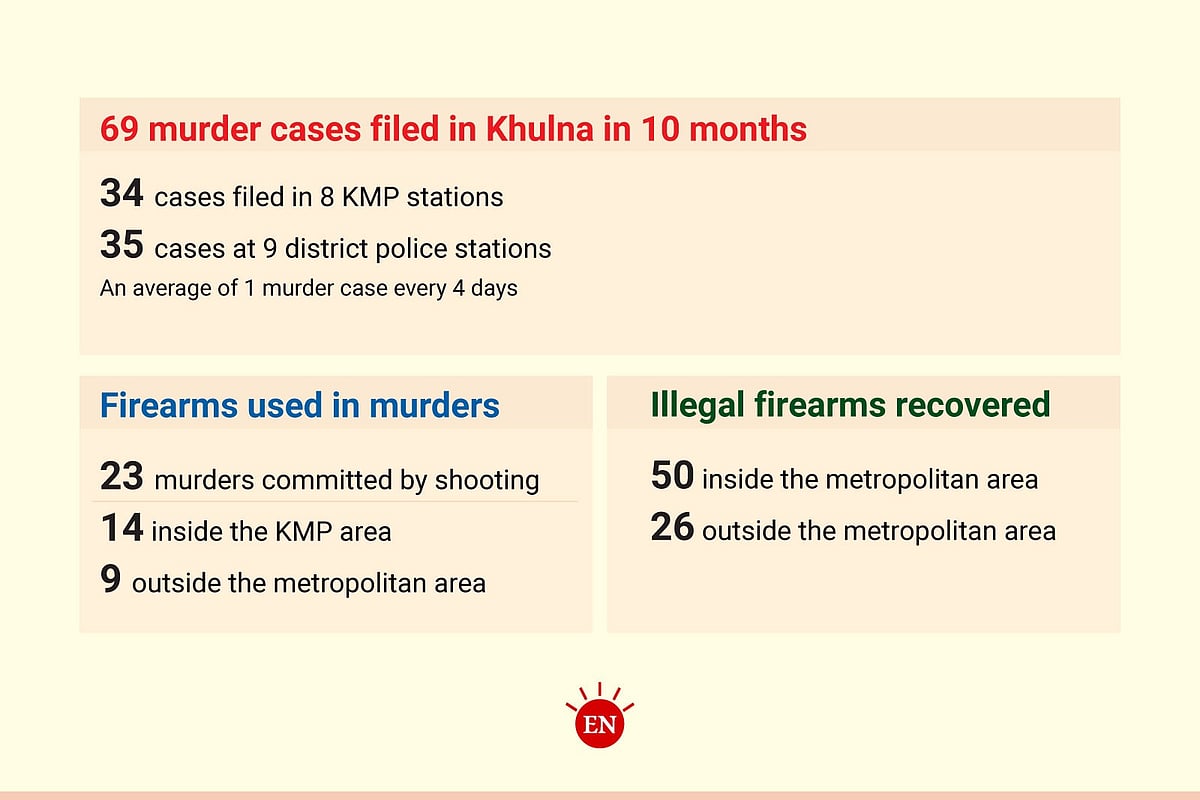
Sometimes people are shot dead in public, sometimes hacked or injured with sharp weapons, and at other times gunmen enter homes and open fire. Firearms are also being used in crimes such as mugging. From January to 23 October this year, 71 people were killed in Khulna city and district over a period of nearly 10 months. Of them, 23 were shot dead. The others were killed by hacking or beating.
A total of 69 murder cases were filed in Khulna city and district during the period in connection with the 71 deaths. The number of cases was lower than the death toll because three people were killed in a single incident. According to police, the killings were linked to drug trafficking, control over extortion, mugging, past enmities and rivalries between criminal gangs.
Most recently, two murders took place in Khulna city within 15 hours on 22 October. In the morning, a young man named Tawhidul Islam was shot dead in the Purba Baniakhamar area. In the evening, housewife Khushi Akter was shot dead by assailants near her home in the Jinnahpara area.
Police initially suspect that drug-related disputes were behind both killings. Investigators are also examining whether the two incidents were connected.
In recent months, Khulna city and district have witnessed a series of shootings, gun attacks causing injuries and other armed assaults. Ordinary citizens, political party leaders and activists, teachers, schoolgirls, women and pedestrians have also been targeted. Although law enforcement agencies say they are recovering illegal firearms and arresting criminals, the killings continue unabated.
SM Shafiqul Alam Mona, president of the Khulna city BNP, said they had urged the inspector general of police and other relevant authorities to improve the law and order situation.
If teen gangs, drugs and terrorism could not be eliminated, Khulna would face a dangerous situation, he said. He added that strict action would also be taken against anyone from his party involved in drug trafficking or other criminal activities.
Nine criminal gangs in focus
The names of nine criminal gangs have repeatedly surfaced in connection with many of the recent crimes in Khulna. They have become so brazen that they do not hesitate to open fire in public, even in crowded areas.
Several police sources said the active criminal groups in Khulna include B Company, led by Rony Chowdhury, also known as Grenade Babu; the Palash Group, led by Sheikh Palash; the Nur Azim Group; the Ashik Bahini; the Huma Bahini, led by Humayun Kabir; the Tengki Shawon Group, led by Sheikh Saidur Rahman, also known as Shawon; the Arman Group, led by Arman Sheikh; the Shakil Group, led by Shakil Sheikh; and the Nasim Group.
According to law enforcement sources, the Babu group holds sway across Khulna city. The Nur Azim and Ashik groups dominate the Khulna Sadar and Labanchara police station areas. The Shawon group is active in Sonadanga and Khalishpur, while the Arman Group and Huma Bahini have influence in the Daulatpur and Khan Jahan Ali police station areas.
Nasimul Gani, head of the Nasim Group, was shot dead in Dighalia upazila on 4 October.
Khulna Sadar, Labanchara and Harintana have witnessed a higher number of shootings and killings in recent months.
Mohammad Ahaduzzaman Mia, deputy commissioner of the Khulna Metropolitan Police's Detective Branch, told Prothom Alo that drug-related disputes were behind most of the killings. Police arrest listed criminals, but some of them become reckless again after securing bail. Ordinary people are also reluctant to speak out against criminals, which is another major problem, he said.
Meanwhile, several senior sources in the Khulna District Police said small armed groups were active in Dighalia, Aranghata, Koyra, Paikgachha and Dumuria. Some of these groups are accused of involvement in drug and arms trafficking. They frequently clash over local dominance, land, fish enclosures, sand businesses, transport and control over contract work.
Two murders in one day
Two murders took place in Khulna city on the morning and evening of 22 October. Tawhidul Islam was killed in the morning, while Khushi Akter was murdered later that evening.
Sources involved in the police investigations said Tawhidul was a member of the Palash Group, which has a rivalry with Rony Chowdhury Babu's group, known as Grenade Babu's group or B Company. Police also have information that Khushi Akter sold drugs on behalf of the Grenade Babu group.
Police filed a case over Tawhidul's murder. The first information report (FIR) mentions that B Company members Shahidul Islam, also known as Sejan; Sakibur Rahman, also known as Jitu; and Rabbi Chowdhury may have been involved.
In Khushi's murder case, her sister, Hashi Akter, filed a complaint naming four people, including top criminal Ashik.
Sheikh Palash, head of the Palash Group, was once involved in Chhatra League politics. The student organisation is now banned. His rise began after the 5 January 2014 general election.
According to local sources, Palash became influential through his close ties with Mohammad Mizanur Rahman, who was then the member of parliament for the Khulna-2 constituency. He subsequently built his own gang.
Palash was arrested in April 2015 and spent some time in prison.
Sources familiar with the matter said that after 5 August 2024, Palash's gang became involved in extortion in several areas of Khulna, including Mistripara, Banargati, Arambagh, Nirala, Paschim Baniakhamar, Rupsha Bagmara and Sonadanga. This led to a conflict with Grenade Babu. The two sides were involved in several killings in their struggle for control of the criminal underworld.
On 30 March 2025, a joint forces operation in Sonadanga, Khulna, resulted in the arrest of Sheikh Palash and 10 of his associates, along with weapons. He has remained in prison since then. Some of his followers have been killed, while others have joined the Nur Azim and Ashik groups in his absence.
Grenade Babu, meanwhile, faces at least 17 cases in different police stations, including murder, attempted murder and assault.
Nur Azim, the head of another group, had been in prison since January 2025. After securing bail in the final week of August this year, his group's activities increased in several areas of Khulna.
Police said members of the Nur Azim and Grenade Babu groups were collecting extortion money from various establishments. There have also been reports of one group extorting money while using the name of another.
69 murder cases
A total of 69 murder cases were filed in Khulna between January and 23 October this year, a period of nearly 10 months. This amounts to an average of one murder case every four days.
An analysis of Khulna Metropolitan Police (KMP) statistics shows that 34 murder cases were filed in the city between 1 January and 23 October, with 36 people killed in these incidents.
The number of murder cases in the city was 15 in 2021, 19 in 2022, 17 in 2023, 29 in 2024 and 34 in 2025.
The number of killings in areas under the District Police has also been alarming. According to district police figures, 30 murder cases were filed in 2021, 22 in 2022, 21 in 2023, 31 in 2024 and 49 in 2025. By 23 October this year, the number had reached 35.
Discussions with relevant police officials revealed that at least 30 attempted murder incidents had also taken place in the district, apart from the killings. Firearms and sharp weapons were allegedly used in these incidents as well.
Use of illegal firearms on the rise
The use of illegal firearms has increased in Khulna. Law enforcement officials suspect that the weapons are entering the country through border routes.
According to KMP data, of the 34 murder cases filed in the city up to 23 October this year, 14 involved shootings. Drug trafficking and disputes over territorial dominance featured in these cases.
In areas under the District Police, firearms were reportedly used in nine of the 35 murder cases. Outside the city, police found direct links between criminal groups and six killings. District Police data also indicate that five killings were linked to drug trafficking and struggles for dominance.
Three senior KMP officers told Prothom Alo that some groups involved in drug trafficking provide their dealers and associates with motorcycles, monthly salaries, commissions and firearms.
Disputes over control of the drug trade can quickly escalate into armed clashes. The easy availability of weapons is also making criminals more reckless, they said.
According to police data, 24 firearms were recovered in KMP areas in 2024 and 47 in 2025. From January to September this year, police recovered 50 firearms and 233 bullets. The recovered weapons included 30 foreign-made pistols and seven foreign-made revolvers.
Forty-three cases were filed under the Arms Act in connection with these recoveries, and 75 people were arrested.
Detective Branch officers said many of the recovered weapons looked similar and most appeared to have been manufactured in India. The firearms were found to be operational. The city detective police estimate that at least 300 illegal firearms remain in circulation in Khulna city.
The district police also recovered 26 firearms and 53 bullets between January and September this year. Eighteen cases were filed in connection with these recoveries, naming 38 people as accused.
Ordinary people fall victim to gun violence
From the beginning of this year to 24 October, political party leaders and activists, businesspeople, women, teachers, schoolgirls and pedestrians were among those affected by shootings in different parts of Khulna city and district.
Dhananjay Kundu, also known as Akash Kundu, a college teacher from South Tutpara in Khulna city, runs a business alongside his teaching job. He was shot at his own shop in the Gachhtala area on 24 October. Police said the incident was linked to an extortion demand.
At midnight on 18 October, a young man named Sheikh Zumman Rahman was shot at the Tutpara Amtala intersection. Assailants arrived on a motorcycle, shot him and snatched his mobile phone.
Earlier, on the evening of 3 July, a 15-year-old Class X student was shot in the Rupsha Notun Bazar embankment road area of Khulna city. On 2 July, a young man named Ratul Sheikh was injured in a shooting by assailants at Ashibigha Balu Math in the Labanchara police station area.
Sources involved in the police investigations said the shootings had different causes. Some stemmed from personal disputes, others from extortion, mugging or conflicts over drug trafficking.
Kudrat-e-Khuda, general secretary of the Khulna district unit of Shushashoner Jonno Nagorik (SHUJAN), told Prothom Alo that shortcomings in police performance had contributed to the deterioration of the law and order situation.
Khulna was once known as a peaceful city, he said. The series of killings taking place now was beyond what people could have imagined.