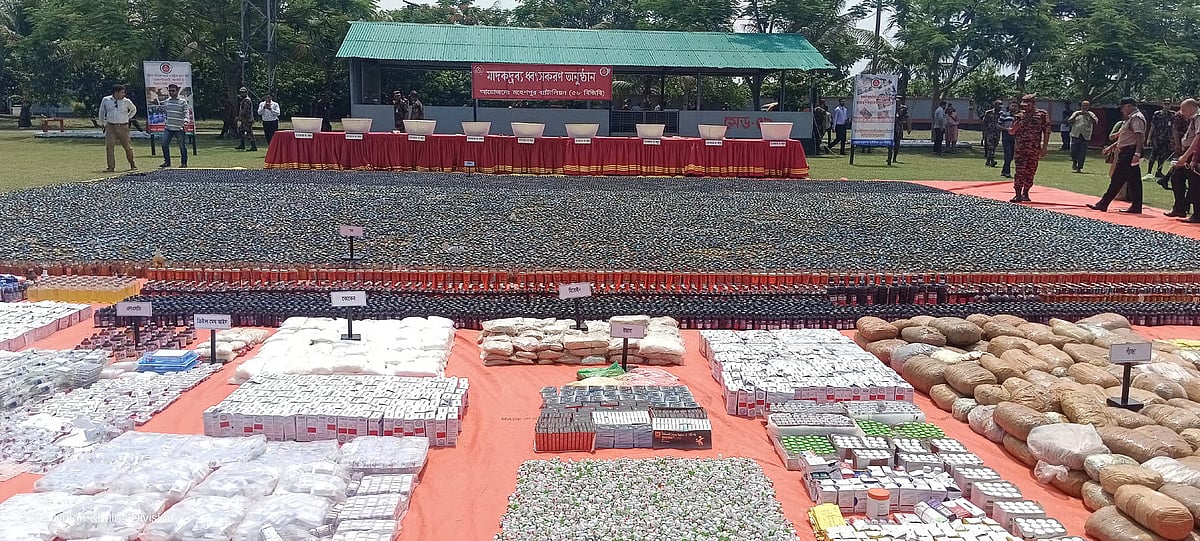
Drug proliferation – Part 1
Drug abuse spreads nationwide, sparking murders and clashes
Nasima Akter had returned home with her salary from a garment factory. Late at night, her husband, Sayedul Islam, asked her for Tk 3,000 to buy drugs. When Nasima refused, he stabbed her to death in front of their two young children.
The incident took place in the early hours of 13 July in Sreepur, Gazipur. Sayedul was later arrested by the then Rapid Action Battalion (RAB). According to the agency, he killed Nasima because she had refused to give him money to buy drugs.
Such incidents are not confined to Gazipur. Recent murders, robberies, domestic violence, gang clashes and armed attacks in different parts of the country have been linked to the need for money to buy drugs, control over illegal drug businesses and disputes involving narcotics.
In some cases, people have allegedly been attacked after refusing to give money to relatives. Elsewhere, clashes have erupted over control of drug-selling territories. There have also been shootings over disputes involving payments from drug deals.
A study published in January this year offers an indication of the scale of drug proliferation in the country. Research by Bangladesh Medical University (BMU) estimates that around 8.2 million people use drugs in Bangladesh. Nearly 90 pre cent of them said drugs were easily available. According to the study, an estimated Tk 590 billion is spent on drugs in the country every year.
Yet thousands of anti-drug operations are conducted across the country every year. More than 200 million yaba pills were seized between 2021 and 2025. Over 435,000 cases were filed during this period, with around 550,000 people named as accused. Despite the large number of cases and seizures, questions remain about how effectively the drug supply network has been brought under control.
A review of government statistics, national and international research, crime records and court verdicts points to three major challenges in tackling drugs: their widespread availability, crime and violence linked to narcotics, with shortcomings in investigation, prosecution and treatment.
Drugs spread beyond cities into villages
Discussions about drugs once focused mainly on border areas and major cities. But the latest national study shows that large numbers of people use drugs in all eight divisions of the country. Dhaka has the highest number of users, while Mymensingh and Rangpur have the highest rates relative to their populations.
The study was conducted between February and June 2025 by BMU and Research and Management Consultants Limited. Under the supervision of the Department of Narcotics Control (DNC), data were collected from 5,280 people in 13 districts and 26 upazilas across the eight divisions. Researchers then used specialised statistical methods to estimate the number of drug users nationwide.
The findings, published on 25 January, estimated that 8.194 million people in Bangladesh use drugs, representing 4.88 per cent of the total population.
In terms of absolute numbers, Dhaka Division has the most users, at around 2.29 million. Chattogram has approximately 1.88 million, while Rangpur has around 1.08 million.
However, relative to population size, the prevalence of drug use is highest in Mymensingh at 6.02 per cent, followed by Rangpur at 6 per cent and Chattogram at 5.5 per cent. The rate in Rajshahi is 2.72 per cent.
This indicates that the problem is not limited to densely populated urban centres. Drug use has also spread significantly in less urbanised regions.
Between January and October this year, visits to 25 upazilas in 10 districts across Barishal, Khulna, Chattogram and Mymensingh divisions revealed an alarming picture of drug proliferation. Drug sales and purchases were reported not only in towns but also in remote villages.
Residents in some areas alleged that local political leaders and activists controlled the drug trade. There were also allegations of assistance from some police personnel. Several local law enforcement officials said that investigations into murders, attacks and clashes repeatedly uncovered links to money for buying drugs and disputes over illegal drug businesses.
From border routes to drug markets across the country
According to the Department of Narcotics Control and law enforcement agencies, the spread of drugs in Bangladesh is linked to cross-border trafficking and domestic supply networks.
Yaba and crystal methamphetamine, commonly known as ice, are primarily reported to enter through the Myanmar border. Teknaf, Ukhiya and surrounding border as well as coastal areas of Cox's Bazar are important drug trafficking routes.
Meanwhile, phensedyl and other narcotics enter through various districts bordering India. Much of the drugs brought across the borders is transported to different cities by road, river and other communication routes. Based on drug cases and seizures, Dhaka has emerged as one of the country's largest drug markets.
For example, on 17 August, district detective police in Cumilla intercepted a luxury car travelling from Cox's Bazar to Dhaka and recovered 300,000 yaba pills from it. The car was heading towards the capital via Chattogram along the Dhaka-Chattogram Highway.
Around 2.7 million yaba pills were seized in six major incidents along the Cox's Bazar border over the past six months. Five of the consignments were destined for Dhaka. According to investigation sources, there were plans to distribute the drugs from the capital to different parts of the country.
An analysis of statistics from the Ministry of Law shows that 166,333 drug-related cases are pending trial across the country. Of these, nearly 22,000 are in Dhaka city courts and more than 15,000 in Chattogram city courts. Serious drug cases are relatively more common in border districts through which narcotics enter the country, along key supply routes and in major cities.
Director general of the Department of Narcotics Control Md Hasan Maruf told Prothom Alo that demand for drugs was increasing in Bangladesh. Narcotics enter through various borders and spread across the country.
"Social degradation and a lack of awareness within families are major reasons behind this. In many cases, parents do not keep track of whom their children mix with, where they go or how they spend their time. As a result, many become involved with drugs at an early age," he said.
He added that reducing demand would automatically reduce supply. "It is not possible to stop the spread of drugs through raids alone."
Drugs behind criminal activities
According to information from various agencies involved in drug control, narcotics are linked to 80 per cent of crimes in the country. Prothom Alo also found similar indications after analysing 30 selected incidents involving murder, hacking, shootings, attacks and clashes between January 2025 and September 2026. The analysis found some form of drug-related connection in 21 of these incidents.
Of those 21 incidents, 17 were murders, leaving 23 people dead. In addition, 15 people were injured in clashes in Jashore, while two others, including a father and a sister, were injured when a mother was murdered in Feni.
Sharp weapons were used in eight of the murders, firearms in four and beatings in two. Some incidents involved more than one method. Other cases included an allegation of shooting, a demand for money while holding a child at knifepoint, and a robbery linked to a dispute over yaba transactions.
The investigation found that the link between drug proliferation and other crimes in Bangladesh is most evident in two areas: the need for money to buy drugs and control over the profits from the drug trade.
For instance, allegations emerged that money for buying drugs was behind the murder of Nasima in Gazipur. In a similar dispute, a son was accused of killing his mother, Mimmi Begum, in Rupsa, Khulna, on 10 April. According to police and family members, the son attacked his mother after she refused to give him money to buy drugs.
Crimes driven by the need for money to buy drugs are not limited to families. Theft, robbery and intimidation to extort money are also linked to this motive. In some cases, even minor financial disputes over drug transactions have escalated into deadly violence.
On 6 August last year, a man named Md Hira was stabbed to death in Bangshal, Dhaka, after refusing to sell two yaba pills on credit. According to case documents, a man named Jibon Mia had asked Hira for the pills on credit. A dispute broke out when Hira refused, and he was eventually stabbed to death.
Criminology offers an established explanation for the relationship between drugs and violence. In a 1985 study titled The Drugs-Violence Nexus: A Conceptual Framework for Three Types of Relationship, American researcher Paul J Goldstein identified three types of links.
First, the direct psychological or physical effects of certain drugs may increase the risk of violent behaviour. Second, people may become involved in crime to obtain money to buy drugs. Third, disputes over control of illegal drug businesses, supply networks and financial proceeds can lead to conflict and violence.
Criminologists say all three types of links can be found in several recent high-profile criminal incidents in Bangladesh.
Bloodshed over control of the illegal drug trade
The investigation found that violence driven by money and dominance in the drug trade takes a different form. In many cases, the objective is not to raise money to buy drugs but to control drug-selling markets and the profits they generate.
On 11 August last year, teenager Shah Alam was killed in a clash between two groups over control of the drug trade at the Geneva Camp in Mohammadpur, Dhaka. According to police, several groups had been involved in a long-running dispute over control of the drug business in the camp.
Another example of the economic interests behind such violence emerged in Pallabi, Dhaka, on 7 August last year. Five people were arrested by the Dhaka Metropolitan Police's Detective Branch (DB) over an alleged shooting stemming from a dispute involving Tk 1.5 million owed from the drug trade. Weapons and yaba pills were recovered from them.
Allegations of armed attacks over drug money, extortion and disputes over local dominance have also emerged in Khulna, Chattogram, Cumilla, Mymensingh and other areas.
How big is the drug market?
Another important aspect of drug proliferation in Bangladesh is the size of the market. The BMU study found that an individual drug user spends an average of around Tk 6,000 a month on narcotics. A portion of this money goes to different stages of drug supply, transportation and sales.
According to government data, 435,347 drug-related cases were filed in the country between 2021 and 2025. A total of 547,439 people were named as accused in these cases.
During the same period, various law enforcement agencies seized more than 208.3 million yaba pills, over 524,000 kilogrammes of cannabis, more than 2,149 kilogrammes of heroin, over 163 kilogrammes of cocaine and more than 2.6 million bottles of phensedyl.
These seizure figures offer an indication of the scale of the drug market. Sources at the Department of Narcotics Control say that 80 per cent of the drugs entering the country go undetected. This means that, at most, only 20 per cent of the narcotics smuggled into Bangladesh are seized.
The DNC's Annual Drug Report of Bangladesh 2025 also provides an indication of the spread of narcotics. Last year, there was a significant increase in seizures of amphetamine-type stimulant pills, including yaba.
According to the report, 43,562,811 such pills were seized last year, compared with 22,857,751 the previous year. This represents an increase of around 91 per cent in a single year.
Experts, however, caution that an increase or decrease in drug seizures does not necessarily reflect a corresponding change in the level of drug use.
Additional Inspector General of Police (Crime and Operations) Md Saiedur Rahman told Prothom Alo that the huge drug market in Bangladesh was attracting traders seeking maximum profits.
"It is relatively easy to arrest retail sellers. However, the police have had both successes and failures in identifying the major operators. Strict action is being taken whenever allegations of drug involvement emerge against police personnel," he said.
He added that families and society also needed to play an effective role in keeping children and adolescents away from drugs.
A mountain of cases, major gaps in investigations
After conducting anti-drug operations, the biggest challenges have emerged in investigations and trials.
According to court-related data released towards the end of September, around 446,000 drug-related cases were pending before courts in all 64 districts of the country. More than 166,000 of these cases involved offences punishable by five years or more in prison. Yet the law stipulates time limits for completing trials of drug-related cases.
Alongside delays in the judicial process, the quality of investigations has also come under serious scrutiny.
In an earlier investigation, Prothom Alo reviewed verdicts in 500 drug-related cases collected from courts in 26 districts. It found that all accused were acquitted in 296 of the cases, while convictions were handed down in only 204. In other words, the charges could not be proven in 59.2 per cent of the cases reviewed.
Several reasons were identified behind the acquittals, including a lack of independent witnesses, inconsistencies in seizure lists, defective first information reports (FIRs), investigating officers failing to testify and questions over chemical examination reports.
More importantly, none of the 500 cases reviewed contained evidence that investigators had identified the financiers, patrons or major suppliers behind the drug trade beyond those arrested with narcotics.
This raises questions about how far investigations are progressing against the principal operators and those controlling the supply networks.
The Department of Narcotics Control's own case records also show a high acquittal rate. According to the agency, of the 122,422 cases it filed between January 2020 and April 2025, only 13,376 had been disposed of. The accused were acquitted in 7,539 of those cases. This means that 56.36 per cent of the cases disposed of ended in acquittals.
Sources familiar with court proceedings say many accused are acquitted because witnesses fail to appear in court in drug cases. In particular, people listed as witnesses in seizure documents are often difficult to trace later.
Meanwhile, investigators appear reluctant to properly preserve and present digital evidence, including photographs, videos and CCTV footage. As a result, many accused escape conviction.
How effective is strict legislation?
The primary legal framework for controlling narcotics in Bangladesh is the Narcotics Control Act, 2018. Depending on the type and quantity of drugs involved and the nature of the offence, the law provides for different terms of imprisonment, including the death penalty for certain serious offences.
The law was amended in July this year. The revised provisions include offences involving the purchase, sale, supply, promotion and financial transactions of narcotics through cyberspace and digital platforms.
The amendments also provide for the establishment of special tribunals to expedite trials in serious drug cases. In September, the government established 22 Narcotics Offences Suppression Tribunals under this provision.
Sources at the Ministry of Law said that although the tribunals had been established, separate judicial posts had not been created for them as of October. Instead, existing judges had been assigned the additional responsibility of conducting trials.
Meanwhile, no consolidated data are available on how many cases have been filed against financiers, major suppliers and patrons of the drug trade, how many have been convicted or how much illegal wealth has been confiscated.
Omar Faruk Faruqui, chief public prosecutor (PP) at the Dhaka Metropolitan Sessions Judge's Court, told Prothom Alo that arresting drug carriers or retail sellers alone would not solve the problem.
"Whenever one person is arrested, another takes their place. Many also resume the same criminal activities after securing bail. Drugs have now spread to villages and remote areas. The situation has taken on the proportions of an epidemic. The source of the drugs must be shut down," he said.