Real estate businessman Mohammad Ali owns nearly 28 kathas of land in Baigartek, an area under Pallabi police station in Dhaka’s Mirpur. He had built a boundary wall around the property and five tin-roofed structures inside it, which he rented out.
On 17 September, Mohammad Ali told Prothom Alo that a group of miscreants demolished that boundary wall and the structures using a bulldozer on the night of 30 April. They have since occupied the land, he said, adding that he can no longer go there.
“The land is worth around Tk 250 million. Mamun gang’s miscreants have occupied it. Mamun’s brother Mashiur Rahman has threatened me over the phone and told me not to go to the land,” he said.
The “Mamun gang” mentioned by Mohammad Ali is the name of a criminal group in Mirpur. Since the July mass uprising, the group has been allegedly involved with crimes like land grabbing, extortion, drug dealing, taking control over jhut (garment waste) trade, cable television and internet connections and collecting rent from houses in illegal slums, among other crimes.
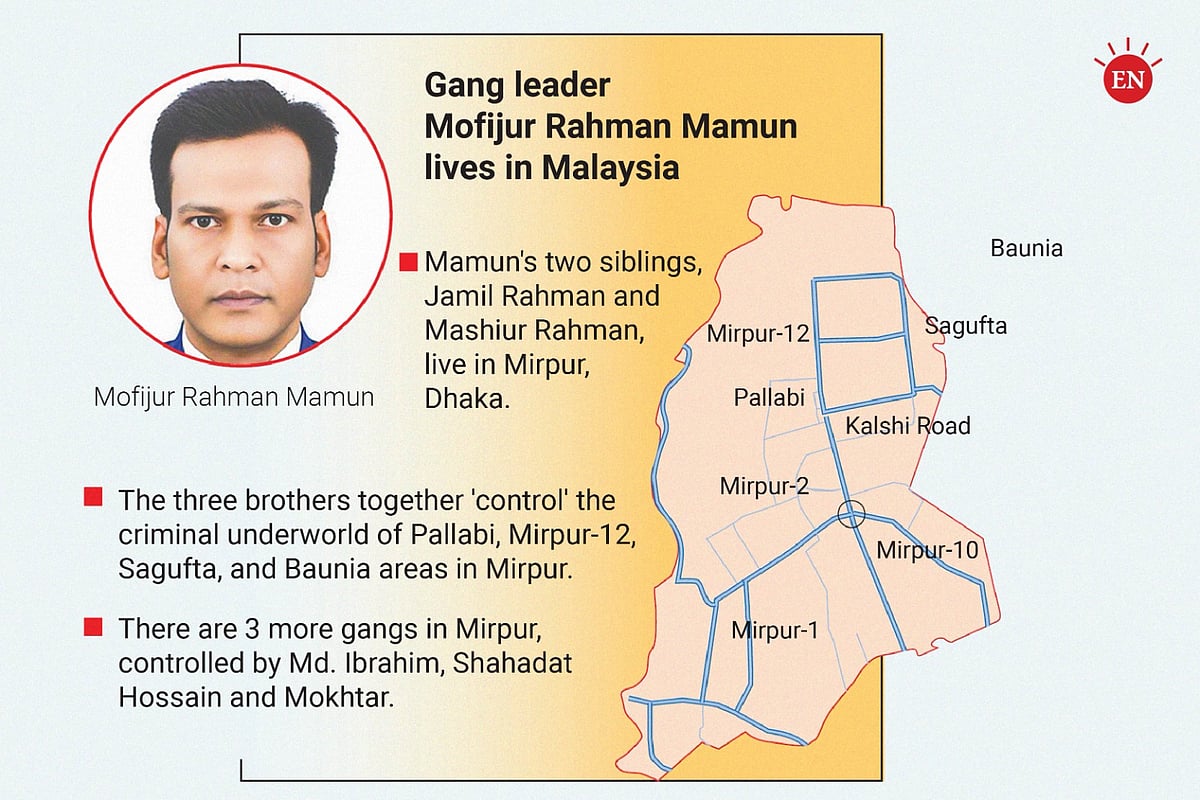
Police and local sources said four “criminals” living abroad jointly operate four groups, collectively known as the “Four Star Group” in Mirpur. The Mamun gang is one of the four. It is led by Mofizur Rahman Mamun, president of ward No. 91 of Dhaka North City Corporation (DNCC) unit BNP (Bangladesh Nationalist Party).
Mohammad Ibrahim, also known as “Killer Ibrahim”, the convener of the No. 1 unit of Bhashantek thana BNP; Shahadat Hossain, a listed top criminal and former president of Mirpur thana Chhatra League and another “criminal” named Moktar separately control the other three criminal groups.
According to police and multiple BNP and affiliate leaders and activists in the Mirpur area, Ibrahim and his followers control the criminal underworld in Mirpur-13, Mirpur-14, Bhashantek and Kalshi areas. Shahadat and his followers control Mirpur-1, Mirpur-2, and Mirpur-6. Mokhtar and his followers control parts of Mirpur-10 and Mirpur-11.
According to police sources, Mofizur Rahman Mamun controls the largest of the four groups. He currently lives in Malaysia. From there, he allegedly controls extortion, the jhut trade, land grabbing and drug dealing in Pallabi, Mirpur-12, Sagufta and Baunia through his criminal gang.
Mamun faces several cases, including murder. Although he lives abroad, his two brothers operate the gang from Bangladesh. His elder brother is Md Jamil Rahman and his younger brother is Mashiur Rahman.
The gang includes Delwar Hossain Rubel, Md Rafiqul, Alamgir, Motaleb, Rajon, Sami, Bhagne Mamun, Sohel, Kayes, Selim, Prakash, Sujon, Habib, Sagar, Rokon, Shamim, Johnny and others. Johnny and Rokon are currently in jail after being arrested in the murder case of Mirpur Jubo Dal leader Kibria.
In March, Dhaka Metropolitan Police (DMP) prepared a list of extortion spots and extortionists in the capital. The list was compiled jointly by the police stations, DMP's Detective Branch (DB), Special Branch (SB) and the intelligence unit of the DMP commissioner.
The list names 72 extortionists operating in seven police station areas of Mirpur and 25 people who provide them with shelter and patronage. Mamun and his two brothers are among those named.
Mamun was arrested by police in February 2021. Police at that time said that after serving a prison sentence for some time in 2001, Mamun fled Bangladesh for India in 2004. He was arrested in India in 2008 on charges of passport forgery and illegal entry and served a 10-year sentence. After completing his sentence, he allegedly continued to control crime in Mirpur while living in India.
Mamun was arrested shortly after returning to Bangladesh in 2021. Police said in a statement at the time that they had found information on 27 cases filed against him with Pallabi police station over allegations including extortion, murder, drugs, illegal use of firearms and robbery. There were also 15 arrest warrants and two warrants for serving sentences against him.
Police sources, however, said Mamun fled after securing bail following his arrest. His influence has increased since the July mass uprising.
A foreign mobile phone number belonging to Mamun was found in a police list. Attempts were made to contact him but he did not respond.
His brother Mashiur, however, told Prothom Alo over the phone that there are often disputes between different parties over land. If any party comes with valid documents, they provide assistance, he said. He denied allegations of extortion and other crimes.
However, concerned individuals point out that forcibly occupying land is not something an ordinary citizen can do. It is a matter for the courts and the police.
Crimes the gang is accused of
Land transactions are quite frequent in Pallabi, Mirpur-12, Sagufta Housing and Baunia, where the real estate business is also expanding. There are more than 100 small and large real estate companies operating in these areas.
Prothom Alo’s investigation found the name of the Mamun gang linked to at least seven incidents of land grabbing.
For example, six years ago, 18 families bought five kathas of land in Sagufta Housing and built tin-roofed houses there. Several of the families lived in those houses. They alleged that members of the Mamun gang demolished their homes with an excavator on the night of 29 July after failing to receive extortion money.
Md Yunus Mia owns another five-katha plot beside the land belonging to the 18 families. He said the Mamun gang had also occupied his land. They occupied a total of 10 kathas of land and put up a signboard there, he said.
There are around 230 small and large garment factories in Mirpur. More than 100 of them are located in areas allegedly controlled by the Mamun gang. The gang is accused of collecting between Tk 20,000 and Tk 500,000 a month from these factories in extortion. It also controls the jhut trade of the factories.
A leader of Dhaka City North unit Jubo Dal, speaking to Prothom Alo on condition of anonymity, said he had been involved in selling jhut from a garment factory after the July mass uprising. Members of the Mamun gang would frequently set off cocktails in front of the factory in an attempt to take control of the business, he said. He eventually left the business.
If extortion money is not paid, members of the Mamun gang go to business establishments and open fire.
For example, in July last year, the office of AK Builders in Pallabi was attacked over a demand for Tk 50 million in extortion. The attackers fired four shots during the incident, police said.
A police source said the person who called AK Builders to demand the money was Jamil, Mamun’s brother.
Md Kaium Ali Khan is the chairman of AK Builders. After the attack, his son Aminul Ehsan told Prothom Alo that criminals had attacked their company twice because they refused to pay extortion money. The attackers also opened fire, injuring one person.
Mamun Gang named in Jubo Dal leader's murder
On 17 November last year, some criminals entered a shop in Pallabi and shot dead Golam Kibria, member secretary of Pallabi thana unit Jubo Dal.
Police said the three people arrested as shooters in the murder case were members of the Mamun gang.
Kibria’s wife, Sabiha Akter, told Prothom Alo on 4 August that Mashiur, Mamun’s younger brother, had hired the shooters to kill her husband. She alleged that Kibria was killed because he had opposed to pay extortion. She also said the accused were now threatening her family in various ways.
The murder case is currently being investigated by the DB's Mirpur division.
Mohammad Rakib Khan, deputy commissioner of the DB’s Mirpur division and the officer supervising the investigation, told Prothom Alo that several people involved in the murder have already been arrested, and efforts are underway to arrest those whose names have emerged during their interrogation.
Several ‘youth gangs’ also active
A police source said several “youth gangs” are active in Pallabi in addition to the Mamun gang.
The largest is reportedly called the “Bhoira De Group”, led by Md Ashik. Ashik recently had a dispute with Mamun’s younger brother Mashiur over extortion. An audio recording of a conversation between the two has circulated on social media.
A source at Pallabi police station said another youth gang active in the area is the “Bahubali Group”. Photos and videos showing members of the group displaying firearms have appeared on social media.
Crime situation in Mirpur
From 5 August 2024 to July this year, 89 people were killed in the Mirpur division of the DMP. During the same period, 224 cases were filed over extortion, 530 over theft, 128 over mugging and eight over robbery in the area. However, victims do not file cases in all incidents of crime.
Mirpur is listed by police as a crime-prone area. DMP Additional Commissioner Osman Gani told Prothom Alo on 30 July that an analysis of crime in the Mirpur region had been carried out and those involved in the crimes had been identified.
“Action will soon be taken against these criminals,” he said.
He said criminals living abroad had formed gangs to control the criminal underworld and were directing their associates in Bangladesh to commit crimes. Some of them face multiple cases and arrest warrants. If necessary, “red notices” will be issued through Interpol to arrest the criminals living abroad.
‘Political patronage must end’
Mirpur has recently come under discussion following the demolition of the mother and child health centre, Radda MCH-FP Centre. The facility was demolished on the night of 24 September. The names of several local BNP leaders have emerged in connection with the incident.
At the same time, people who operate criminal groups hold positions in the BNP.
Asked about the issue, Dhaka City North unit BNP convener and State Minister for Youth and Sports, Aminul Haque, told Prothom Alo that many people commit various crimes by using the party’s identity.
If anyone becomes involved in crime by using the party’s identity, strict organisational action will be taken against them, he said.
Tawohidul Haque, an associate professor at the Institute of Social Welfare and Research at the University of Dhaka, said ending political patronage is essential to controlling crime.
According to him, leaders and activists of the ruling political party often receive a share of the money earned by goons through crimes. Many political leaders patronise criminals in exchange for a cut of the money. This must be stopped. Otherwise, crime cannot be brought under control.