Extremist activity
Surveillance eases as extremists seek to regroup
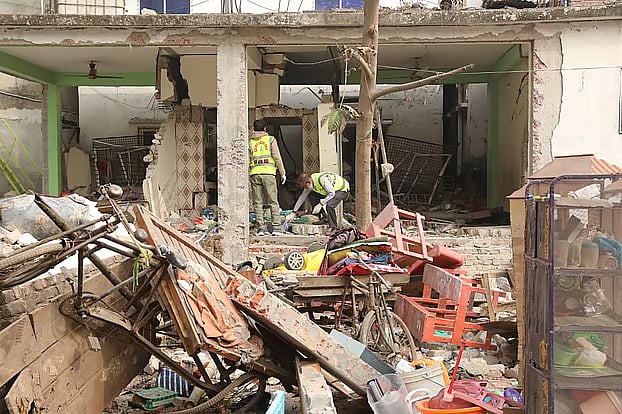
A powerful explosion ripped through a house in the Hasnabad Housing area of Keraniganj, on the outskirts of Dhaka, at around 10:30 am on 26 December last year. The property had been rented in the name of Ummul Qura International Madrasah. The force of the blast brought down sections of the building's surrounding walls and roof.
Police later recovered a large amount of explosive materials from the house, including hydrogen peroxide, acetone, nitric acid and nearly 400 litres of liquid chemicals. They also seized nine freshly assembled bombs wrapped in black plastic. Seventeen people, including Sheikh Al Amin, director of Ummul Qura International Madrasah, were arrested in connection with the incident.
Sources involved in the investigation said those arrested were members of Neo JMB, an Islamic State (IS)-inspired extremist organisation. Among them, Sheikh Al Amin, Oli Ullah Jony and Shaheen, also known as Abu Bakar, had previously been arrested on allegations of involvement in extremist activities.
Alongside the Keraniganj explosion, law enforcement agencies have since found the extremist organisation to be linked to three other incidents that occurred in different parts of the country up to March this year.
In February, several assailants attacked police during a search in Kutubkhali of Dhaka's Jatrabari area. A number of bombs were recovered from bags abandoned by the attackers as they fled. The investigators found similarities between those devices and the bombs seized in Keraniganj.
The following month, an explosion occurred during a police search operation in the Janapad Mor area of Syedabad in the capital. Another explosion took place at a Shiva temple in Cumilla town later that month. Police say they have found links among the three incidents.
By examining CCTV footage from the stabbing of a police officer in Jatrabari and the explosions in Syedabad and Cumilla, investigators identified two close associates of Sheikh Al Amin who had been involved in the Keraniganj case. They were identified as Nazmul Hasan Mamun and Mohammad Arif. Sources connected to the investigation said both men were involved in all three incidents.
Investigators believe Al Amin manufactured the bombs on the night before the Keraniganj explosion and stored them in separate rooms. The blast is believed to have occurred accidentally during a moment of carelessness. Al Amin, his wife and their child were injured.
The investigators further said that leaving his wife and child in hospital, Al Amin fled. He first took shelter at the Savar residence of Nazmul Hasan Mamun before going into hiding at Mohammad Arif's residence in Dhaka's Dolairpar area. Al Amin was arrested from that house in February this year, although Arif managed to escape.
Following the fall of the Awami League government on 5 August 2024, many members of various extremist organisations escaped from prison, while others secured release on bail. Law enforcement officials believe the Neo JMB group began stockpiling bombs and explosives after being released on bail, a development that came to light following the Keraniganj explosion. Subsequent explosions and attacks on police further heightened security concerns over the group's activities.
However, based on allegations made by Sheikh Al Amin and Oli Ullah, both arrested in the Keraniganj explosion case, a police officer is currently standing trial before the International Crimes Tribunal (ICT).
Several law enforcement officials said this has created a degree of unease among officers on the ground when dealing with similar cases.
The Keraniganj explosion alerted law enforcement agencies to attempts by the IS-inspired extremist group to reorganise. Although authorities initially stepped up efforts to arrest those involved, several officials familiar with the matter said surveillance has since eased considerably.
Police have two specialised units responsible for countering extremism and terrorism—the Anti-Terrorism Unit (ATU) and the Counter Terrorism and Transnational Crime (CTTC) unit. Several officials from the two units told Prothom Alo that there is currently little meaningful surveillance of extremist activities. According to them, the government has not provided clear guidance on what strategy or priorities should be followed in tackling extremism and terrorism.
Speaking on condition of anonymity, several officials said the online activities of extremist organisations, the movements of suspected members, the activities of individuals released from prison and possible links with foreign extremist groups are all supposed to be monitored on a regular basis. With such monitoring largely absent, law enforcement agencies have no clear picture of whether members of banned organisations are attempting to regroup or are engaged in other activities.
Law enforcement agencies have also yet to establish why the bombs and explosive materials recovered in Keraniganj had been stockpiled. Although multiple sources initially claimed that investigators had obtained some information on the matter from those arrested, no clear findings have since been disclosed.
Several officials from different levels of the law enforcement agencies said officers faced various difficulties after two individuals were arrested and filing of a case with Savar police station during the tenure of the interim government on allegations of links to Tehreek-e-Taliban Pakistan (TTP), which operates along the Pakistan-Afghanistan border.
They said that experience has made many officers reluctant to become involved in counter-extremism operations. Many have adopted a cautious approach for fear that any action they take in such cases could be interpreted differently.
None of the officials from the two specialised police units agreed to comment on the record. However, the ATU said the incidents remain under investigation and that it would not be appropriate to comment until the investigations are complete.
Shafqat Munir, senior fellow at the Bangladesh Institute of Peace and Security Studies (BIPSS), told Prothom Alo that violent extremism has become a serious security threat across the world.
According to him, the situation in Bangladesh may currently be better than at any previous time, but there is no room for complacency regarding violent extremism or extremist threats.
To keep the situation under control, he said, the capacity of specialised agencies and forces must be strengthened, and the entire state mechanism for countering extremism needs to be reinforced.