'Mob violence reemerges as perpetrators not brought to justice'
The day after the BNP formed the government, newly appointed Home Minister Salahuddin Ahmed declared, ''Mob culture has ended."
His statement was made against the backdrop of a series of mob violence incidents during the 18 months of the interim government's tenure. He was referring to the end of those events.
Salahuddin Ahmed made his statement on 18 February. Within two months, last Friday, a mob was created in Shahbagh of the capital, labeling some leisure-sharing men and women as ‘homosexual’ or ‘transgender’ and attacking them. The day after that, a mob was created, leading to a murder in Kushtia.
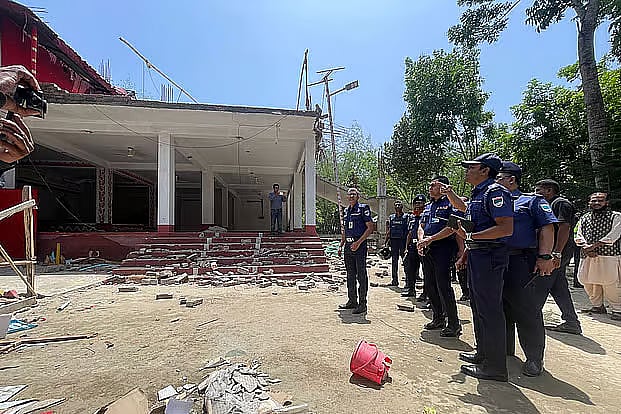
In the Daulatpur upazila of this district, Shamim Reza, locally known as a pir, was attacked and hacked to death in his shrine. An old video was brought forward to accuse him of blasphemy, prompting this attack.
The incident in Kushtia has brought the issue of mob violence back into focus.
Experts say that such incidents are recurring due to the lack of justice for previous occurrences. If strict measures are not taken immediately, such violence will continue to increase.
Writer and teacher Anu Muhammad told Prothom Alo that the repetition of such events is due to the lack of justice for previous incidents. The government should investigate past mob attacks, publish a white paper, and take action. If these events are not addressed, it would seem that the government supports them.
The annual report by the human rights organisation Ain O Salish Kendra (ASK) in 2025 stated that 197 people lost their lives due to mob beatings or ''mob violence'' in that year. The number was 128 in 2024.
Assistant Professor Rezaul Karim Sohag, the chairman of the Department of Criminology at Dhaka University, also believes that the lack of justice paves the way for new incidents. He told Prothom Alo that whoever commits mob violence should be brought to justice.
‘The attack was planned, the police were inactive’
Anu Muhammad, a former professor of economics at Jahangirnagar University, believes that the politics of dictatorship and the economy of looting that have prevailed in society for a long time have created a situation like mob violence.
He also said that within this system, a terrible form of intolerance has been born. Anything that differs from one's own thinking, identity, gender, or opinion invites hostility and attack. If others do not comply in the way one speaks, dresses, lives, or follows religion, they are attacked. This type of fascist thought has widely spread in society.
Regarding the increase in this tendency during the interim government, Anu Muhammad commented that they were inactive in many incidents, lenient in some, and even sponsored several events. In some cases, there was an attempt to legitimise. As a result, mob violence has taken deeper roots.
He perceives the recent events in Shahbagh and Kushtia as planned and holds the government responsible for its failure to prevent them.
Anu Muhammad noted that the government should have had a clear message against such mob violence for the police and administrative systems. During the Shahbagh attack, the police were passive and did not take action, meaning that there is no message to prevent such occurrences within the police force. A strong stance by the police was also absent in Kushtia.
Anu Muhammad believes that those involved in breaking shrines and attacking the Bauls during the interim government are involved in recent attacks. Thus, he comments that the police should have been cautious regarding this group. He also deems it a failure of intelligence.
Anu Muhammad, editor of the quarterly journal Sarbojonkatha, states that the groups carrying out attacks have political motives. They aim to incite and orchestrate coordinated attacks to establish a culture of fear to entrench fascist politics. They hold specific ideas about women and exhibit violent thoughts toward those of different genders or beliefs, aiming to politically establish them. It is particularly concerning.
He emphasises the need for socio-cultural movements and advises the government to conduct campaigns on radio, television, and social media.
Anu Muhammad hopes the new government will take a firm stance against mob violence. He remarks that this government is not very old. The Home Minister had declared that mob violence would no longer occur. It can still be hoped that this government will take action against mob violence.
‘A habitual crime due to lack of justice’
Explaining how the lack of justice increases mob violence, Rezaul Karim Sohag, chair of the Department of Criminology at Dhaka University, states that a perception has developed among people that crime is not adequately punished if handed over to the law. There's a lack of awareness about what constitutes a crime. Without understanding, they form their definition and attack based on rumours.
He says the new government's statement that mob violence will no longer occur has not been proved in practice.
Calling for ensuring justice for mob violence, Rezaul Karim Sohag states that the same individuals and groups are repeatedly committing attacks and crimes. The kind of punishment that should have been meted out for such crimes has not occurred. Because the same crimes are not being adjudicated, they are occurring repeatedly and becoming habitual crimes. If these incidents are not immediately brought under the law to ensure justice, mob violence will increase further.
The criminology teacher believes that the morale of the police force, which broke down after 5 August 2024, has not yet been restored.
Rezaul Karim Sohag notes that for various reasons, there is a fissure in police morale. They are afraid to go to crime scenes as they are being attacked everywhere. Incidents of mob violence in Shahbagh and Kushtia did not see a prompt response from law enforcement.
He adds that there have been many changes within the police post-August. Many have been transferred. Officers who did not previously conduct investigations are now being tasked with crime investigation responsibilities. Many are quickly being moved from their workplaces. This leaves them with limited knowledge of local events.
Regarding impediments to preventing crime, Rezaul Karim Sohag also mentions the shortage of police personnel. He states that ideally, there should be one police officer for every 200 citizens, but currently, one police officer is responsible for 800 people. This vast discrepancy contributes to the increase in crimes like mob violence.
Emphasising the need to strengthen the police, he says that it is essential to identify which crimes are increasing. The polices' response to these incidents and public reactions should be analysed and evaluated. He also advises engaging local government to counteract rumours.
He concludes by saying that ensuring justice for mob and other crimes will enhance public confidence in the law.