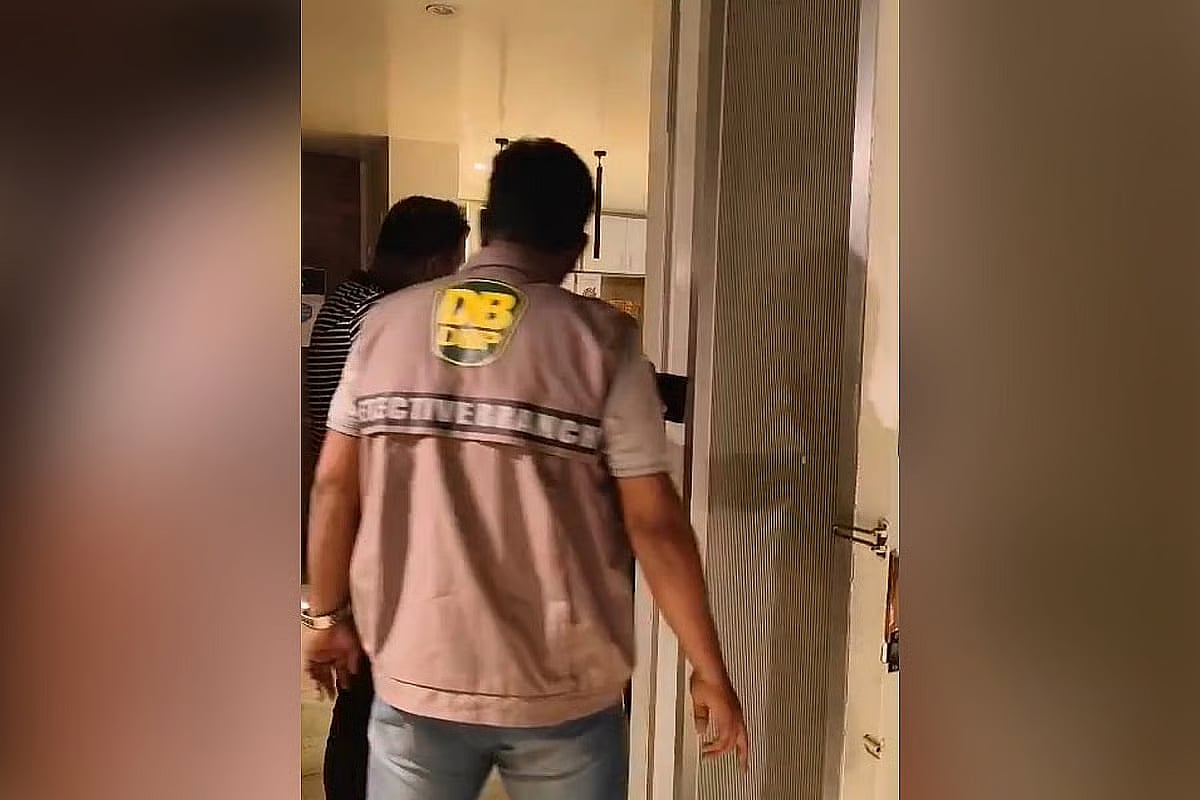
Raid on Additional DIG’s residence
85 penalised without drug testing, raising widespread concerns
An instrumental musician is one of the 85 people sentenced to imprisonment following a raid on a rented residence belonging to an Additional DIG (Deputy Inspector General) of Police. His father is a renowned member of a well-known musical band.
Speaking to Prothom Alo on condition of anonymity, the father claimed that his son had gone to the rented property of the Additional DIG as he was appointed to perform at the event. A mobile court sentenced him to one month’s imprisonment on charges of drug consumption. Crucially, however, no medical test was conducted to verify whether his son had actually consumed drugs.
The raid was carried out on the night of 19 October at a three-storey house named ‘Golden Sunrise’, situated in the Police Officers’ Housing Society-1 residential area at Bhatara in the capital.
Among the 85 individuals detained during the operation, 26 were women. The women were sentenced to 15 days’ imprisonment along with a fine of Tk 500 each. The men were sentenced to one month’s imprisonment and fined Tk 1,000 each.
The operation has raised serious questions:
First: Why were sentences handed down without mandatory drug testing?
Second: How was video footage recorded by the police, showing everyone crammed into two rooms, leaked and circulated publicly?
Third: Given that the plots surrounding the Additional DIG’s house are vacant, how was public peace disrupted?
Fourth: Why did the Detective Branch (DB) dismantle the building’s CCTV cameras prior to the raid, where are the memory cards containing the CCTV footage now, and why are they absent from the official seizure list?
Fifth: Police alleged that DJ parties were routinely hosted at the property, so why is DJ equipment entirely missing from the seizure list?
The raid was carried out on the night of 19 October at a three-storey house named ‘Golden Sunrise’, situated in the Police Officers’ Housing Society-1 residential area at Bhatara in the capital.
The owner of the house is Additional DIG of Police Abdullah Al Zahir, who had rented out the property. Following the raid and subsequent media coverage, Abdullah Al Zahir was relieved of his operational duties and attached to Police Headquarters.
Various civil society organisations have issued statements expressing deep concern over the incident, accompanied by growing demands for an independent investigation.
What was observed at the scene
The Police Officers’ Housing Society is an official residential project designated for police personnel. Located approximately 4.5 kilometres along the July 36 Expressway (popularly known as 300-Feet Road) from Kuril in Dhaka, the housing society lies on the left side of the avenue.
Spanning 143 acres, the project comprises roughly 1,100 plots allocated to police officers. However, the majority of the plots remain vacant, with only a few buildings constructed to date.
Additional DIG Abdullah Al Zahir’s three-storey building stands on a 3.5-katha plot. The tree-lined property features an open space of roughly two kathas at the front, which serves as the primary venue for hosting events.
Additional DIG Abdullah Al Zahir told Prothom Alo that his residence was rented out for private functions. The property is listed on Airbnb, the US-based home-sharing platform, as well as on Travela, a similar domestic platform. Furthermore, the house was let out for events through a Facebook group.
On visiting the house on Monday afternoon, the main gate was found locked. Two cars parked in front of the gate were covered in dust. According to sources, the vehicles belong to two individuals detained during the raid; no one had come to retrieve them since they were sent to prison.
What transpired on the night of the raid
The raid on the Additional DIG’s rented house was conducted by a team from the Uttara Division of the Detective Branch (DB) of the Dhaka Metropolitan Police (DMP).
Based on accounts from DMP and DB sources, relatives of the convicts, and witnesses present during the operation, guests began arriving at the residence from 8:00 pm onwards. By midnight, a total of 85 individuals had gathered in phases.
At around 12:30 am, a DB contingent of 40 to 50 officials entered the premises while the main gate was open. Upon entering, officers instructed guests socialising outside to move indoors. Subsequently, everyone was forcibly confined inside two rooms—a process that took nearly half an hour.
Sources report that police officers then searched for the CCTV cameras installed on the premises. Out of six cameras, four were dismantled and taken away. The remaining two were disconnected, and their memory cards were removed.
Following the removal of the CCTV cameras, a thorough search of the premises was conducted. Sources indicate that no narcotics were recovered during the initial search. Police officers then requested those present to hand over any illicit substances in their possession, but no one surrendered anything. A second search yielded two empty liquor bottles.
We had no prior intelligence regarding the party at the residence. The raid was executed following instructions from higher police authorities.Elias Kabir, Deputy Commissioner of DB Uttara Division, DMP
After being detained in two rooms throughout the night, all 85 individuals were transported to the DB headquarters in the early hours of the morning, where summary sentences were handed down.
Prior to this, police officers filmed the detainees inside the rooms and recorded footage as they were being led out.
Under standard legal procedure, law enforcement agencies must prepare an official seizure list following any operation. According to the list compiled by the DB, four liquor bottles were recovered from the house: one empty 750ml bottle of locally produced Carew & Co. liquor; one 1-litre bottle of foreign liquor containing approximately 500ml; another foreign liquor bottle containing around 200ml; and a fully sealed 1-litre bottle.
The DB seizure list also recorded the recovery of a single Yaba tablet, drug-consumption paraphernalia, and a small quantity of kush.
The operation was led by the Deputy Commissioner (DC) of DB Uttara Division, Elias Kabir. When queried by Prothom Alo, he stated that they had no prior intelligence regarding the party at the residence. The raid was executed following instructions from higher police authorities, adding that illegal drug consumption and DJ parties had allegedly been hosted there for a long time.
Notably, a video circulated online showing Elias Kabir preventing a woman from covering her face during a raid at a residential hotel in the capital’s Abdullahpur bus stand area on 12 August. In the video, addressing a crying woman, he was heard saying: “Don’t cover your face, or you will be beaten.”
The concerned magistrate is in the best place to answer as to what extent the offense was proven and on what basis the sentence was passed. Adjudication is not our responsibility.DMP Additional Commissioner Shafiqul Islam, who is in charge of the DB
Prothom Alo published a report on that incident. Commenting on the matter at the time, former member of the National Human Rights Commission Nur Khan told Prothom Alo that if a woman commits a crime, she must be tried and sentenced by a court based on evidence; however, police arranging informal punishments prior to judicial trial is strictly illegal.
Sentencing without toxicological screening
Special Metropolitan Magistrate Asaduzzaman of DMP’s Uttara Division passed the sentences on the individuals detained from the Additional DIG’s rented house. A document detailing fine collection from 40 individuals cites Section 36(5) of the Narcotics Control Act, 2018 under the offense column.
The section stipulates that if a person consumes narcotics and, in an intoxicated state, causes a breach of public peace, engages in disorderly conduct, or drives a vehicle, they shall be punished with imprisonment for a term not exceeding one year along with a fine.
When contacted, DMP Additional Commissioner Shafiqul Islam, who is in charge of the DB, told Prothom Alo, “The concerned magistrate is in the best place to answer as to what extent the offense was proven and on what basis the sentence was passed. Adjudication is not our responsibility.”
Regarding whether any of the detainees were tested for intoxication prior to sentencing, Magistrate Asaduzzaman himself confirmed to Prothom Alo that no medical tests were conducted. He stated that the accused were sentenced after pleading guilty.
In a mobile court, the judge, jury, and executioner become one and the same entity. In the vast majority of cases, justice is denied.Barrister Jyotirmoy Barua
However, relatives of several convicted individuals told Prothom Alo that the claim of pleading guilty is untrue. They visited the convicts in prison to clarify the matter as they prepare to lodge appeals.
The relatives further alleged that signatures were obtained on a paper under the pretext of releasing them upon signing a bond, only for them to be subsequently convicted on charges of drug consumption.
Speaking to Prothom Alo, advocate Barrister Jyotirmoy Barua stated that a guilty plea alone does not warrant conviction in a narcotics case.
Pointing out that the DB might have coerced the accused before presenting them to the magistrate, He said, “The magistrate ought to have scrutinised the DB’s allegations critically. If intoxication was suspected, there should have been no impediment to conducting tests to establish proof, especially given the accessibility of simple testing methods today.”
“In a mobile court, the judge, jury, and executioner become one and the same entity. In the vast majority of cases, justice is denied,” Jyotirmoy Barua added.
Jyotirmoy Barua expressed strong suspicion regarding the entire operation, noting that if an offense occurs at a rented property owned by a police officer, the force would typically attempt to suppress it. Conversely, conducting a raid and publicising it raises serious questions.
Those convicted in the operation are primarily entrepreneurs, employees at multinational companies and domestic corporate entities, and students from reputable universities.
According to police sources, Abdullah Al Zahir had a dispute with an influential faction within the police force over transfers of OCs and related administrative decisions. Consequently, he was removed from that division on 1 October and posted to the Maintenance and Repair branch of Police Headquarters. Shortly thereafter, the raid on his residence was executed.
A relative of one convict remarked, “The DB recovered four liquor bottles—one full, two partially full, and one empty. Did 85 individuals become intoxicated by consuming this negligible quantity of alcohol?”
He added that people have been unjustly penalised.
How the video leaked
Article 35(5) of the Constitution of Bangladesh guarantees protection in respect of trial and punishment, stating, “No person shall be subjected to torture or to cruel, inhuman, or degrading punishment or treatment.”
Furthermore, Articles 2(1) and 4 of the UN Convention against Torture mandate member states to enact legislation categorising torture, cruel, inhuman, or degrading treatment and punishment as criminal offences.
On 11 December 2012, the High Court issued a directive restraining law enforcement agencies from presenting arrested or suspected individuals before the media.
At the time, the High Court also issued a rule asking why instructions should not be given to keep law enforcement agencies within their legal bounds. The Home Secretary, Inspector General of Police, Director General of RAB, and the DMP Commissioner among others were asked to reply within two weeks.
Since the tenure of the previous interim government, agencies including the Police, RAB, and BGB began blurring the faces of detained or arrested individuals in press releases. In this instance, however, video footage shot by police officers leaked through official channels and spread rapidly. News outlets that published the video without blurring faces have also faced public backlash.
Speaking to Prothom Alo, senior advocate of the Supreme Court Ehsanul Huq Samaji stated that there are legal limitations regarding the publication of photos or videos of accused persons.
According to him, if such photos or videos are leaked by law enforcement agencies, serious questions arise as to their authority to do so.
It is essential to examine the extent to which these legal boundaries have been violated, he added.
Operation driven by internal rift?
From the tenure of the interim government until last September, Abdullah Al Zahir served in the Personal Management-2 division at Police Headquarters. This division oversees the transfer, posting, and promotion of Officers-in-Charge (OCs), Inspectors, Assistant Sub-Inspectors (Armed), Assistant Town Sub-Inspectors (ATSI), and Nayeks.
According to police sources, Abdullah Al Zahir had a dispute with an influential faction within the police force over transfers of OCs and related administrative decisions. Consequently, he was removed from that division on 1 October and posted to the Maintenance and Repair branch of Police Headquarters. Shortly thereafter, the raid on his residence was executed.
An attempt was made to obtain a statement from DMP Additional Commissioner Shafiqul Islam regarding these allegations; however, he terminated the phone call before the question could be put to him.
Meanwhile, Additional DIG Abdullah Al Zahir told Prothom Alo, “I have been serving in the police force for 22 years. If any allegation arose against me, a basic inquiry or verification could have been conducted.”
Demands for an independent inquiry
In response to the arrest and summary conviction of 85 individuals, including women, 101 prominent citizens issued a joint statement on Sunday expressing deep concern and protest.
They demanded the immediate release of the detainees and convicts, an independent investigation into the incident, and accountability for those who violated legal norms.
They also called for an immediate end to encroachments on citizens’ personal lives, privacy, and dignity.
In a separate statement issued on Sunday, human rights organisations including BLAST, Human Rights Support Society (HRSS), Naripokkho, and Sopran called for an end to mass sentencing via mobile courts.
The statement urged that an impartial investigation be conducted to ascertain whether there was an abuse of power or rights violation during the arrest and sentencing, and that those responsible be held accountable.
Concurrently, they demanded action against those responsible for unlawfully collecting, circulating, and publishing the personal data, images, videos, and identities of the detainees.
A relative of one of the convicts, speaking anonymously, urged, “Let there be an impartial investigation into this incident. That is our sole expectation from the government.”