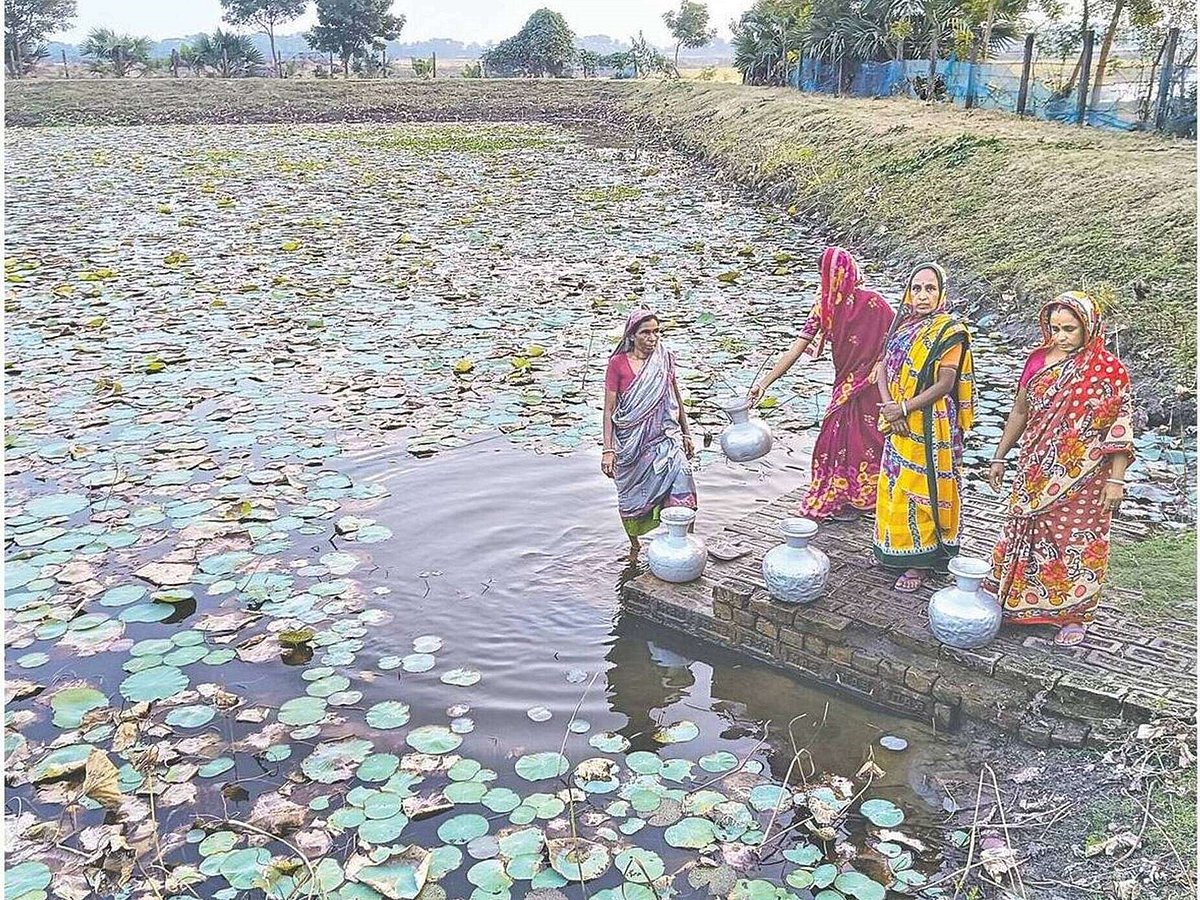
Water crisis
Arsenic, bacteria and lead pose risks in saline coastal areas
A pipe runs from the roof of Kamrul Islam’s house in Gobra village of Koyra upazila in Khulna, near the Sundarbans, to a water tank. During the monsoon, rainwater falling on the roof is collected in the tank through the pipe. The family uses the water for cooking, drinking and other household purposes.
“There is a severe shortage of fresh water here. During the rainy season, we collect as much water as possible when it rains. Once the tank is full, the water lasts for several months. Sometimes the tank still has water even after five or six months,” Kamrul Islam said.
For many families in saline coastal areas, rainwater is their only source of water for several months in this way. But is water that looks clean actually safe?
A recent survey by the Bangladesh Bureau of Statistics (BBS) and UNICEF, along with several studies on the southwestern coast, shows that the crisis is not limited to salinity. Arsenic and fecal bacteria have been found in water from tube wells and other sources. Rainwater stored as an alternative to saline water can also become contaminated with bacteria and lead if it is not properly collected and maintained.
“If the water looks clean, we drink it. You cannot see bacteria with your eyes. We have never had the water tested,” Kamrul said.
He further said the tank is not cleaned regularly. It is cleaned when the water runs out or when dirt is visible inside. Members of the family occasionally suffer from stomach problems, diarrhoea or vomiting.
Bacteria in 93pc of household drinking water
The final report of the Bangladesh Multiple Indicator Cluster Survey (MICS) 2025, conducted by BBS and UNICEF, provides the latest major picture of water quality. The survey was conducted between 24 February and 30 June in 2025. Interviews were conducted with 61,207 households, while water quality was tested in 6,106 households.
The published data are presented at the divisional level. Therefore, the figures for Khulna Division cannot be used to determine the rate for any individual district. However, they provide an important indication of the risks facing southwestern Bangladesh.
The MICS tests found E. coli, a type of bacteria, in water from sources used by 63.2 per cent of people in Khulna Division. E. coli was present in the water being consumed at home by 92.9 per cent of people.
Researchers say contamination can occur while water is collected, transported and stored. However, the difference between the rates at the source and in households alone cannot establish the specific cause of contamination.
SM Shamim Ahmed, executive engineer of the Khulna Circle of the Department of Public Health Engineering, said both salinity and arsenic are major problems.
According to him, the shortage of safe water is particularly severe in Dacope, Koyra and Paikgachha in Khulna; Mongla, Rampal and Morrelganj in Bagerhat; and Shyamnagar and Assasuni in Satkhira.
He said the government was working to provide safe water despite the difficult natural environment.
Arsenic disaster
Shafiqul Islam Moral, a resident of Tala upazila in Satkhira, still bears the scars of arsenic poisoning. He developed various health problems after being exposed to arsenic. At one point, the palms of his hands became hardened.
Many members of his family—including his father, mother, wife, grandmother and aunt—died from arsenic-related illnesses.
After arsenic contamination was detected, officials concerned instructed residents to dismantle contaminated tube wells. Villagers did so, but the shortage of safe water did not end.
Shafiqul said the government had arranged water supplies at different times, but these were inadequate for their needs. In some places the water is saline, while in others people have to travel long distances to collect safe water.
As a result, poor people are sometimes forced to use tube well water and sometimes pond water.
According to the survey, 17.8 per cent of people in Khulna Division have arsenic levels in their water sources above the limit set by the World Health Organization (WHO). The WHO guideline is 10 micrograms per litre, or 10 parts per billion (ppb).
Arsenic levels exceeded Bangladesh’s limit of 50 micrograms per litre in the sources used by 10.7 per cent of people nationwide.
The same survey found moderate salinity in the water sources of 10.7 per cent of people in Khulna Division and high salinity in those of 3.8 per cent.
When the criteria for safely managed drinking water are considered together—including an improved source located on the premises, availability when needed, water free from E. coli and arsenic levels within 10 ppb—only 18.2 per cent of people in Khulna Division have access to safely managed drinking water.
Even when Bangladesh’s arsenic standard of 50 ppb is used, the rate rises to only 20.1 per cent. This means that the safety of water cannot be ensured simply by looking at the type of source.
5 months of uncertainty in 5 upazilas
Another study covered 39 unions in Koyra, Dacope and Paikgachha in Khulna and Assasuni and Shyamnagar in Satkhira.
The study was published in the journal Utilities Policy in 2026. Researchers collected data from 66,234 households in February 2021. They also tested the salinity of water from 666 community tube wells and 224 ponds.
The average total dissolved solids (TDS) in tube well water was 1,733 milligrams per litre, compared with 1,330 milligrams per litre in pond water. Both averages were above Bangladesh’s standard of 1,000 milligrams per litre.
Only 27 per cent of the tested tube wells and 48 per cent of the ponds had water within that standard. TDS is an indicator of dissolved salts and minerals in water. It cannot be directly compared with the electrical conductivity indicator used in MICS.
The study found that reliable water was unavailable for an average of 4.65 months a year across the five upazilas. The figure was 7.15 months in Paikgachha and 2.84 months in Koyra.
Only 16 per cent of households had their own drinking-water source. In about 80 per cent of households, women and adolescent girls were responsible for collecting water.
Low-income families had to spend up to 4 per cent of their monthly income on drinking water.
Tasnim Chowdhury Fahim, a lecturer at Dhaka University’s Institute of Disaster Management and Vulnerability Studies and a researcher on the study, said, “The water quality is poor. Women in coastal areas spend at least an hour and a half collecting one pitcher of water. I have been working on this for five years, and I have not seen any change in the situation.”
Lead and bacteria also found in rainwater
For Saraswati Munda, a resident of Burigoalini in Shyamnagar upazila of Satkhira, rainwater was once a source of security for several months.
Before she had a rainwater storage system at home, she had to collect water from a freshwater pond some distance away. Her hardship was reduced considerably after she received a tank to store rainwater.
“Previously, I had to travel a long way to collect water. Now, when it rains, I collect and store water at home. Once I can collect enough water, I do not have to go outside for several months,” Saraswati said.
She said the water sometimes lasts for seven or eight months if it is collected properly.
Some people collect rainwater using plastic sheets, while others collect it from tin roofs into tanks or drums. They generally consider the water safe if it looks clean. They do not drink it if there is a problem with its taste or smell.
Collecting rainwater is an important solution in saline areas. But a new study in Sutarkhali union of Dacope upazila has shown that even rainwater is not free from risks if it is not properly collected and stored.
The study was published online in the journal Environment, Development and Sustainability on 22 September. Researchers surveyed 116 households and tested 45 water samples from four types of storage systems: drums or pitchers, private tanks, communal tanks and reinforced concrete (RCC) tanks.
The samples were collected in November 2024 after the water had been stored for two to three months.
Fecal coliform and total coliform levels were above acceptable limits in all types of storage systems.
Lead concentrations ranged from 0.03 to 0.33 milligrams per litre. Average lead levels in samples from drums or pitchers, private tanks and RCC tanks exceeded WHO and Bangladeshi standards.
The highest levels of lead, iron and both types of coliform were found in samples from RCC tanks, while communal tanks had comparatively lower levels.
The researchers said lead-based paint used on roofs could be a possible source. However, source-tracking tests did not establish that the lead had come from the paint.
Old pipes and materials used in water collection or storage systems could also play a role.
Possible routes of bacterial contamination include dust on roofs, bird or animal droppings, the lack of a system to divert the first flush of rainwater and inadequate cleaning of tanks.
In the survey, 59 per cent of households said they did not treat water before drinking it. Ninety-one per cent of households could not collect enough water to meet their needs throughout the year, while the average storage period was 4.7 months.
The risk of diarrhoea was 2.41 times higher among households that did not treat their water, while the risk of other stomach problems was 2.18 times higher.
Water crisis increasing health risks
Dacope Upazila Health Officer Sudip Bala said the number of patients with waterborne diseases tends to increase at hospitals from March to May.
Based on his clinical experience, he also regularly hears complaints from women about abnormal vaginal discharge. He believes the problem may be linked to prolonged exposure to saline water.
Preliminary findings from a joint study by icddr,b and Imperial College London have also highlighted the risk of cardiovascular disease in two coastal upazilas.
The study assessed the risk among 15,471 people aged 40 or older in Koyra of Khulna and Assasuni of Satkhira.
It found that 21.6 per cent of them had at least a 10 per cent risk of developing cardiovascular disease or suffering a stroke within the next 10 years—a level the researchers defined as moderate to high risk.
The rate was 19.7 per cent in Koyra and 23.6 per cent in Assasuni.
Alia Nahid, a senior scientist at icddr,b, said the study found both salinity in drinking water and a high prevalence of cardiovascular risk in the same population.
However, she said the preliminary findings do not establish that saline water directly causes cardiovascular disease.
Further research is needed to determine the long-term health effects of sodium and other minerals in drinking water, she said.