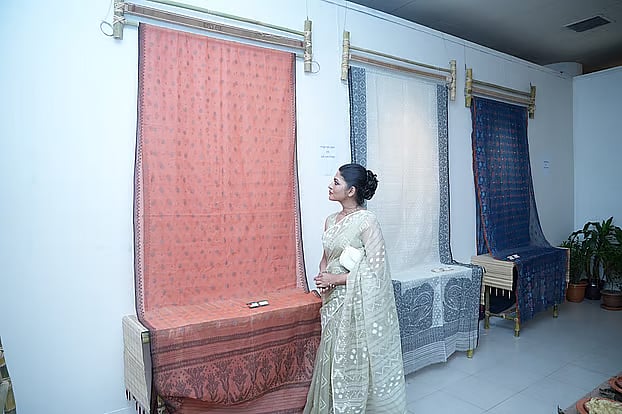
Heritage
Jamdani belongs to Bangladesh, history cannot be overwritten
Claims are now being circulated in the media of a neighbouring country that Jamdani has “returned.” In reality, Jamdani never disappeared; rather, this living weaving tradition has survived despite adversity. It belongs exclusively to Bangladesh. Yet today, this heritage has become the subject of new claims, confusion, and battles of narrative.
Shared legacy or strategic claim?
The idea of a “shared legacy” is itself a consequence of geopolitical history, and the Indian subcontinent is no exception. Since Bangladesh, India, and Pakistan were once parts of undivided India, many commonalities remain in art, culture, literature, music, and handicrafts. These shared elements continue to be discussed in various ways today.
This has become particularly visible in disputes surrounding several weaving traditions as Geographical Indication (GI) products. The issue began in 2009 with Uppada Jamdani. Since then, India has registered another “Jamdani” as a GI product and has applied for yet another. Each time, Bangladesh has reacted only after the fact. We failed to act proactively then, and we are still failing now.
Media narratives and the spread of confusion
India’s continued encroachment on Jamdani is being reinforced by misleading campaigns carried out regularly by its media and influencers. They are no longer stopping at merely using the word “Jamdani”; they are now claiming the weaving technique itself as their own, even extending such claims to UNESCO recognition. All this has become possible because of weaknesses in Bangladesh’s textile diplomacy.
On 23 April, while the West Bengal elections dominated headlines, Bollywood actress Kangana Ranaut’s saree also became widely discussed. During her campaign appearance in Nandigram, East Midnapore, she wore a white saree with woven motifs. Indian newspapers described it as Jamdani and even went so far as to call it a “UNESCO heritage.”
Soon afterward, several articles about Jamdani appeared. One of them was published on a website called “Aza” (www.azafashions.com) under the title: “The Jamdani Comeback: How the 2000-Year-Old Bengali Loom Claimed Its Spot on the Global Map.”
The absurdity of the “comeback” theory
The fundamental problem with the Aza article lies in its opening premise. Jamdani has not “come back.” Although muslin disappeared around 170 years ago, Jamdani never vanished; it survived through countless challenges. The role of Bangladeshi weaving artisans and their families in preserving this tradition is undeniable.
At various times, the governments or heads of state of Bangladesh, their spouses, members of the elite, entrepreneurial institutions, and organisations such as the Bangladesh National Crafts Council have all contributed to sustaining this art form. This entire struggle belongs to the people of Bangladesh. Therefore, the notion of a “comeback” is entirely misplaced and detached from reality.
The article also places Dhaka alongside Fulia and Shantipur. Yet Jamdani was never woven in Shantipur. Nor was it historically woven in Fulia. In fact, Fulia’s weaving history is not significantly ancient.
Moreover, the article vaguely claims that this Jamdani “technique” has been included in UNESCO’s list of the “Intangible Cultural Heritage of Humanity.” That is not actually the case, as will be discussed later.
False information and misrepresentation
On the same day, another article appeared on the website of Vogue India. Written under the byline “Vogue Staff,” the article was titled: “Nita Ambani’s Jamdani Saree Was Woven Twenty-Four Months by a Padma Shri Awardee.”
Nita Ambani wore the saree at the TIME100 Summit in New York, where she was also seen speaking about it. The saree was named Swadesh Jamdani and woven by Biren Kumar Basak, a recipient of India’s Padma Shri award. Basak migrated from Tangail to Fulia in West Bengal.
The saree features woven work across its entire body, something Basak has done previously as well. Indian designers even exhibited such textiles at MIT in the United States, aided by Nobel laureate economist Abhijit Banerjee.
However, these fabrics are not Jamdani, because they are woven using jacquard or vital looms, whereas genuine Jamdani is woven on pit looms.
This point will be addressed further shortly. Before that, another Vogue India article deserves mention. On 8 October, 2025, Nupur Sarvaiya wrote an article titled: “Alia Bhatt’s Custom Olive Dhakai Jamdani Saree Was Handwoven Over Three Months.” That article too distorted the truth by explicitly stating that Jamdani originated in both West Bengal and Bangladesh.
The saree was embellished with zardozi work by celebrated Indian designer duo Abu Jani and Sandeep Khosla, turning it into a “designer saree.” Alia Bhatt wore it during Durga Puja.
Yet the intellectual ownership of Jamdani belongs to its weaving artisans. Therefore, adding such “value” to their creations in this way undermines the originality of the weavers’ work.
The true nature of Jamdani
Jamdani is essentially figured muslin. In other words, motifs are woven by hand using additional threads during the weaving process. This is why Jamdani is also known as “figured muslin.” These figures are generally floral motifs, vines, bird’s feet, and other geometric patterns.
History suggests that Jamdani flourished during the reign of Mughal Emperor Jahangir (1569–1627). He brought weaving artisans from Persia, who taught local weavers the technique of inserting motifs by hand while weaving. Even the word “Jamdani” is derived from Persian. It carries several meanings, including goblet or patterned garment.
Until 1900, Jamdani remained white or undyed. Colours were introduced later, as were silk threads, largely due to Nawab Sir Salimullah of Dhaka. However, authentic Jamdani is woven with cotton thread.
Thus, the idea that Bengali weaving traditions are “returning after 2,000 years” is meaningless. Muslin was woven even 5,000 years ago, while Jamdani has been woven continuously for roughly 500 years.
One of Jamdani’s most remarkable features is that it depends on memory and oral transmission. All motifs are preserved in the memories of the weaving artisans. Learning Jamdani weaving begins around the ages of 10 to 12, much like the training required for classical music.
Jamdani is woven on pit looms. Two weavers sit side by side, weaving from opposite directions. One is the master artisan, while the other is the apprentice, or harkit. The master chants instructions rhythmically while weaving, and the apprentice follows to reproduce the same pattern.
Jamdani possesses its own motifs, borders, and anchal designs, all developed through generations of artistic practice by the weaving community itself. In this way, this weaving heritage evolved into its present form.
Bangladesh’s role in reviving and elevating Jamdani
The Bangladesh National Crafts Council has played an extremely effective and timely role in Jamdani’s current prominence and revival.
Between 2016 and 2018, with funding from the American Ambassadors Fund for Cultural Preservation, surveys were conducted, original Jamdani motifs were collected and published in book form, and in 2019 the Jamdani festival titled Reconstruction of Heritage was organised.
For this festival, photographs of more than 500 Jamdani textiles were collected from museums around the world. From these, selected designs were recreated into over 40 sarees and lengths of fabric, which were displayed in a month-long exhibition.
During this period, Bangladeshi weaving artisans mastered techniques for weaving fabrics with 200-count hand-spun yarn in both warp and weft. They are now comfortably weaving textiles with counts of 300 or even higher.
It was during this same period that the World Crafts Council recognised Sonargaon as a World Crafts City. The excellence and popularity of Jamdani continued to grow from there.
UNESCO recognition: Reality versus presentation
The article mentioned earlier claimed that the Jamdani technique had been included in UNESCO’s “Intangible Cultural Heritage of Humanity” list. This is entirely inaccurate.
In reality, it was the Jamdani weaving tradition of Bangladesh that UNESCO inscribed on the Representative List of the Intangible Cultural Heritage of Humanity in 2013 during its session in Baku, Azerbaijan. It is internationally recognised as a heritage of Bangladesh.
However, in recent years, various Indian media outlets have begun presenting this recognition differently, creating confusion. This was first noticed on a website called Uppada.com, and such misleading representations have since become widespread.
This brings us to the issue of Geographical Indications (GI).
The matter first came to public attention in 2009, when India applied for GI status for Uppada Jamdani and successfully obtained it the following year. Although the Bangladesh National Crafts Council attempted in various ways to oppose this, the effort failed at the time due to obstacles from individuals connected to the government.
Bangladesh’s Jamdani finally received GI recognition in 2016.
Interestingly, the website of the Crafts Council of Andhra Pradesh openly states that “Uppada Jamdani” did not originally exist. Local weavers there previously produced plain sarees. Later, three weavers travelled to Bangladesh, learned the Jamdani weaving technique, and then began producing Jamdani in Uppada.
Yet their looms are fundamentally different from ours. They use jacquard looms; we use pit looms. Their motifs are also different, as is the weaving process itself. Uppada Jamdani resembles tapestry work in many respects. It cannot legitimately be classified as Jamdani.
Although they admit that the technique was learned from Bangladesh, this fact was omitted from their GI application.
Likewise, India’s GI registration for Tangail sarees—claimed as originating in West Bengal—describes the motifs themselves as “Jamdani.” But Jamdani is not a motif; it is a weaving technique or method. Thus, their own claims contradict one another.
And the matter does not stop there. India has now applied for GI recognition for yet another textile under the name “Jamdani Saree of West Bengal.” The application was submitted on 13 April, 2024, in the names of two associations from Shantipur and East Bardhaman.
The application claims that the production cost of such sarees is no less than 2,500 rupees, which is unrealistic. The loom shown in the application is a vital loom. The submitted documents also contain numerous inconsistencies.
The application even quotes a line from Rabindranath Tagore’s poem Banshi: “Porone Dhakai saree, kopale sindur” (“A Dhakai saree on her body, vermilion on her forehead”). Here, “Dhakai” clearly refers to a saree handmade in Dhaka. Historically, people in West Bengal referred to Jamdani as “Dhakai.” Now they increasingly use the phrase “Dhakai Jamdani” to legitimise their own so-called Jamdani.
This naturally raises the question: how many kinds of “Jamdani” can one country claim? On one hand, they describe Tangail motifs as Jamdani; on the other, they seek GI registrations for multiple sarees under the Jamdani name.
In doing so, they themselves become trapped in contradiction and confusion. Their media further muddles the situation.
If this is acceptable, then why do they not seek GI recognition for other sarees from multiple locations as well? Why is it only Jamdani and muslin that they repeatedly pursue?
What must be done
This is not merely a question of preserving heritage; it is a matter of strategy, policy, and representation.
There is no alternative but to strengthen Bangladesh’s textile diplomacy. Future diplomats must also be educated about the country’s heritage and traditions.
Simultaneously, experts argue that Bangladesh must formulate modern policies to protect its heritage textiles—not only Jamdani—while increasing international promotion of these traditions. Proper research must define the boundaries of “shared legacy,” and Bangladesh must protest whenever its heritage is falsely claimed by others under that label.
What is needed is a comprehensive, 360-degree strategy involving capable and relevant individuals.
Silence is not an option
Jamdani is not merely fabric—it is woven memory, skill, and identity.
False representation cannot erase the truth, but silence can weaken it. This is the time to speak consciously, clearly, and collectively.
History cannot be overwritten, which is precisely why the truth must be asserted openly. And that truth is simple: Jamdani belongs to Bangladesh; so do muslin and Tangail Taant.