11 May, afternoon. Walking along the bank of the Rupsha River, the area initially appeared similar to any other busy riverside terminal. Young people gathered near the river, food stalls lined the sidewalks, tea shops were buzzing, and the atmosphere carried the usual urban noise and river breeze. However, as evening set in, the scene began to change.
Groups of adolescents and young adults gathered along the riverbank. In some places, cannabis was used in the open. From small makeshift shacks on the western side of the main road, individuals were seen heading toward the railway station. Locals said these huts and nearby shops are used for the sale and exchange of various narcotics, including yaba.
The following day, 12 May, similar scenes were observed in the same area from evening until night. Yet there was no visible activity from law enforcement agencies. A food vendor along the footpath stated informally that drug sales and consumption occur quite openly in the area.
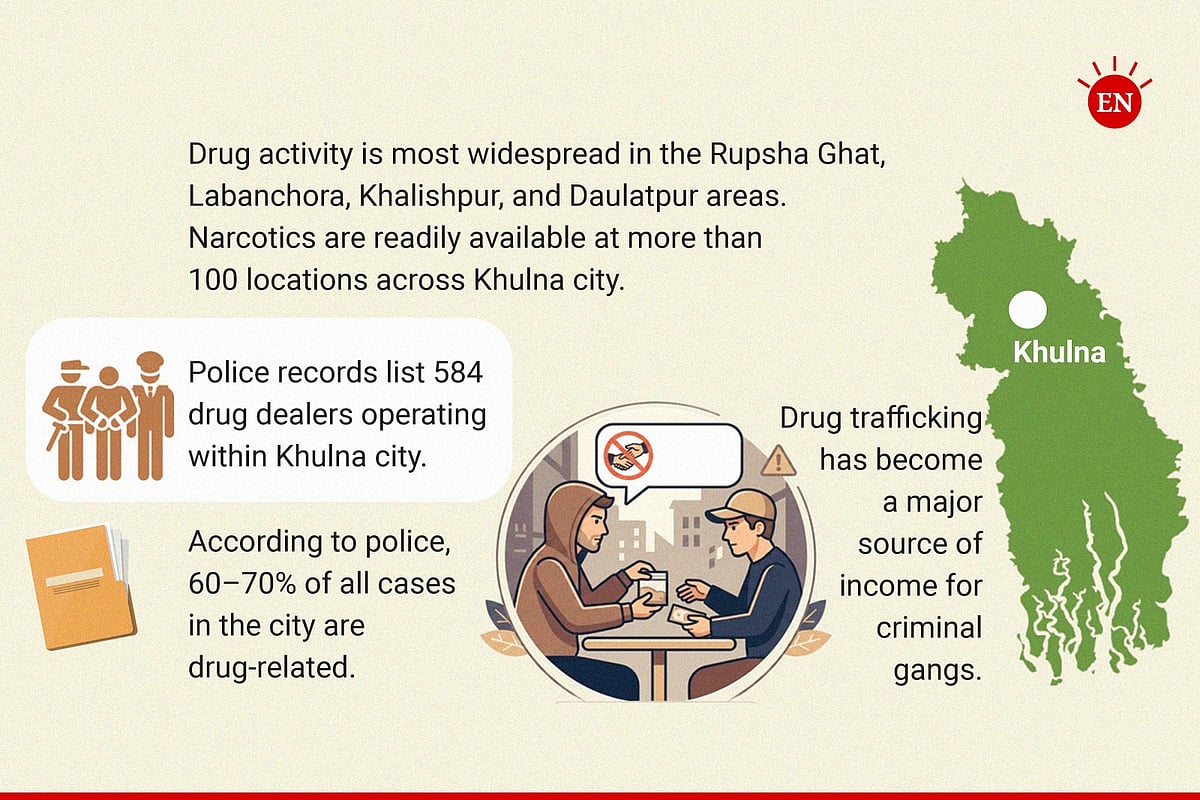
Drugs easily available in over a hundred locations
According to local residents, public representatives, law enforcement personnel, and officials from the narcotics control authorities, drugs are not only prevalent in the Rupsha terminal area alone. They are easily available across more than a hundred locations in Khulna city. Among the most affected areas are Rupsha Ghat, Khalishpur, Harintana, Sonadanga, Lobonchora, and Daulatpur.
In these areas, drugs are sold from small makeshift structures. In addition, retail distribution networks operate in various other locations.
Khulna Metropolitan Police maintains a list of 584 identified drug dealers in the city. Of them, 123 are from Khalishpur, 102 from Harintana, and 102 from Sonadanga police stations. Despite the existence of such lists, locals allege that effective control has not been achieved.
They say authorities are aware of who sells, who transports, and which groups control specific areas. Yet influential “bosses” remain out of reach, while couriers, small-scale sellers, and users are routinely arrested.
Drug abuse has also become a major driver of social conflict and family breakdown. On 10 April, in Rupsha upazila, a son allegedly killed his mother over money for drugs—an incident widely cited as an example of social devastation caused by narcotics.
Foundation of an underground criminal economy
Drug trafficking has become a central pillar of Khulna’s criminal economy. Local sources report that selling yaba sourced from criminal groups can yield a profit of Tk 120–150 per tablet. The lure of quick income has drawn rickshaw pullers, labourers, and low-income individuals into retail drug distribution.
It is also alleged that drug money is used to sustain armed groups, fund legal cases, maintain administrative “management networks,” and secure political protection. As a result, narcotics have become a major source of cash flow for organised crime.
Carriers are caught, controllers remain in the shadows
According to officials of the Department of Narcotics Control, around 95 per cent of drugs recovered in Khulna are seized while being transported. Only about 5 per cent are recovered from houses or other premises. This data provides important insight into the nature of the drug trade.
Large consignments rarely remain in one place for long and are quickly transferred from hand to hand. As a result, the carriers are arrested, while those who finance the trade, control drug operations, or run retail networks remain out of reach.
Sources involved in the matter say that drug networks now operate in such a way that supplies are delivered wherever users demand. Earlier, enforcement operations could focus on specific neighbourhoods, river terminals, or gathering points. Now, drugs are distributed through mobile phone coordination, small consignments, motorcycle or rickshaw transport, and temporary sellers.
A large portion of well-known criminal groups in Khulna are allegedly running their drug operations using this method.
Md Ahsanur Rahman, Additional Director of the Department of Narcotics Control, told Prothom Alo that control of drugs in Khulna is in the hands of a few individuals. He said there are 5–7 persons against whom there are no cases, but who effectively control the drug trade. Many of them also have social recognition and influence.
During the interim government period, there are examples of joint forces led by the armed forces arresting individuals with political identities along with drugs. For instance, on 20 June last year, a joint force arrested four people, including Salauddin Molla Bulbul, president of Ward 30 BNP in Khulna city, and former city Jubo Dal member Towhidur Rahman, with weapons, ammunition, and drugs. However, such operations have become rare.
Some members of law enforcement, speaking on condition of anonymity, said that those who control the drug trade or operate behind the scenes are not directly involved in carrying or selling drugs. Political identity, social status, and local influence make action against them difficult.
Drugs enter via Narail route
Sources say a large share of drugs entering Khulna comes through the Narail route. One route passes through Mollahaat Bridge, and another comes from Narail via the Kalna Bridge. Lohagara in Narail has been identified by multiple sources as a major supply hub.
Once drugs enter Khulna through these routes, they are quickly broken into small quantities. They are then distributed under the supervision of local criminal groups and controllers in Khalishpur, Daulatpur, Lobonchora, Rupsha riverside areas, Station Para, ghats, and labour-dominated neighbourhoods. In some cases, criminal groups directly supply drugs themselves, while in others they take a share from dealers.
Police statistics from Khulna Metropolitan Police (KMP) also show the scale of the problem. From 2021 to March 2026, a total of 5,311 cases were filed related to recovered goods, of which 5,129 were drug-related cases. This means nearly all seizure-related cases are drug-focused.
Khulna district police records show a similar picture. From 2021 to August 2025, a total of 2,832 drug seizure cases were filed across nine police stations, with 3,501 people named as accused. This indicates that drug trafficking has spread even to the upazila level.
According to the Department of Narcotics Control, 317 operations were conducted in Khulna in the first three months of the current year, resulting in 93 cases. However, these figures represent only a partial picture of the extent of drug proliferation.
Questions over police role
Questions have also been raised regarding the role of police in controlling drugs in Khulna. Multiple sources allege that in many cases, some police members maintain contact with drug dealers. Similar allegations exist against several police drivers who have long served in KMP. Recently, two such individuals were removed from station duties, according to a police source.
An incident on 5 May has further intensified these allegations. On that day, Khulna district police constable Ashikul Islam was arrested in Chattogram while travelling to Khulna with 50,000 yaba tablets collected from Cox’s Bazar.
However, KMP Commissioner Mohammad Jahidul Hasan told Prothom Alo that action is taken if any member becomes involved in crime.
Local residents allege that political shelter, along with silent cooperation from some police members, plays a major role in sustaining the drug trade at the field level. In some cases, information about operations is leaked in advance. At times, police reach the scene but fail to take adequate action.
Several internal orders of Khulna Metropolitan Police also indicate such issues. An order dated 17 March mentioned allegations against two officers of Daulatpur police station (an SI and an ASI) for “association with criminals” and receiving undue benefits from drug traders.
Another order dated 16 March stated that even when known criminals and murder suspects fired shots and escaped in front of police, officers did not take appropriate steps to arrest them despite having official weapons and ammunition. Instead, the record noted that the officer concerned arrested innocent civilians.
A similar situation was seen in Harintana police station. A KMP commissioner-signed order dated 17 March stated that suspected individuals fired blank shots and escaped in front of police. Officers on duty failed to take legal action despite having weapons and did not alert other stations or checkpoints using radio communication. As a result, five police members were attached to the police lines.
Observers say these incidents indicate police inactivity, unprofessional conduct, and unclear relations between some field-level officers and criminal networks, raising serious public doubts about police capability and neutrality.
Attacks on operations, weak case outcomes
Drug trade expansion is not limited to sales and consumption; enforcement operations also face resistance. On 4 April, officials of the Department of Narcotics Control were reportedly trapped during an operation in Khalishpur. They were attacked and had their mobile phones snatched. The situation was later brought under control by local administration and army personnel. A case was filed on 7 April for obstruction of government work.
Such incidents illustrate how organised and bold local drug dealers have become. A concerned official told Prothom Alo that such attacks on government officers are unlikely without strong local backing.
Conflicts are also increasing in several areas over control of the drug trade. In some places, new groups are trying to replace older syndicates. In others, criminal groups are attempting to establish control over drug profits, territory, and extortion networks. Political identity and protection have further complicated the situation.
Kudrat-e-Khuda, Khulna district secretary of Sujan (Citizens for Good Governance), told Prothom Alo, “Earlier the drug trade was controlled by individuals linked to the previous Awami League government. Now BNP-backed local influential groups are trying to take over, leading to clashes and killings between rival syndicates.”
Another major obstacle in controlling drug crime is the lengthy judicial process. According to Department of Narcotics Control data, more than half of drug accused in the Khulna region are acquitted. Around 8,000 drug-related cases are pending in the division. Delays in trials, weak evidence, investigative limitations, and poor case management allow many accused to obtain bail and re-engage in similar crimes.
KMP Commissioner Mohammad Jahidul Hasan said that many homeless or marginal people are also involved in drugs, and many are arrested repeatedly, but return to the same activities after being released on bail, making control difficult.
In drug cases, generally only the person from whom drugs are recovered is charged. However, questions such as ownership of the drugs, investment sources, supply chains, and destinations often remain unanswered in many cases.
Khulna Metropolitan Police states that 60–70 per cent of all cases in the city are drug-related. In January this year, 54 such cases were filed; 29 in February; 39 in March; and 44 in April. However, compared to other metropolitan units, KMP’s number of drug cases is relatively lower, despite local claims that drug prevalence is increasing.
Residents allege that police activity often appears symbolic, with limited impact on the core network. Operations frequently remain limited to the retail level.
Triangle of drugs, crime, and politics
In discussions on Khulna’s crime situation, it is difficult to separate drugs from the broader structure. Drug money strengthens criminal groups, while those groups control distribution, territory, and extortion. Political protection further increases their power. As a result, a triangle of drugs, crime, and politics has emerged, according to local observers.
A law enforcement member said, “The person caught selling drugs is only the lowest level. Unless those who fund, divide territory, and provide political protection are brought under accountability, nothing will change.”
The scenes observed along the Rupsha River on 11 and 12 May represent only a fraction of Khulna’s drug situation. River terminals, tea stalls, makeshift huts, and station roads all reflect how drugs have become integrated into everyday urban movement. Behind this visible layer lie controllers, political influence, police weaknesses, judicial delays, and the pursuit of rapid financial gain.
In Khulna, drugs are no longer merely intoxicants; they have become fuel for the criminal economy. As long as this fuel is not cut off, cycles of violence, extortion, territorial control, and killings will remain difficult to stop.