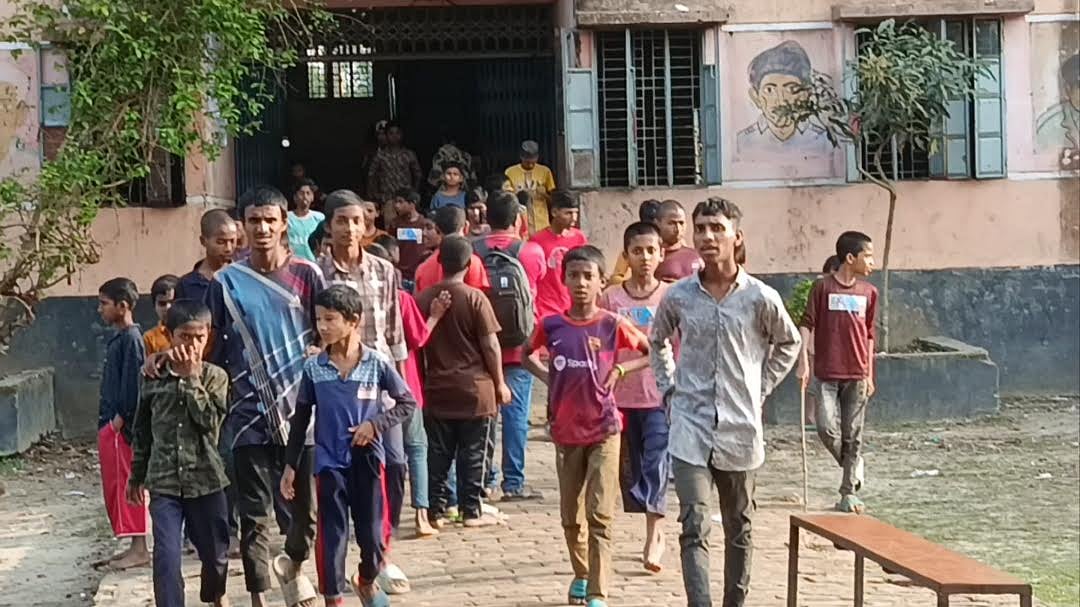
Eid with family still a distant reality for 160 Panchagarh children
Eid is traditionally a time for family reunions, shared meals, and celebration but for around 160 children living at Ahsania Mission Shishu Nagari in Panchagarh, the festival arrives with a different meaning-one shaped by loss, separation, and resilience.
Located in Jalapara village under Hafizabad union of Panchagarh Sadar upazila, the children's home has been providing shelter, education, and care to vulnerable children since its establishment in 2012.
Many of its residents have lost one or both parents, while others have been separated from their families and never found their way back.
Among them are Shukkur Ali, 8, and Fahim, 12, two boys whose stories reflect the reality of many children in the facility.
Shukkur, who grew up as a street child after being separated from his family at birth, was later rescued from a railway station and brought to the shelter. For him, the concept of celebrating Eid with family remains unfamiliar. Still, he finds joy in new clothes, communal prayers, and special meals during the festival.
Shukkur, who grew up as a street child after being separated from his family at birth, was later rescued from a railway station and brought to the shelter. For him, the concept of celebrating Eid with family remains unfamiliar. Still, he finds joy in new clothes, communal prayers, and special meals during the festival.
Fahim's story carries a similar tone of loss. He went missing at the age of six and has since been unable to reunite with his family. Having already lost his mother and been separated from his father, Fahim now considers the caregivers at the shelter his family. "I wanted to celebrate Eid with my family," he says, "but now the sirs [Teachers] here are my family."
Other children share similar experiences. Twelve-year-old Sagar Islam recalls his early life in Old Dhaka and years spent wandering in the Kamalapur area before being brought to the shelter by a social worker. Today, he looks forward to Eid celebrations at the centre, complete with new clothes, perfume, and henna.
Fourteen-year-old Sajjadul Islam Baijid, who was separated from his mother in Dhaka after arriving from Chattogram, still remembers the moment he realised she was gone.
Years later, he continues to hope for reunion. "Like everyone else, I want to celebrate Eid with my family," he says.
Every year, we make special arrangements so the children can celebrate Eid with joy. Our goal is to help them forget their hardships, even if only for a short timeCentre manager Deepak Kumar Roy
Imam Mahadi, also 14, went missing in 2019 and endured hardship on the streets of Dhaka before being rescued with police assistance. Now, he studies and lives at the centre.
"I pray Eid prayers here and study here. The sirs are now my parents," he says.
The story of seven-year-old Joynal is particularly tragic. He claims to have lost his parents to violence before eventually finding shelter at the children's home after moving between different places.
Despite these painful backgrounds, the authorities at Shishu Nagari are committed to ensuring that the children experience the joy of Eid.
Preparations include new clothing, festive meals, and special arrangements such as purchasing goats for Eid meat. The institution also provides free education up to higher secondary level, along with food, clothing, housing, and medical care.
Social worker Yusuf Ali said, "We try to create a family-like environment for these children so they do not feel the absence of their families, especially during Eid."
Centre manager Deepak Kumar Roy added, "Every year, we make special arrangements so the children can celebrate Eid with joy. Our goal is to help them forget their hardships, even if only for a short time."
For these children, Eid may not bring family reunions—but within the walls of Shishu Nagari, they are creating a new sense of belonging together.