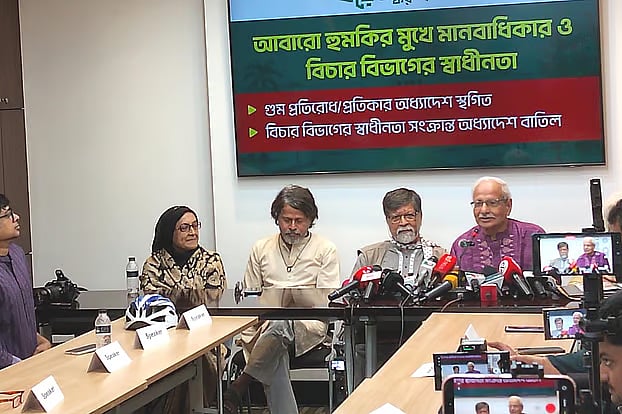
Badiul Alam Majumdar warns against 'two-thirds majority’ curse
Shushashoner Jonno Nagorik (SHUJAN) secretary Badiul Alam Majumdar said that a two-thirds majority in parliament is a curse which has appeared multiple times in the politics of Bangladesh in the past.
Therefore, lessons must be learned from the past to avoid falling into that curse again, he added.
Badiul Alam Majumdar made these comments today, Monday, during a citizen dialogue held at the BDBL building in Karwan Bazar, Dhaka.
The dialogue titled ‘Repeal of the Ordinance on Judicial Independence and Suspension of the Ordinance on Prevention/Remedy of Enforced Disappearances: A Threat to Good Governance and Human Rights Advancement’ was organised by Voice for Reform.
As an example of the ‘Curse of Two-Third Majority’, Badiul Alam Majumdar referred to the situations following the elections of 1973, 2001, and 2008.
He stated, "We must learn from our history that we should not suffer the curse of a two-thirds majority again."
The SUJAN secretary commented that whenever any party has achieved a two-thirds or greater majority in parliament, the result has been negative for the country. Gaining absolute power has led to controversial amendments to the constitution, interference in the judiciary, and destruction of the electoral process.
He described the mindset to employ absolute power as a ‘curse of the majority’.
Badiul Alam Majumdar stated that disregarding the main recommendations due to a ''note of dissent'' by one or two members outside the majority decision in any commission is unconstitutional and unreasonable.
In the current context, he questioned the process of using a ''note of dissent'' as an excuse to disregard public consent.
Regarding parliamentary sovereignty and constitutional limits, Badiul Alam Majumdar said that the Parliament of Bangladesh is not sovereign like the British Parliament. Since there is a written constitution in Bangladesh, the parliament operates under the constitution rather than above it.
The dialogue was chaired by photographer and human rights activist Shahidul Alam.
He mentioned that victims of enforced disappearances were subjected to inhumane treatment and stated that it is extremely urgent and important for society to end the inhumane practice.
Shahidul Alam said many individuals of the current government have fallen victim to enforced disappearances.
He questioned why those who are themselves victims of enforced disappearances would object to ending this practice.
According to Shahidul Alam, the discrepancy between the words and actions of politicians and the lack of control encourage corruption and wrongdoing. If the system doesn't change with the change of regime, the benefits aren't realised.
Highlighting the horrors of the ''house of mirrors'', he stated, "It has been used as a tool to suppress political opponents, and this inhumane practice needs to be completely stopped."
Voice for Reform's co-coordinator Fahim Mashroor moderated the event, where lawyer and human rights activist Manzur Al Matin spoke.
He said that while ordinances relating to the removal of elected representatives are rapidly adopted, the law ensuring the independence of the judiciary is bogged down in bureaucratic complexities.
Manzur Al-Matin urged the government not to delay any further in making the judiciary independent to uphold the aspirations of the common people and the mandate to end enforced disappearances.
When the ruling party boasts about the majority and retreats from reforms, another people's uprising like in ''24 will start at some point, mentioned Hasnat Abdullah, the Member of Parliament of Cumilla-4 from the 11-party alliance.
He said without a change in the state structure, the nation will once again head towards darkness.
Tasnim Zara, the former senior joint secretary of the National Citizen Party (NCP), said that it is essential to maintain the effectiveness of the Supreme Judicial Council and the prevention of enforced disappearance ordinance to ensure the good governance and independence of the judiciary. If these are abolished or weakened, the scope for political interference will increase, and the process of justice for offenders will be hindered.
Tasnim Zara, who contested the election as an independent candidate in Dhaka-9, further mentioned that after a successful uprising, instead of reverting to the old system, it is necessary to further strengthen and implement existing legal tools to protect citizens' rights.
Other speakers at the dialogue included political analyst Dilara Chowdhury, general secretary of the State Reform Movement Syed Hasibuddin Hossain, chairman of the AB Party Mojibur Rahman Manju, human rights activist Rubi Amatullah, and journalist Ashraf Kaiser.