Measles: Why are there higher number of cases in Barguna
The family of child Nuzaifa is not sure whether she has fully recovered from measles. She was diagnosed with measles last February at Barguna Sadar Hospital. She was treated at Barguna, Barishal Medical College Hospital, and a private hospital in Dhaka. She still has reddish rashes on her body and occasionally develops fever. She had to visit a physician twice last week. Nuzalfa is from the Karaitola area of Barguna Sadar upazila.
Prothom Alo correspondent visited their house yesterday, Monday, and spoke with her mother, Hawa Begum. The yard and the house environment were quite unclean. At first glance, it looked like an abandoned house. Garbage had accumulated in the yard for a long time. Inside the house, there was dirt and dust.
Hawa Begum told Prothom Alo that she was married at the age of 14. Now her first daughter is 14 years old, the second daughter is 7, and the youngest, Nujaifa, is 11 months old. Her husband runs a small business. There is no major financial hardship in the family. However, more than Tk 80,000 has been spent on the child’s treatment in the last two months, which has been a big shock.
Hawa Begum does not know whether she received measles or other vaccines in her childhood. However, she vaccinated Nuzaifa against measles at the age of 9 months on 16 February. Before receiving the vaccine, the child had been admitted to the hospital with a fever.
According to a prescription from the Sadar Hospital dated 28 February, the child was suffering from measles and pneumonia. She was later treated first at the Sher-E-Bangla Medical College Hospital in Barisal and then at a private hospital in Dhaka. Showing her daughter in her arms, Hawa Begum said that the child still has rashes and develops fever.
Hawa Begum said she has no idea where the measles infection might have come from. However, since the symptoms appeared after hospital admission, it could have originated from the hospital. Alternatively, she had taken Nuzaifa to the annual sports event at her older daughters’ school, which could also be a cause. However, she is not certain.
Hawa Begum said that due to her own physical problems, the child did not receive breast milk after one and a half months of age. The child has been dependent on baby formula. However, physicians have told her that the child is suffering from malnutrition, as she does not have the expected weight for her age.
Child health specialists say that malnourished children are at higher risk of contracting measles. Whether this child from Karaitola in Barguna contracted measles due to malnutrition or was infected in the hospital has not been thoroughly investigated.
Why measles is higher in Barguna
The southern district of Barguna has recorded more measles patients, with 184 suspected cases reported so far, including 35 confirmed cases. In Barguna Sadar alone, 26 cases have been identified. According to Expanded Programme on Immunization (EPI) data, the infection rate here is 294.5 per million. No other place in the country has recorded such a high rate.
At a discussion held at the office of the Barguna District Civil Surgeon on Sunday, officials from various government departments, representatives from the World Health Organization and UNICEF, and media personnel raised the question of why measles rates are higher in Barguna. Last year, people in this district were widely affected by dengue. This year, measles has emerged. Three possible causes were identified in the discussion: malnutrition, lack of awareness, and shortage of manpower in the health sector.
Malnutrition
Barguna is a coastal district. Agriculture and fishing in the sea are the main occupations of the people. Women’s rights activist and executive head of the private organization Jago Nari, Hosne Ara Hasi, told Prothom Alo that during work at the upazila level, she has observed that poverty is high in villages, and so is malnutrition.
Non-government organisation Eminence conducts research on child nutrition. Its executive head and public health expert Shamim Haydar Talukder told Prothom Alo that according to the latest data, nationally 24 per cent of children under five are stunted, while in Barguna the rate is 27.3 per cent. The rate of underweight children of the same age is also higher in Barguna than the national average. These statistics indicate that malnutrition is deeply rooted in Barguna.
Shortage in workforce
According to a document signed by Barguna Sadar Upazila Health and Family Planning Officer Arunava Chowdhury, there are 120 posts for physicians, nurses, and other staff in the Sadar upazila, of which 55 are vacant—meaning 46 per cent of positions are unfilled.
Superintendent of the 250-bed Barguna Sadar Hospital, Md Rezwanur Rahman, said that on average 350 patients are admitted daily, and around 1,000 patients visit the outpatient department every day. However, there is a severe shortage of manpower. He told Prothom Alo, “It is difficult to provide services with such limited staff. It becomes very difficult to handle outbreaks like dengue and measles.”
According to data from the hospital’s statistics department, there are 55 sanctioned posts for physicians of all categories, of which 36 are vacant—meaning 65 per cent of physician positions are unfilled. There are 52 third class posts, of which 36 are vacant, and 20 fourth class posts, of which 12 are vacant. However, out of 107 nursing posts, only 4 are vacant.
Barguna District Civil Surgeon Mohammad Abul Fattah told Prothom Alo that there is a severe shortage of manpower at the upazila, Sadar, and hospital levels. To tackle measles, it is urgently necessary to appoint more physicians in the area.
Level of awareness
Many government officials, physicians, and development workers have said that there is a lack of awareness among the people of Barguna. Media persons had a similar view. However, no one could provide data, statistics, or comparative research to support this claim.
A senior official of an NGO said that child marriage is quite prevalent in some areas of the district. A physician said that in Amtali and Taltali upazilas, certain groups actively campaign against vaccination, and some people trust them more than government health workers.
A health department official said that last year all members of a family in Barguna Sadar were infected with dengue. Health workers who visited the house found stored water in multiple containers and mosquito larvae in the water.
However, none of these alone prove that awareness is low among the people of Barguna. Over the past two days, these reporters spoke with more than 10 mothers about measles vaccination. None of them could say whether they had ever received a measles vaccine in their lives. Some had not given even a single dose of the measles vaccine to their children. These attitudes toward vaccination also indicate low awareness in Barguna. However, some believe that rather than lack of awareness, measles or dengue is spreading from the Sadar Hospital.
Lack of control in the hospital
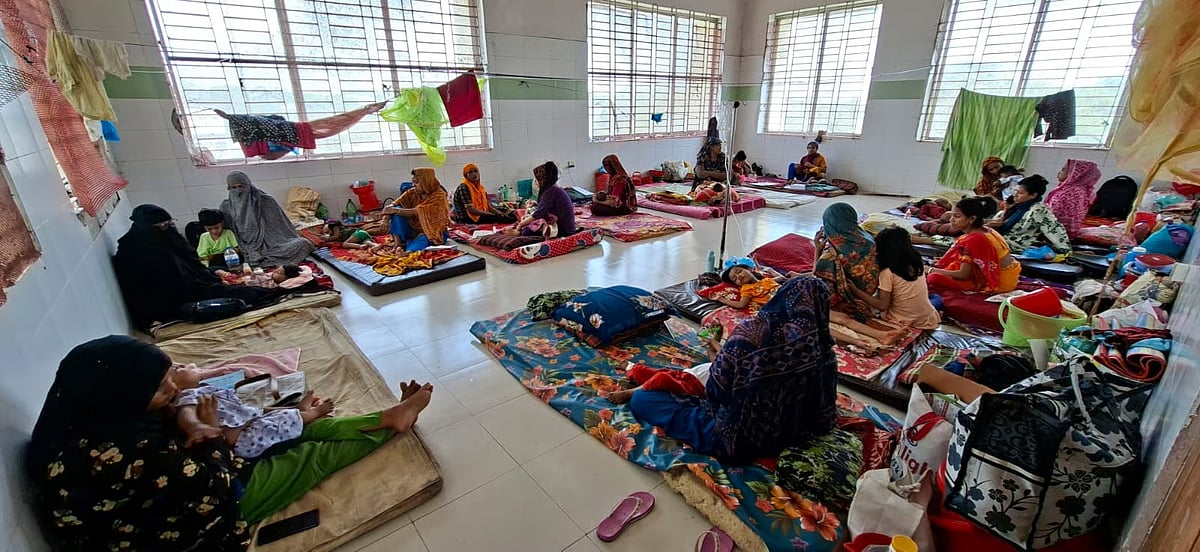
Every day, hundreds of people come to and leave the hospital. Each patient is accompanied by multiple visitors. Children are accompanied by parents and close relatives. People accompanying patients can be seen on different floors and verandas. Crowds of people with children are seen using elevators. There is no system or manpower to manage the crowd in any of these situations. Public health experts say that if infections are not controlled in hospitals, healthy people can become sick there or return home with new diseases. It is globally recognised that infections can spread from hospitals.
Barguna Sadar Hospital is no exception. The day before yesterday, the grandmother of a child infected with measles and undergoing treatment complained that they had brought the child to the hospital with a fever, and measles appeared after admission. Nujaifa’s mother from Karaitola also suspects that the infection may have originated from the hospital.
However, hospital superintendent Md Rezwanur Rahman did not show interest in commenting either for or against this. He only said, “You have seen the reality during last year’s dengue outbreak, and now you are seeing it during the measles outbreak.”
However, the people of Barguna want to know the real causes. Some have said that research is necessary. It is important not only to understand why Barguna has suddenly become a ‘hotspot’ for multiple diseases, but also to find solutions.
Regarding this, public health expert Mushtuq Hossain told Prothom Alo, “I am not ready to accept that the people of Barguna lack awareness. The weaknesses of primary healthcare across the country have become evident through the outbreaks of dengue and measles in Barguna.”
“If there were a regional healthcare system instead of a centralised one, there would not have been such a manpower shortage in Barguna. The problem seen in Barguna today could appear in another remote area tomorrow. Therefore, the new government should take necessary reforms in the healthcare system,” he added