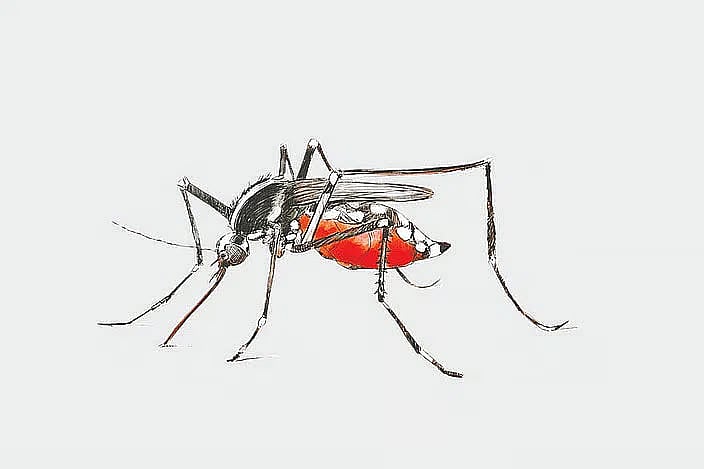
Dengue cases are on the rise. Patients have already been detected in 58 districts, with the highest numbers being reported in the districts of Barishal division.
According to data released yesterday, Saturday, by the Health Emergency Operation Centre and Control Room of the Directorate General of Health Services (DGHS), dengue patients were detected in 58 of the country's 64 districts between 1 January and 19 June this year.
The six districts where no dengue cases have been identified are Shariatpur in Dhaka division, Moulvibazar in Sylhet division, with Kurigram, Dinajpur, Thakurgaon and Panchagarh in Rangpur division.
However, both the number of infections and deaths remain lower than that during the same period last year. Between 1 January and 19 June last year, 7,077 dengue patients were admitted to hospitals and 30 people died from the disease. During the same period this year, 4,680 dengue patients were hospitalised and seven people have died.
A dedicated cell has been formed comprising directors from the Communicable Disease Control (CDC) unit, the Institute of Epidemiology, Disease Control and Research (IEDCR), the Management Information System (MIS) unit and the hospital division to monitor the dengue situation and take necessary measures as needed.Professor Pravath Chandra Biswas, director general of DGHS
After the Bangladesh Nationalist Party (BNP) government came to power, it began placing greater emphasis on dengue prevention from March. The government has formed mobile courts to inspect institutions and homes for Aedes mosquito larvae. It has also decided to establish dengue corners at upazila hospitals.
To cope with a potential surge in patients, a field hospital has been prepared on the grounds of Dhaka Medical College Hospital. The health authorities said more of the similar facilities would be set up if necessary.
Professor Pravath Chandra Biswas, director general of the DGHS, told Prothom Alo that a dedicated cell has been formed comprising directors from the Communicable Disease Control (CDC) unit, the Institute of Epidemiology, Disease Control and Research (IEDCR), the Management Information System (MIS) unit and the hospital division to monitor the dengue situation and take necessary measures as needed.
The DGHS director general also said that 100,000 bags of saline have been stockpiled. Private hospitals have been asked to provide free treatment for dengue patients in 10 per cent of their beds, while diagnostic centres have been requested to offer an 80 per cent discount on dengue-related tests.
In addition, with support from the Bangladesh Society of Medicine, the integrated treatment guidelines for dengue have been updated. Training based on those guidelines has begun for physicians across the country, with support from UNICEF, he added.
Dengue cases could continue rising for one to one-and-a-half months after the monsoon ends. Dengue infections typically peak in July and August. However, unless the government implements a strong response programme, the outbreak could persist beyond October.Mushtuq Husain, former chief scientific officer of IEDCR
Dengue cases rising
Dengue patients are being admitted to hospitals throughout the year. However, epidemiologists and entomologists say the disease tends to be more prevalent during and immediately after the monsoon season.
Dengue cases are usually higher between April and October. Infections begin to increase from April and generally start to decline towards the end of October. However, dengue is no longer considered a disease confined to a particular month or season; it has become a year-round public health concern.
A total of 1,081 dengue patients were admitted to hospitals in January this year. The number fell to 409 in February and dropped further to 353 in March. Since then, infections have been on the rise.
Hospital admissions increased to 640 in April and climbed further in May, when 714 patients were admitted. In the first 19 days of June alone, 1,483 patients were hospitalised nationwide.
Public health experts believe this upward trend will continue until October. Former chief scientific officer of the Institute of Epidemiology, Disease Control and Research (IEDCR), Mushtuq Husain, told Prothom Alo that dengue cases could continue rising for one to one-and-a-half months after the monsoon ends.
He said dengue infections typically peak in July and August. However, unless the government implements a strong response programme, the outbreak could persist beyond October.
Barishal division recorded 1,243 hospital admissions, followed by Chattogram with 956, Khulna with 490, Rajshahi with 170, Mymensingh with 138 and Sylhet with 53. Rangpur division has reported the fewest cases so far, with 29 patients identified.
Barishal worst affected
According to a regular weekly analysis (8–14 June) by the World Health Organization (WHO) on measles, respiratory diseases, dengue and diarrhoeal diseases, dengue outbreaks this year have been more severe in the districts of Barishal and Khulna divisions.
Data from the Health Emergency Operation Centre and Control Room of the Directorate General of Health Services show that 1,601 dengue patients, including those from the two Dhaka city corporations, have been admitted to hospitals in Dhaka division this year.
Barishal division recorded 1,243 hospital admissions, followed by Chattogram with 956, Khulna with 490, Rajshahi with 170, Mymensingh with 138 and Sylhet with 53. Rangpur division has reported the fewest cases so far, with 29 patients identified.
All six districts in Barishal division are experiencing relatively high dengue prevalence. Last year, Barguna district in particular saw a major outbreak. According to official figures, 9,533 people in Barguna were hospitalised with dengue and 15 died from the disease.
Asked why Barishal is seeing more dengue cases, mosquito expert and zoology professor at Jahangirnagar University, Kabirul Bashar, told Prothom Alo that dengue spreads when three factors converge: mosquitoes and favourable breeding conditions, the virus itself, and human populations.
“It can be assumed that this combination currently exists in Barishal. Dengue can be controlled if mosquitoes are eliminated, their breeding is prevented, or infected individuals are kept in complete isolation. This applies not only to Barishal but to any area,” he said.