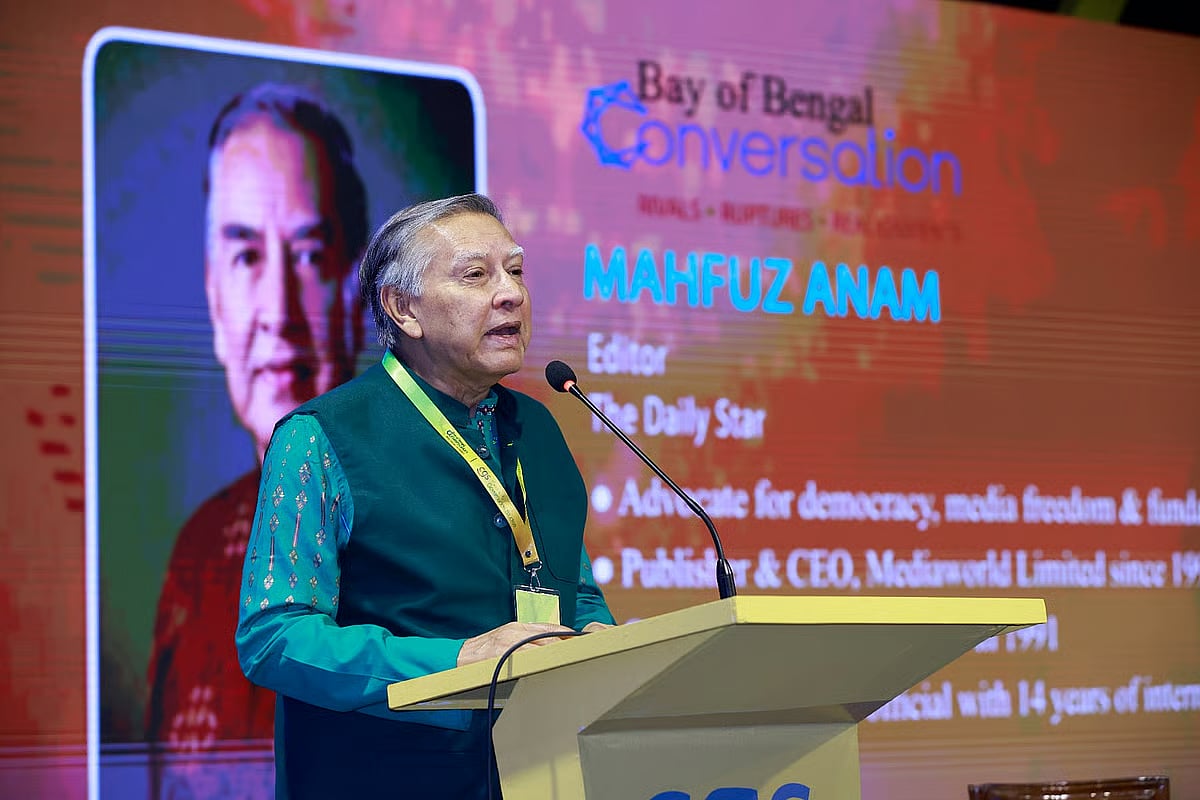
Daily Star editor Mahfuz Anam has said that hatred, confusion, and falsehoods are effectively being monetised on the social media in the garb of freedom of expression.
He described this changing reality as a “danger of lies” and called upon the country's policymakers and leaders to take steps to protect the society.
Referring to social media, Mahfuz Anam said, “The more hateful the comments, the more misinformation, the more lies, the more provocative writing against someone—the more the clicks, and the higher the revenue.”
He made these remarks in a solo speech during a session of the Bay of Bengal Conversation. The event was organised today, Saturday afternoon, at a hotel in the capital by the Centre for Governance Studies (CGS).
Speaking at the discussion, the Daily Star editor presented his views on “War, Fragile States and the End of Global Stability” and “Artificial Intelligence and the Threat of Disinformation.”
Mahfuz Anam said, “It is true that social media has democratised information flow; now every individual can express their opinion. But the negative side is that, in most cases, these are not information-based, not knowledge-driven, and not even rational.”
In the discussion, Mahfuz Anam elaborated on his views regarding “War, Fragile States and the End of Global Stability.” He said, “For small countries like ours, global stability is extremely important—particularly in the economic sphere.”
Noting that “knowledge, skills, and experience are the most valuable assets for Bangladesh as a developing country,” Mahfuz Anam said, “We cannot compete with the world in terms of wealth or military strength; our only competitive advantage is knowledge and skills. But in this era of populism, we are rapidly heading toward a frightening reality.”
Referring to global trade wars and commercial volatility, the Daily Star editor said, “This is a clear warning that the future world is going to be much more dramatic and unstable. Therefore, we must deeply understand our geopolitical position, economic capabilities, and the related realities.”
Mahfuz Anam raised the question of why Bangladesh’s primary and secondary education standards do not improve under any government. He said, “We need to ask—where do our graduates and postgraduates stand? We are causing ourselves the greatest harm by not investing sufficiently in research.” He cited China’s heavy investment in education and research as an example.
Mahfuz Anam said, “In Bangladesh, we still have not fully grasped the importance of knowledge and how it determines our future. We are not investing in knowledge.” According to him, Bangladesh’s education system is neither sufficiently high-quality nor internationally competitive.
Although he acknowledged that the country’s private universities have good standards, he questioned their investment in research. He said, “I want to emphasise that Bangladesh’s future will depend on a knowledge-based economy.” He also warned that if this sector is not prioritised immediately, the country risks falling prey to “mental colonialism” in the future.