Accident exposes deprivation faced by govt physicians at upazilas
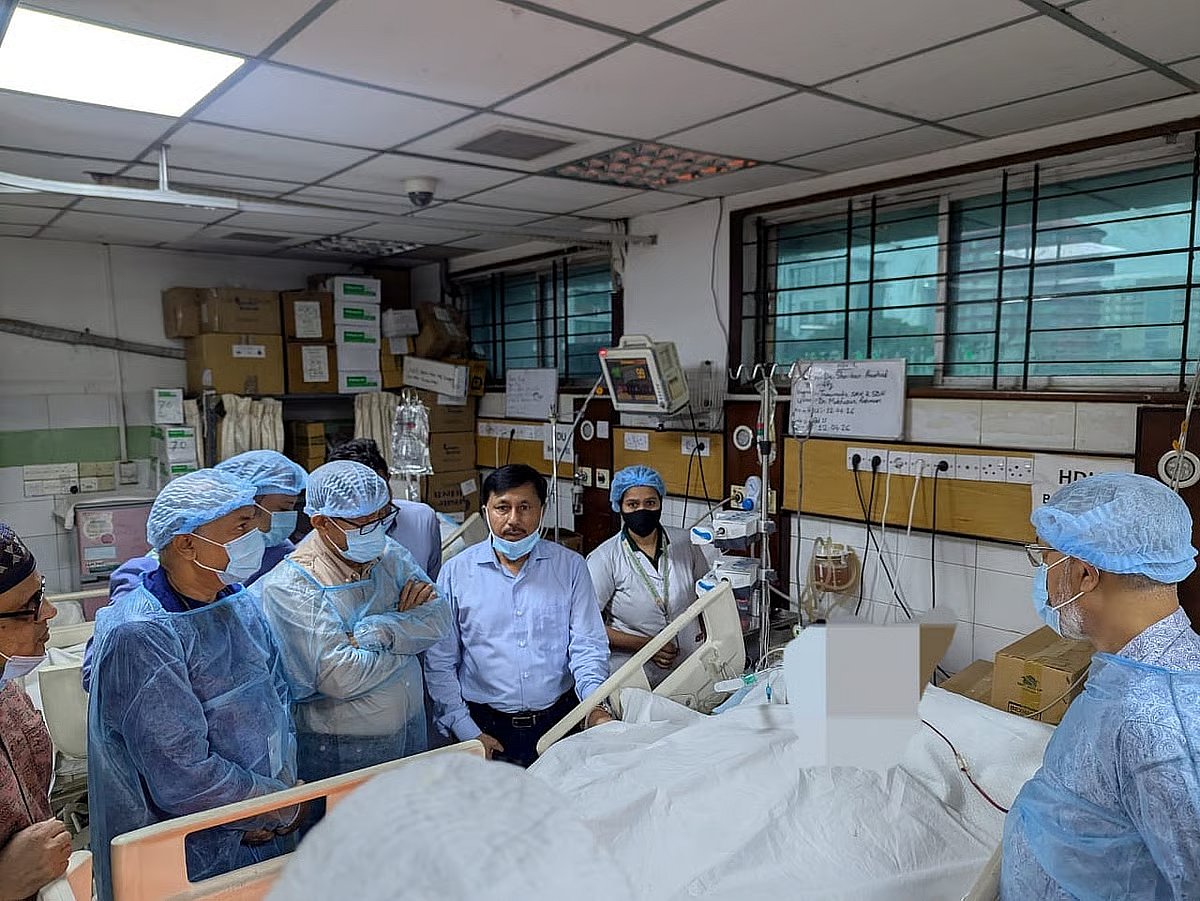
Anxiously waiting outside the Intensive Care Unit (ICU) of the National Institute of Neurosciences and Hospital in Dhaka, 43-year-old Arpita Haldar struggled to contain her grief. Inside, her husband, Shankar Prasad Adhikari, a physician by profession, lay in critical condition following a road accident five days earlier.
A bank officer by profession, Arpita broke down repeatedly as relatives and well-wishers gathered to enquire about her husband’s condition. Shankar Prasad, currently serving as the Upazila Health and Family Planning Officer (UHFPO) at Kalapara Upazila Health Complex in Patuakhali, sustained severe head injuries on 12 April while travelling to inspect a community clinic.
He had been a passenger on a motorcycle when a cow suddenly crossed the road, causing the rider to lose control. While the driver escaped with minor injuries, Shankar Prasad suffered life-threatening injuries.
According to Arpita, her husband would not ordinarily have travelled by motorcycle. The health complex has an official vehicle, which he had routinely used for field visits until recently. However, government support for drivers and fuel has been discontinued for the last one and a half years, effectively rendering such vehicles unusable.
Standing outside the ICU, Arpita reflected with anguish that the accident might have been avoided had the vehicle been operational.
Physicians attending to Shankar Prasad have described his condition as extremely critical. He remains in a coma, prompting widespread concern within the medical community. Many physicians view the incident as emblematic of systemic neglect and administrative indifference towards public healthcare professionals, particularly at the upazila level.
Colleagues of physician Shankar Prasad have expressed frustration over what they describe as discriminatory treatment. They point out that both Upazila Nirbahi Officers (UNOs) and UHFPOs hold equivalent fifth-grade status, yet UNOs are provided with vehicles, drivers, and fuel, while physicians are not.
Following the formation of the interim government in 2024, allocations for fuel and drivers for UHFPO vehicles were reportedly suspended. This policy shift has significantly hampered the mobility and operational capacity of government physicians responsible for rural healthcare oversight.
Health Minister Sardar Md Sakhawat Hossain, along with senior officials from the Ministry of Health, visited Shankar Prasad at the hospital on 14 April. During the visit, they acknowledged the concerns raised by physicians and assured that the government would bear the cost of his treatment, given that he was injured in the line of duty.
Originally from Kotalipara in Gopalganj, Shankar Prasad graduated from Dhaka Medical College and joined government service in 2010 through the 28th BCS examination. He married Arpita Haldar in 2005. Arpita currently works as a Customer Service Manager at City Bank’s Madani Avenue branch and resides in Dhaka with their two sons.
‘He was not picking up phone that day’
The couple’s elder son, Shashwata Shuddha Adhikari, 13, is a child with special needs, while the younger, Sauranil Adhikari, 11, studies in Class-III at South Point School and College in Baridhara. The family relocated to Dhaka in 2022 following medical advice, as adequate facilities for children with special needs were unavailable in Patuakhali.
Recalling the day of the accident, Arpita said she had phoned her husband around 10:00 am, but he did not answer. Shortly afterwards, a staff member from the health complex informed her that he had been injured and was being taken to Barishal Medical College Hospital.
Patuakhali Civil Surgeon Mohammad Khaledur Rahman Mia told Prothom Alo that the accident occurred when a cow unexpectedly came onto the road, causing the motorcycle driver to lose control.
As Arpita prepared to travel to Barishal, she was informed that her husband was being transferred to Dhaka. City Bank arranged an air ambulance to facilitate his urgent transfer.
In a critical condition
Speaking about the health condition of Shankar Prasad, Professor Kazi Gias Uddin Ahmed, Director of the National Institute of Neurosciences and Hospital, stated that Shankar had suffered catastrophic brain injuries. His skull was fractured, and there was significant intracranial bleeding.
Emergency surgery was performed at around 2:00 am on the night of admission. A portion of his skull has been preserved at the Bangladesh Atomic Energy Commission facility in Savar.
Allocations for drivers’ salaries and fuel have remained suspended for over a year and a half.Civil Surgeon Mohammad Khaledur Rahman Mia
Professor Ahmed further noted that Shankar’s Glasgow Coma Scale (GCS) score currently stands at 6, compared to the normal score of 15. He has also developed a high fever, possibly due to infection.
He observed that the severity of the injury might have been reduced had Shankar Prasad been wearing a helmet. However, Arpita later learned from colleagues that the motorcycle rider did not have an extra helmet.
Fighting back tears, she said, “For the sake of our children, especially our special-needs son, I just pray that he returns.”
There’re vehicles but no driver
Colleagues of physician Shankar Prasad have expressed frustration over what they describe as discriminatory treatment. They point out that both Upazila Nirbahi Officers (UNOs) and UHFPOs hold equivalent fifth-grade status, yet UNOs are provided with vehicles, drivers, and fuel, while physicians are not.
Arpita explained that government fuel support was withdrawn around August–September 2024. Initially, drivers were retained through outsourcing, but that arrangement was later discontinued as well. Although Shankar Prasad occasionally used personal funds to fuel the vehicle, he found it financially unsustainable due to high fuel consumption, forcing him to rely on motorcycles for official duties.
In 2020, Mitsubishi Outlander vehicles were distributed to upazila health complexes nationwide under the health sector’s operational plan (OP). The government previously covered fuel and driver expenses through this budgetary framework. However, the OP expired in June 2024. Later, the interim administration did not reactivate the programme for 38 sectors of the health or introduce a replacement.
Civil Surgeon Mohammad Khaledur Rahman Mia confirmed that allocations for drivers’ salaries and fuel have remained suspended for over a year and a half, severely restricting physicians’ ability to conduct field inspections and supervision.
Abu Hossain Md Moinul Ahsan, Director (Hospitals and Clinics) at the Directorate General of Health Services, acknowledged that these expenditures were discontinued after August 2024.
He added that the government is currently exploring alternative funding mechanisms to restore operational support.