Second Padma Bridge to take Y-shape, link three districts, where will the second Jamuna Bridge be built?
Plans to build a second Padma Bridge to improve connectivity between the south-western region of the country and the capital, Dhaka, date back nearly three decades.
Over the years, various alternatives have emerged regarding the bridge’s location and design.
Initially, the plan was to build a bridge between Paturia in Manikganj and Daulatdia in Rajbari. Later, the Awami League government proposed the idea of constructing a tunnel beneath the riverbed.
Subsequently, a pre-feasibility study explored the possibility of building a bridge between Rajbari and Pabna, excluding a direct connection with Dhaka.
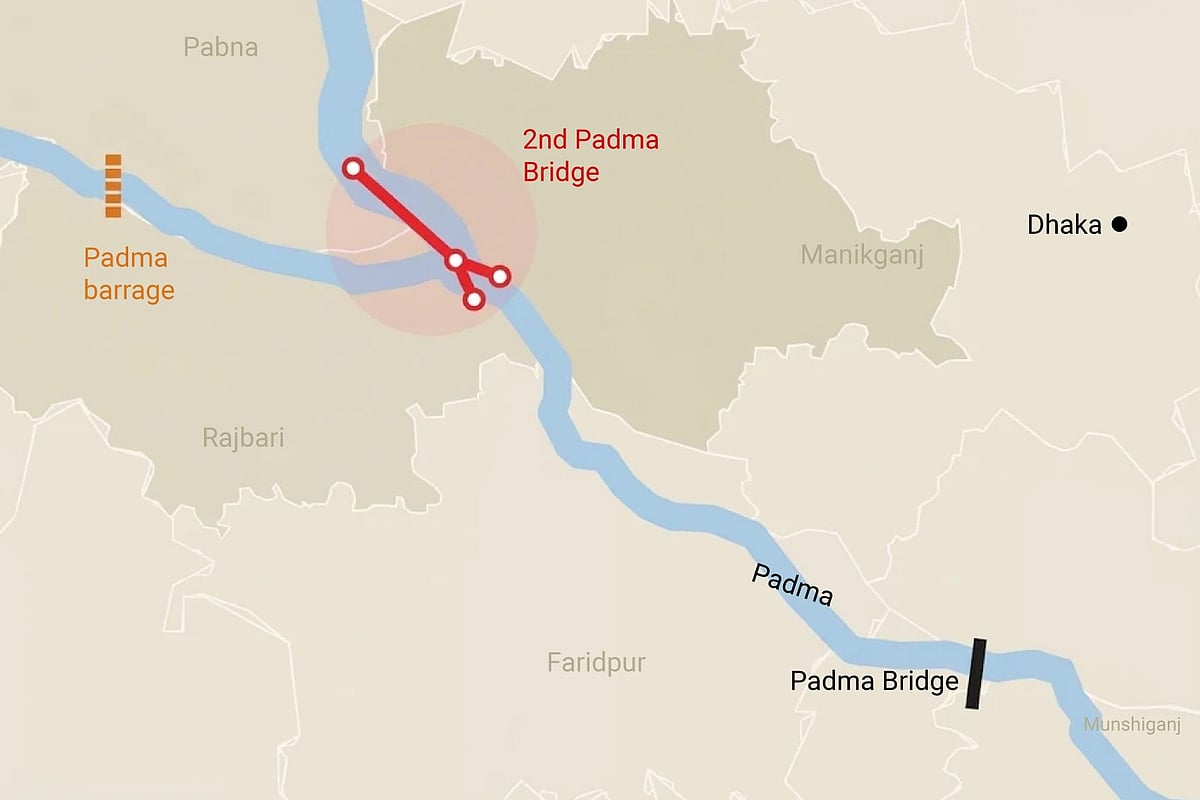
Now, the current BNP government has taken an in-principle decision to construct a Y-shaped bridge connecting the three districts of Manikganj, Rajbari and Pabna.
Under the latest plan, the bridge will connect Paturia in Manikganj, Daulatdia in Rajbari and Kazirhat in Pabna. The government’s Bridges Division will oversee the project.
According to sources at the Bridges Division, the second Padma Bridge will provide an alternative route connecting Dhaka with various districts in the northern and south-western regions. It will also establish alternative links between the capital and Mongla Seaport, as well as the land ports of Benapole, Bhomra and Darshana.
The Bridges Division expects the project to reduce the time and cost of transporting goods.
The existing Jamuna Bridge is struggling to cope with growing traffic. The construction of a second Jamuna Bridge is expected to have a significant impact on the economy of northern Bangladesh.
The government is pursuing several development plans centred on Bogura in particular, and the second Jamuna Bridge forms part of those initiatives.
However, the final locations, lengths, designs and construction costs of both bridges have yet to be determined. A fresh feasibility study is under way to establish these details. The authorities aim to complete the study by September next year.
The Jamuna Bridge currently serves as one of the main routes connecting the northern region with the capital. An average of 25,000 vehicles cross the bridge every day. Traffic congestion occurs during festivals and on the first and last days of the week, when vehicle pressure increases.
The bridge opened to traffic in 1998. The government has planned a second Jamuna Bridge as an alternative to the existing structure.
Meanwhile, an average of 20,000 vehicles cross the Padma Bridge every day, which opened in 2022.
Abdur Rauf, secretary of the Bridges Division, told Prothom Alo, “The government's in-principle decision is to construct both the second Padma Bridge and the second Jamuna Bridge. We have also discussed building the second Padma Bridge in a Y-shaped design. Once the feasibility study is complete, we will prepare a Development Project Proposal (DPP). We will then have detailed information about the bridge routes, designs and costs.”
Two bridges included in BNP’s election pledges
The BNP pledged to construct the second Padma Bridge and the second Jamuna Bridge in its election manifesto. The current government has also prioritised the construction of the Padma Barrage to improve connectivity in the northern region and protect agriculture and the environment.
On 3 November, Prime Minister Tarique Rahman held a special review meeting at the Secretariat with senior officials from the relevant ministries and divisions.
The meeting resulted in an in-principle decision to expedite work on the second Padma Bridge, the second Jamuna Bridge and the Padma Barrage projects. The Prime Minister instructed officials to move forward with implementing these projects.
Following the meeting, Road Transport and Bridges Minister Shaikh Rabiul Alam told journalists, “Work on the Padma Barrage and the second Padma Bridge will proceed in a coordinated manner. We have also decided to construct a second bridge over the Jamuna River. Once we receive the feasibility study report, we will prepare detailed designs and development project proposals before starting construction.”
Meanwhile, on 25 October, the Bridges Division recommended including 59 projects in the pipeline list of nationally prioritised integrated logistics projects. The second Padma Bridge project is among them.
A PowerPoint presentation by the Bridges Division shows that the second Padma Bridge will reduce travel distances and journey times between Dhaka and Meherpur, Chuadanga, Kushtia, Jhenaidah, Magura, Rajbari and Faridpur.
It will also improve connectivity for parts of Narail, Gopalganj, Madaripur and Jashore. In particular, connecting Kazirhat will create a new route to Dhaka for people in the Pabna region.
The bridge will also strengthen direct connectivity between Pabna, Manikganj and Rajbari. It is expected to facilitate the transportation of agricultural and industrial goods as well.
Authorities have identified four to five possible routes for the second Jamuna Bridge, with two emerging as the most prominent options. One route would connect Dewanganj Ghat in Jamalpur with Balashi Ghat in Gaibandha. The other would link Madarganj in Jamalpur with Sariakandi in Bogura. Authorities are also considering building the second Jamuna Bridge between Chilmari and Rowmari in Kurigram.
Second Padma Bridge under discussion for three decades
The first pre-feasibility study on constructing a bridge over the Padma River took place in 1999. Later, in 2005, the Japan International Cooperation Agency (JICA) supported a detailed technical and economic feasibility study.
The study proposed three possible routes for the Padma Bridge: Mawa in Munshiganj to Jazira in Shariatpur; Paturia in Manikganj to Daulatdia in Rajbari; and Dohar in Dhaka to Charbhadrasan in Faridpur.
Ultimately, the government built the Padma Bridge between Mawa and Jazira. Meanwhile, the Paturia-Daulatdia route remained under consideration as an alternative location for another bridge.
The Bangladesh Bridge Authority's master plan for 2020–2024 also included the second Padma Bridge. The plan proposed a cable-stayed bridge along the Paturia-Daulatdia route.
Two bridges and the barrage will be located close to each other
Sources at the Bridges Division said that, while discussions about the second Padma Bridge were under way, authorities also conducted a pre-feasibility study to explore the construction of another bridge between Rajbari and Pabna. Under the proposal, the bridge would connect Dhaowapara Ferry Ghat in Rajbari with Hasampur in Sujanagar upazila of Pabna.
However, sources at the Bridges Division said that constructing the second Padma Bridge in a Y-shaped design would eliminate the need for a separate bridge between Rajbari and Pabna.
In addition, the government has planned to construct a Padma Barrage between Rajbari and Pabna. The proposed site lies between Habashpur in Pangsha Upazila of Rajbari and Satbaria in Sujanagar, Pabna. It is within 30 kilometres of the Daulatdia end of the second Padma Bridge. The barrage will also have a road running across its top once constructed.
Officials at the Bridges Division said they expected to obtain preliminary designs and other concepts for the second Padma Bridge and the second Jamuna Bridge within three to four months. Once they receive the full feasibility study reports by September next year, they will be able to decide on the final routes, construction costs, designs and other details of the bridges.
The Bangladesh Bridge Authority has appointed consultants to conduct feasibility studies for the second Padma Bridge and the second Jamuna Bridge. The study officially began on 28 September.
A consortium comprising Nepal's Environment and Resource Management Consultant (ERMC), Sweden's Swedish National Road Consulting (SWEROAD), South Korea's DASAN, and Bangladesh's Desh Upodesh and SARM Associates is jointly conducting the study.
The contract is worth Tk 185.9 million (18.59 crore), and the Bangladesh Bridge Authority is funding the work from its own resources. The study will run for 12 months, with the authorities aiming to submit the reports by September next year.
Asked for his opinion, Professor Shamsul Hoque of the Department of Civil Engineering at Bangladesh University of Engineering and Technology (BUET) told Prothom Alo, “The second Jamuna Bridge has become extremely necessary. The second Padma Bridge is also needed. However, the authorities must select the designs and routes in a way that benefits the largest possible number of people.”
Professor Shamsul Hoque further said, “There are plans to construct several bridges and barrages close to one another. Therefore, the authorities must also consider how these structures will be interconnected.”