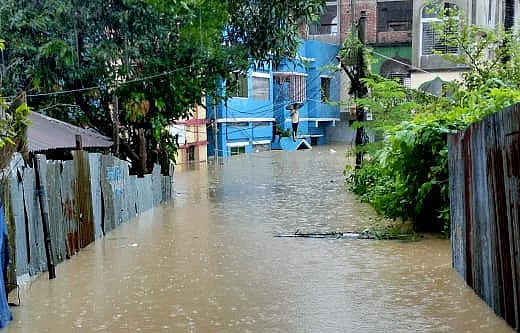
Bandarban flood: Unprecedented in 25 years, people still in shelters
Pul Mong Marma retired from the family planning department four years ago. He lives with his wife, son, and two daughters in Ujanipara, Bandarban Sadar, near the banks of the Sangu river. Part of his two-room fenced house was washed away in the recent flood, including their furniture. Fortunately, they moved to safety just before the flood, saving their lives. They have now rented a house nearby.
He informed Prothom Alo that he hadn't witnessed a flood of this magnitude in the past 25 years. The last occurrence of such a devastating flood was in 1997. The authorities compare this flood with the one in 1997. Local residents noted that even though water levels rose somewhat in 2019, the impact wasn't as severe. Numerous individuals lost their homes and sought refuge with relatives, while others relocated to rented houses. Many have started rebuilding the houses, while some are currently living in shelters.
As per information from the district administration, a total of 6,569 houses suffered damage. Presently, approximately 400 families are still staying in shelters alongside their poultry and cattle.
Water started receding in Bandarban from Thursday and went down completely on Friday. The signs are still there after three days. The district commissioner's office, court building, police superintendent's office, library, water treatment plant, everything was submerged in the flood. The ponds and other water bodies are flooded, the road is still covered with mud, the crops and jhum have been destroyed.
The biggest crisis is now the shortage of fresh water. The army and the Department of Public Health Engineering (DPHE) are struggling to ensure safe water supply. Anupam Dey, executive engineer of the DPHE, said, "Our water treatment plant has been submerged in water. Now we are purifying water in a makeshift arrangement.”
Deputy Commissioner Shah Mujahid Uddin is currently addressing the task of mitigating the risk of waterborne illnesses, including diarrhoea, in the aftermath of the flood. During the district's law and order meeting yesterday, the DC reported that the flash floods have tragically claimed the lives of 10 individuals thus far. A total of 132 schools have been inundated by water. Numerous individuals remain in shelters, and relief efforts are actively being carried out. Reestablishing communication with the isolated upazilas of Thanchi and Ruma is expected to take between one to one and a half months.
The severity of the flood can be understood by looking at the accounts of the Water Development Board. Due to heavy rains and landslides, the Sangu river has flowed 5 meters above the water level (14.8 meters) (ie 19.25 meters). In 1997, it flowed 5.5 meters above the danger level. Along with Sangu, water of Matamuhuri river also flows 3 and a half meters above danger level (11.8). Because of this, the damage has increased.
People took shelter with their livestock
Around 228 people took shelter in Sadar's Bandarban Para Government Primary School Shelter. At present there are about 100 people. One of them is Paynuching Marma, 48, a resident of Ujanipara. Her house was washed away by the flood. Then she came here with her husband and two daughters.
Another woman named Rika Sardar (30) came to the shelter with a goat. Apart from this, another Marma woman came to the shelter with her four ducks. Most of their houses were washed away by the floods. Rika said, they did not receive any food assistance for three days. However, on Saturday, the wife of minister Bir Bahadur gave 10 kg of rice to each family.
There are still many men and women in the shelter of Bandarban Government Girls' High School. Rahima Begum, 35, of Madhyam Para, who took shelter here, said, “My husband is a day labourer. He has no work. We were given two kg rice. I am cooking that now.”
These correspondents visited the shelter in person. People in there were making fires and cooking. Some of them have also brought as much furniture as they can from home to the shelter.
In Madhyampara, people returning home from the shelter were struggling to start afresh. Some did not return home. One such Ubanu Marma said, "My house has been washed away. Now I am in big trouble with two children and wife. I don't even have the money to repair my house.”
Damages
Multiple departments are actively surveying the full extent of the flood's impact. As explained by Executive Engineer Mosleh Uddin Chowdhury, total 15 kilometres, which includes the Ruma-Thanchi road managed by the Roads and Highways Department, has been damaged. He also mentioned that the military usually oversees the repair work for the Ruma and Thanchi roads. In addition to this, there are roughly 15 kilometres of roads that have suffered damage, leading to a total cost of Tk 100 million for repairs.
About 200 kilometres of rural roads have been damaged. The local government engineering department works on rural roads. Assistant engineer of the company Jamal Uddin said that 200 kilometres of roads have been damaged. One side of some road has completely collapsed. A loss of 100 crore rupees has been determined.
The flood has resulted in a financial loss of approximately Tk 25 million for the fisheries department. A total of 430 water bodies have been eroded by the floodwaters. Additionally, District Fisheries Officer Abhijit Sheel reported that 159 fish farming initiatives have been impacted. He highlighted Lama Upazila experienced the greatest impact, with 150 reservoirs and 30 lakes being affected.
About 9,855 hectares of land were damaged in the agricultural sector, including seedlings. In this, various fruit orchards including papaya, banana, mango, cashew nuts have been destroyed.
No electricity in three upazilas
Between 6 and 9 August, the district faced a power outage due to rain and floods, caused by the submersion of the power plant. On the 10 August, electricity was partially restored in urban areas. However, Ruma, Thanchi, and Rowangchhari upazilas still have no electricity.
The Power Division explains that factors like damaged supply lines and transformers have prevented electricity from reaching various city areas. Sumit Banik, a resident of Ward No. 3 in Bandarban Municipality, mentioned that since 6 August, there has been no electricity, leading to challenges in fetching water and causing ongoing difficulties.
Relief operations
It was reported in the meeting of the district administration yesterday that 168 tonnes of rice and Tk 750,000 in cash have been allocated so far in seven upazilas. Apart from this, 12,500 litres of bottled water, 1,000 packets of dry food were distributed.
Through the DPHE, 350,000 litres of water is supplied to Sadar and 40,000 litres to Lama upazilas. Apart from this, the army has provided 71,000 litres of fresh water. Dry food is also distributed. The zilla parishad has allocated a total of Tk 4 million in cash for the affected upazilas.
Chahai Mong, the Chairman of Rowangchhari Upazila Parishad, said that they received assistance in the form of Tk 100,000 and 15 tonnes of rice from the district administration. This aid is currently being distributed, but it falls significantly short of meeting the actual needs. Additional relief efforts are necessary.