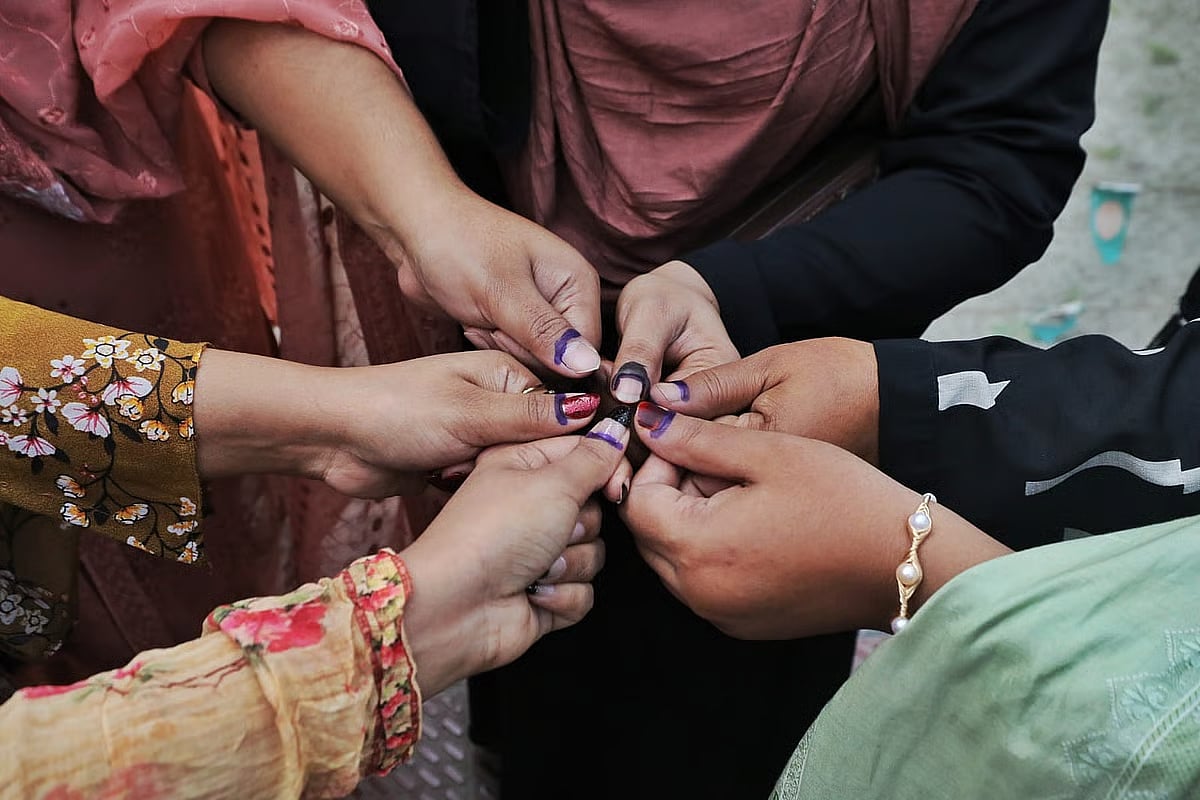
Voting concludes amid festive atmosphere
The voting for the 13th Jatiya Sangsad (national parliament) election and the 2026 referendum has concluded, with counting beginning immediately after.
Across the country, voting was carried out in a festive atmosphere. Apart from a few isolated incidents, the overall process remained peaceful.
Reportedly, four individuals died in separate incidents during the voting period. Political parties have raised some complaints regarding the election.
Voting began simultaneously across the nation at 7:30 am in 299 parliamentary constituencies and continued uninterrupted until 4:30 pm today, Thursday.
Today, voters cast their ballots to establish an elected government, nearly one and a half years after the fall of the Awami League government following the July mass uprising.
At the same time, voters expressed their opinions on several fundamental constitutional amendments through a “Yes” or “No” vote in the referendum. If the “Yes” vote prevails, it will mark the beginning of implementing fundamental constitutional reforms.
Chief adviser said ‘Eid Mubarak’
The chief adviser of the interim government, Professor Muhammad Yunus, cast his vote at the Gulshan Model School and College centre in Dhaka this morning. Speaking to journalists afterwards, he said, “Today is the birthday of a new Bangladesh. It is a day of immense joy in my life and for all of Bangladesh. It’s a day of freedom, the end of a nightmare, and the start of new dreams.” He wished everyone well, saying, “Eid Mubarak.”
“Bangladesh has boarded the democracy train”
Chief Election Commissioner (CEC) AMM Nasir Uddin voted at Iskaton Garden High School in the morning. Speaking to reporters afterwards, he said, “With the auspicious start of today’s historic voting, Bangladesh has boarded the train of democratisation. I firmly believe that this train of democracy, Bangladesh has boarded, will reach its station successfully.”
‘Optimistic about victory’
BNP Chairman and Dhaka-17 candidate, Tarique Rahman, cast his vote at Gulshan Model School and College in the morning. Speaking to reporters afterwards, he expressed full confidence in his party’s victory. Later, in response to journalists’ questions in front of BNP’s Gulshan office, he said that if the election is fair and undisputed, his party will accept the results.
Hopeful about forming government
Jamaat-e-Islami leader Shafiqur Rahman cast his vote at Manipur High School and College in the capital. Speaking to the press afterwards, he said, they hope the election is peaceful, fair, free from violence and interference, and accepted by all. Through this vote, a government should be formed that belongs to no individual, family, or party, but to all 180 million people.
He said they are optimistic about forming such a government. If the election is fair and credible, they will accept the result, and others should do so as well. That is the beauty of democracy, he said.
“On the brink of forming government”
Nahid Islam, coordinator of the National Citizen Party (NCP), voted at AKM Rahmatullah College in Beraid area of Dhaka. His party is part of an 11-party electoral alliance with Jamaat-e-Islami. After voting, he told journalists, “The 11-party alliance has been formed with the aim of forming the government. We believe we are on the brink of forming the government.”
Seven deaths reported
During voting, seven individuals were reported to have died in separate incidents in different parts of the country.
In Bhairab upazila of Kishoreganj, a man named Razzak Mia, 55, died after allegedly being chased by law enforcement officers. The incident occurred around 11:30 am near the Aganagar Southpara Government Primary School polling centre in Aganagar union of the upazila.
In Chattogram, a voter died after falling ill at a polling centre while gone to cast his vote. His name was Md Monu Mia, 57. He fell ill at 7:35 am and was later taken to a local private hospital, where the physician on-duty declared him dead.
In Khulna, BNP leader Mohibuzzaman Kochi, 60, died after going to a polling centre. The incident took place around 9:00 am at the Khulna Alia Madrasa polling centre. Mohibuzzaman was a former office secretary of the Khulna Metropolitan BNP.
According to BNP, he had gone to vote in the morning. When he objected to campaigning inside the centre, supporters of rival party Jamaat allegedly pushed him, causing him to fall and suffer a head injury. When he was taken to hospital later, he was declared dead by the physician on-duty.
In Sarail upazila of Brahmanbaria, polling officer Md Mujahidul Islam, 48, collapsed at around 8:00 am at booth no. 2 of the Syed Sirajul Islam Auditorium polling centre in Kachari Para. He was taken to the Upazila Health Complex, where the physician on-duty declared him dead. He was a teacher at the Panishwar Islamic Foundation in Sarail Upazila.
Cocktail explosions
Voting was proceeding peacefully at the Atakara Government Primary School polling centre in Jagannathdighi Union of Chauddagram Upazila, Cumilla. There had been long queues of voters at the Cumilla-11 constituency centre since morning. However, at around 12:00 pm, a series of crude bomb explosions occurred at the centre, causing panic as voters ran in all directions in fear.
In Gopalganj Sadar upazila, a cocktail was thrown at a polling centre during voting. Three people, including two Ansar members, were injured in the incident. It took place at approximately 9:30 am at the Reshma International School polling centre in Gopalganj Sadar.
Voting in numbers
The election in the Sherpur-3 constituency was cancelled due to the death of a candidate. Of the 60 political parties registered with the Election Commission for this election across 299 constituencies, 50 parties took part, including the BNP, Jamaat-e-Islami, National Citizen Party (NCP), Jatiya Party, and Islami Andolon Bangladesh.
The Election Commission suspended the registration of the Awami League due to a ban on its activities, and as a result, the party was unable to contest the election.
The total number of voters in this election exceeded 127.7 million. Of them, more than 50 million were aged between 18 and 37. Nearly half of the total voters were women.
According to Election Commission data, there were 64,825,361 male voters, 62,885,200 female voters, and 1,232 voters of the third-gender.
To ensure security during the election, approximately 900,000 members of law enforcement agencies were deployed in the field, alongside more than 100,000 members of the armed forces.