Where water takes young lives, a rural project offers hope
In rural Bangladesh, ponds are more than just sources of water; they are part of everyday life. A pond beside the house, a ditch near the courtyard, a canal behind the home—children grow up coexisting with water. Yet this water often becomes a source of profound tragedy.
It was a tragedy that unfolded one afternoon in Baithakhai village of Dowarabazar upazila in Sunamganj. Two young girls, Ruma Akter and Papiya Akter, were playing in the yard while family members were busy with household chores. Unnoticed, the children wandered to a pond beside the house. After frantic searching, they were found unconscious in the water. Doctors later declared both girls dead.
A similar incident occurred in Porsha, Naogaon. Two-and-a-half-year-old Abrar Fahad had been playing near his home when he accidentally fell into a pond without his family noticing. He was later found floating in the water. Another child in the same incident was rescued alive, but Fahad could not be saved.
Such incidents occur almost every day across Bangladesh.
Against this backdrop, the Bangladesh Shishu Academy, under the Ministry of Women and Children Affairs, implemented the “Integrated Community-Based Center for Child Care, Protection and Swim-Safe Facilities (ICBC)” project.
The first phase of the project was carried out from 2022 to 2025 in 45 upazilas across 16 districts. Around 200,500 children aged between one and five years were enrolled in 8,020 community-based childcare centers.
Drowning is now the leading cause of death among Bangladeshi children aged one to four. Quoting data from the Bangladesh Health and Injury Survey 2016, the ICBC project evaluation report states that 43 per cent of deaths in this age group are caused by drowning. More than 19,000 people die from drowning every year in Bangladesh, a large number of them children from rural areas.
There is growing hope that the project can significantly reduce child drowning deaths. However, experts also argue that preventing drowning should not remain confined within a project framework; rather, it should be viewed as a broader social initiative.
Mornings Are the Most Dangerous
In rural life, the hours between morning and noon are often the riskiest for children. During this time, parents or guardians are busy with household chores, farming, shopping, cooking, or earning a livelihood. Young children are frequently left alone or under the supervision of older siblings. If there is a pond or ditch nearby, even a few moments of inattention can prove fatal.
The ICBC model specifically targets this high-risk period. Each childcare center operates from 9:00 am to 2:00 pm. Children spend the time playing, listening to stories, engaging in creative activities, and participating in group learning. Each center is designed to keep 25 children in a safe environment.
Measuring success
Project stakeholders claim that no child died from drowning while attending the daycare centers, largely because the children remained under close supervision during the most vulnerable hours of the day.
Among the NGOs implementing the project at the field level were the Adivasi Unnayan Sangstha (AUS) and TMSS.
Masud Parvez, executive director of AUS, said the organisation worked in Netrokona, Barguna, and Sunamganj districts, where around 25,000 children attended daycare centers. Four children associated with the program later died from drowning, he said, but none of the incidents occurred while they were at the centers.
TMSS implemented the project in Mymensingh, Sherpur, and Patuakhali districts. Mushfiqur Rahman, the project’s central coordinator, said their centers also served around 25,000 children. According to him, not a single child died while staying at the centers.
More than just supervision
The project was not merely about keeping children indoors. It also incorporated early childhood development, play-based learning, hygiene education, parental awareness, and child protection.
An evaluation by BRAC IED, an institute under BRAC University, found that children attending ICBC centers performed comparatively better in communication, listening skills, problem-solving, and personal-social development.
The benefits extended beyond children. Research showed that safe childcare facilities allowed many mothers to work without constant anxiety about their children’s safety. This brought significant mental relief, particularly for low-income rural families.
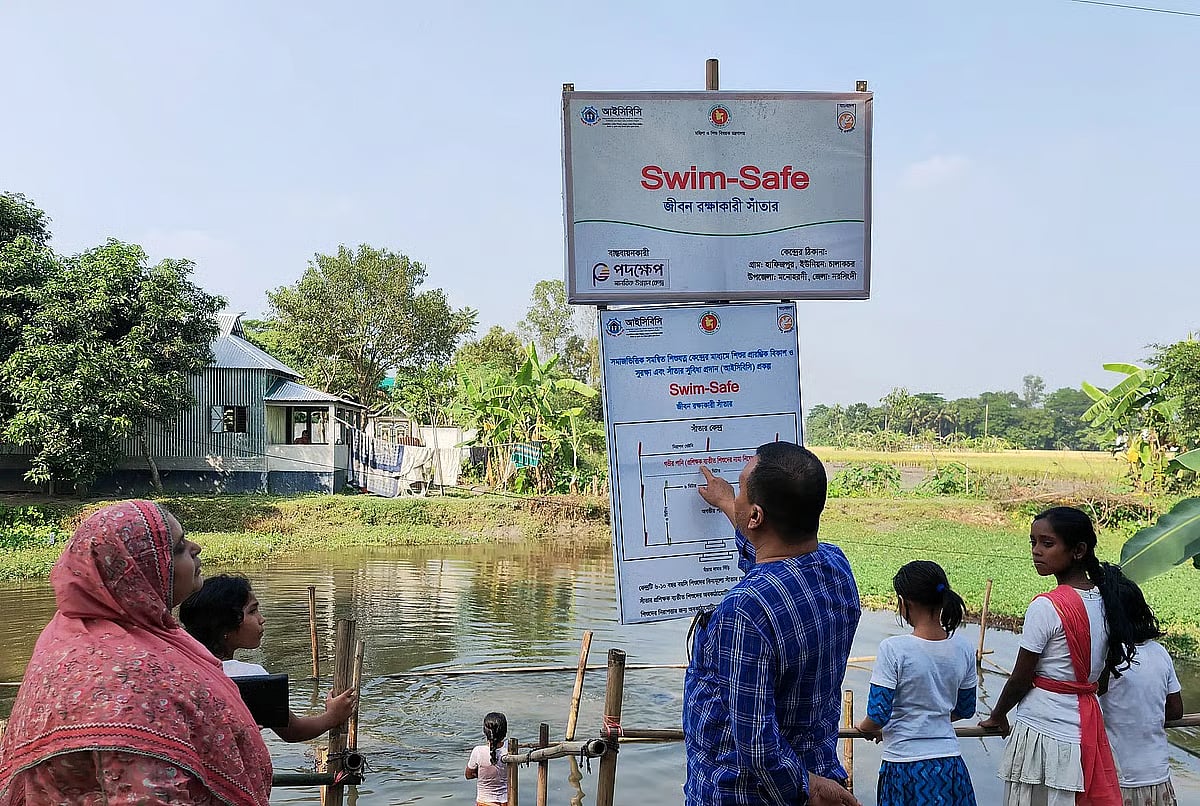
The project also included swimming lessons for children aged six to ten. According to the evaluation report, 800 Swim-Safe centers were established to teach swimming to 360,000 children.
Pathways to school
The ICBC centers also created pathways to formal education. A total of 48,049 children enrolled in pre-primary school after turning five. Among them, 51 percent were girls and 49 percent boys.
Another project report found that 70 per cent of children graduating from the centers enrolled in government primary schools, 15 per cent in madrasas, 10 per cent in kindergartens, while 5 per cent either pursued other options or did not enroll anywhere.
However, the evaluation also identified several weaknesses.
Among 402 observed childcare centers, although 96 percent remained operational, only 13 percent had the minimum required space of 250 square feet. First-aid boxes were available in only 14 per cent of the centers.
Inequalities were also found among the swimming centers. Of the 81 centers observed, 85 per cent had complete fencing around ponds, while 10 percent had no fencing at all. Nearly 47 percent lacked flotation equipment.
Questions over the evaluation
The project was implemented by the Bangladesh Shishu Academy in collaboration with several non-governmental organisations.
Speaking to Prothom Alo, Minister for Women and Children Affairs Abu Jafar Md. Zahid Hossain said he had heard about the project’s success but had not yet seen a fully rigorous evaluation of its impact.
“Still, I accepted their evaluation in good faith,” he said.
Disaster expert Gowher Naeem Wara believes the reported success in preventing child drowning requires deeper analysis.
He told Prothom Alo that drowning data from before the project should be compared with current outcomes in the areas where success is being claimed. He also argued that the benefits of such centers may remain temporary if activities continue only within a project framework.
Referring to the anganwadi system in the Indian state of Kerala, Wara suggested that mothers themselves could be given responsibility for running daycare centers on a rotational basis, with different mothers supervising children on different days.
“In reality, drowning prevention should not remain confined within projects; it has to become a social movement,” he said.
He also recommended involving local government institutions more actively in drowning prevention efforts. Every ward already has women councillors, he noted, and they could be assigned responsibilities related to child safety. Preventing drowning deaths, he argued, should become part of the formal responsibilities of local government bodies.
Preparing for the second phase
The project’s first phase demonstrated that preventing drowning does not necessarily require expensive technology. What matters more are locally rooted, low-cost, regular, and trusted systems.
Keeping children in safe centers during the most dangerous hours of the day, raising parental awareness, and teaching older children how to swim—combining these three approaches can significantly reduce child mortality.
The first phase of the project has now ended. Mohammad Rizwanul Haque Khan, senior program manager at Synergos Bangladesh, one of the project’s key implementing partners, said preparations are underway for a second phase. The US-based organization has long worked to prevent child deaths.
Speaking to Prothom Alo, Rizwanul Haque said the model had proven effective in saving children’s lives.
“If the program stops, children will once again face increased risks,” he warned.
However, Minister Abu Jafar Md. Zahid Hossain said the government had already decided to move forward with a second phase of the project considering its importance.
“We have not abandoned the project. But its monitoring and oversight need to be more effective, and we hope to ensure that,” he said.
Rizwanul Haque Khan added that plans for a “stronger and more enriched” second phase had already been developed. Areas identified for improvement during the first-phase evaluation, he said, are now being treated as stepping stones toward achieving greater excellence in the future.
He also acknowledged that different evaluations had identified several limitations in the earlier phase of the project. “Now, a 24-hour monitoring system has been planned,” he said.