Lions Model School, located in the Nayatola area of Moghbazar in the capital, provides education up to class-VIII.
The school serves approximately 150 students and employs six teachers. However, it does not have separate wash blocks for boys and girls. Everyone uses toilets located within the same wash block.
A visit to the school on Monday afternoon revealed that the institution operates on the ground, first, and second floors of a four-storey building. A wash block is located on the ground floor.
Although it was clean, it was not separated by gender. Acting Head Teacher Kazi Shah Alam told Prothom Alo, “Although we do not have separate wash blocks, we have verbally designated separate toilets for boys and girls.”
The school, established in 1959 and recognised by the education authorities, does not receive support under the Monthly Pay Order (MPO) scheme.
Teachers’ salaries and allowances depend largely on students’ tuition fees. The monthly fee is Tk 300 up to class-III and Tk 400 from class-IV to class-VIII.
However, the absence of separate wash blocks is not unique to this school. Recent inspections conducted by the Monitoring and Evaluation Wing of the Directorate of Secondary and Higher Education (DSHE) identified similar conditions in many educational institutions across the country.
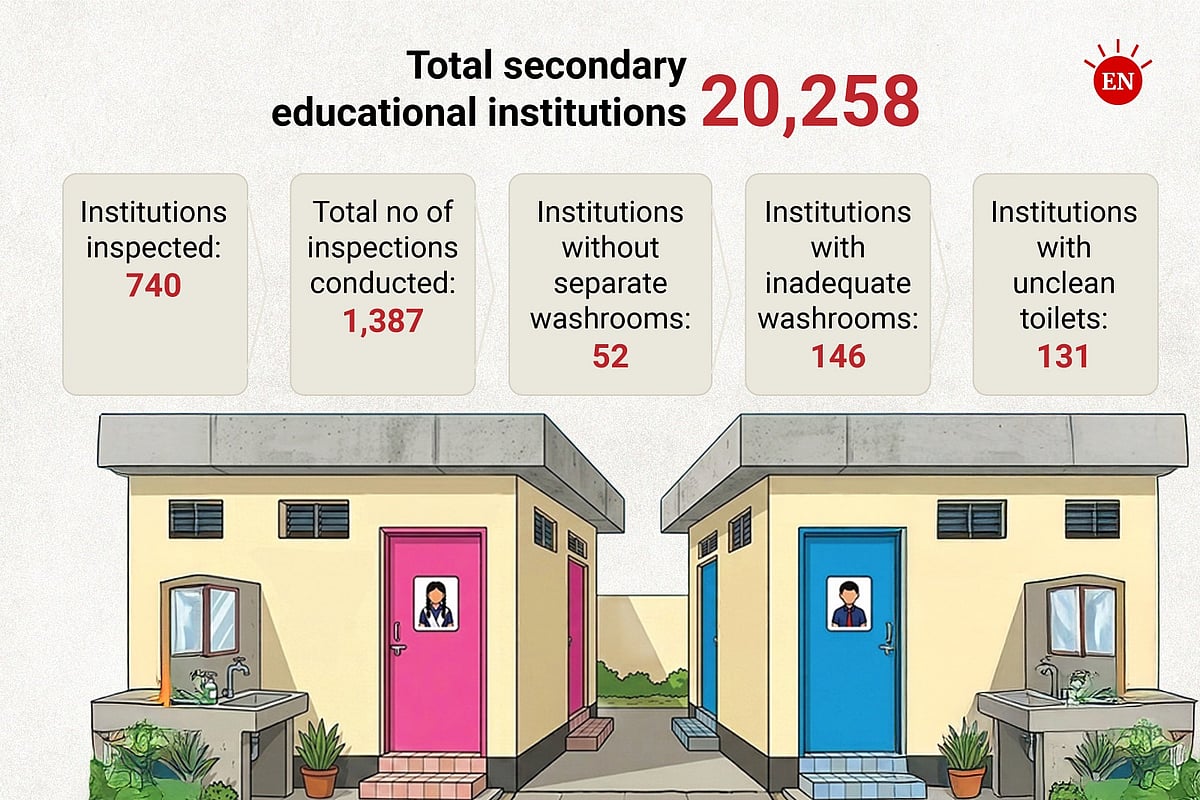
The Monitoring and Evaluation Wing inspected 740 educational institutions between 1 January and 31 March. Its report found that 52 institutions did not provide separate wash blocks for boys and girls.
Education specialists and health experts say that the absence of separate wash blocks in schools creates not only health risks but also adversely affects students’ privacy, comfort, and regular attendance.
A further 146 institutions had separate wash blocks, but the facilities were inadequate for the number of students. In another 131 institutions, wash blocks were sufficient in number but remained unclean.
The DSHE Monitoring and Evaluation Wing submitted a list of the 52 institutions without separate wash blocks to the Director General of DSHE.
Of these institutions, 13 are located in the Mymensingh region, 10 in Rajshahi, six in Barishal, five each in Chattogram and Khulna, four each in Dhaka and Rangpur, three in Cumilla, and two in Sylhet.
Female students face larger impact
Education specialists and health experts say that the absence of separate wash blocks in schools creates not only health risks but also adversely affects students’ privacy, comfort, and regular attendance.
Female students, in particular, experience significant discomfort. Notably, enrolment rates for girls exceed those for boys at both primary and secondary levels.
The situation reflected in the report is actually better than the reality on the ground. The real picture is considerably worse. Raising awareness among heads of institutions alone will not solve the problem. The government needs to allocate dedicated funding to ensure the maintenance and cleanliness of washrooms in every educational institution.An official of the Directorate of Secondary and Higher Education
A female education cadre officer shared a practical example to illustrate the importance of separate and hygienic wash blocks. She told Prothom Alo that her two children attended a well-known school in Dhaka.
Although they regularly received food and water from home, they often avoided consuming them because they feared they might need to use the school's unsanitary toilets.
DSHE oversees 20,258 secondary-level educational institutions. Field-level officials monitor these institutions every three months through the Digital Monitoring System (DMS).
During the first quarter of the year, from January to March, officials conducted a total of 1,387 monitoring visits to 740 institutions, including multiple visits to some institutions.
The report shows that inspectors found students’ hygiene practices satisfactory during 948 visits.
However, they observed no visible evidence of such practices during 116 visits. In addition, inspectors noted an absence of initiatives to maintain a healthy and safe environment during 169 visits.
According to the inspection report, most institutions provide an adequate water supply. However, inspectors found that water provision remained inadequate despite being available in 150 inspections.
They also identified insufficient water facilities in 62 institutions. Although most institutions have their own playgrounds, 138 use designated open-floor spaces instead of proper playing fields.
Furthermore, 18 institutions lack both their own playground and access to any nearby open space for recreational activities.
Professor Tipu Sultan, director of the Monitoring and Evaluation Wing of the DSHE, told Prothom Alo, “Our responsibility is to collect information from the field and report it to the appropriate authorities. We have informed the relevant authorities about the findings of the monitoring process, including the issue of separate wash blocks and other related matters.”
An official of the Directorate of Secondary and Higher Education told Prothom Alo, “The situation reflected in the report is actually better than the reality on the ground. The real picture is considerably worse. Raising awareness among heads of institutions alone will not solve the problem. The government needs to allocate dedicated funding to ensure the maintenance and cleanliness of washrooms in every educational institution.”
Commenting on the issue, Khan Moinuddin Al Mahmud Sohel, director general of DSHE, told Prothom Alo, “We will send the list of educational institutions that do not have separate toilet facilities to the Education Engineering Department so that it can take the necessary measures.”
“The current government places special emphasis on adolescent girls’ health and hygiene. Therefore, when we undertake new projects, we will give serious consideration to ensuring appropriate and safe sanitation facilities for girls,” he added.