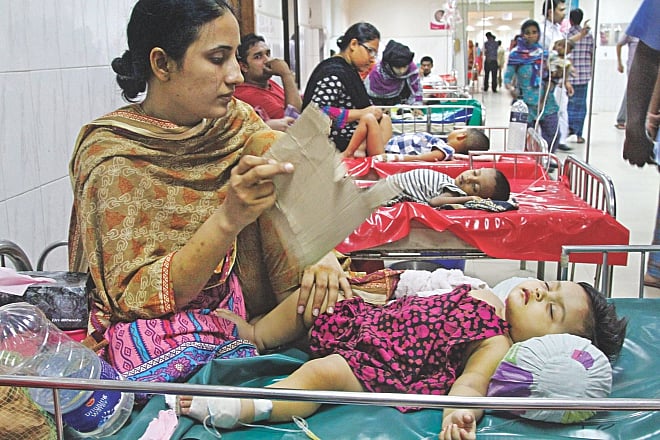
Approximately 4 to 5 out 100 children aged below five suffer from diarrhoea in Bangladesh— lowest among eight South and Southeast countries including India, Pakistan and Philippines, according to a study.
The study covered 24,679 children from Bangladesh, and as many as 1,178 cases of diarrhoea (4.85 per cent of children) were reported in the two weeks preceding the survey.
A total of 593,315 children under five from Bangladesh, India, Cambodia, Myanmar, Nepal, Philippines, Pakistan, and Timor-Leste were covered by the study.
Researchers from Flinders University, Australia, University of Western Australia and The Kids Research Institute Australia conducted the study titled ‘Impact of climate change on diarrhoea risk in low- and middle-income countries’, which was published online in the scientific journal Environmental Research, recently.
Pakistan reported the highest prevalence at 17.6 per cent, with 2,107 cases out of 12,094 children, followed by the Southeast Asia nation of Timor-Leste at 12.9 per cent, with 2,090 cases out 16,417 children.
Bangladesh’s neighbours India recorded diarrhoea prevalence at 8.02 per cent (37,834 cases out of 478,289 children) and Myanmar at 12.0 per cent (550 cases out of 4,687 children) while Nepal saw a 10.2 per cent diarrhoea rate as the Himalayan nation reports 1,537 cases out of 15,286 children.
Two South Asia countries, Philippines and Cambodia reported a diarrhoea rate of 6.08 per cent (1,130 cases out of 18,749 children) and 11.1 per cent (2,541 cases out of 23,114 children) respectively, according to the study.
Climate changes to worsen diarrhoeal risk in children
Diarrhoea remains one of the most serious health threats to young children in the Global South, and new research shows that climate change is set to worsen the risk substantially, said in a press release issued by Finder University received in Dhaka on Wednesday.
However, improved access to education and targeted health policies could help families protect their children from this deadly disease.
Led by Hira Fatima formerly of Flinders University, Australia researchers including Professor Corey Bradshaw from Flinders, and Melinda Judge and Professor Peter Le Souef from The Kids Research Institute Australia and the University of Western Australia, analysed observations of more than 3 million children in eight Asian countries, and highlighted temperature extremes and declining rainfall as the two main climate-associated drivers of higher risk of children getting diarrhoea.
This study shows that rising temperatures and unusually drier rainy seasons — both hallmarks of climate change — are expected to increase the risk of diarrhoeal diseases across South and Southeast Asia, posing serious health threats to millions of children.
Although preventable and treatable, diarrhoeal diseases currently claim hundreds of thousands of child lives every year, predominantly in low- and middle-income countries. Increasing the use of measures known to limit the spread of the causal infections can help counter the expected increases in mortality from climate change.
Led researcher Hira Fatima said the results make it clear that maternal education on good hygiene practices, the importance of breastfeeding, and recognising the symptoms of diarrhoea are the most effective ways to reduce diarrhoea in children in South and Southeast Asia.
“Children of mothers with less than eight years of schooling faced an 18 per cent higher risk of diarrhoea,” said Hira Fatima. “This makes investing in maternal education one of the most powerful and scalable climate-adaptation strategies — not only to improve child health, but also to address broader challenges like overcrowding and poor hygiene. Education empowers mothers to act early when their children fall ill, which can save lives.”
“Education is not only a United Nations Sustainable Development Goal, but also a powerful tool for climate adaptation that must be central to climate-health policies, particularly in densely populated, high-risk regions of the world.
Co-author, Professor Corey Bradshaw says the modelling shows that temperature swings of 30 to 40 °C increased diarrhoea risk by 39 per cent while drier rainy seasons raised the risk by 29 per cent.
“Our modelling emphasises that we need to develop and implement climate-related health policies that protect children under five years old from this increasing health risk,” said Professor Bradshaw.
“Around 88 per cent of diarrhoeal deaths are linked to unsafe drinking water and related causes. Improved access to drinking water can reduce the risk of diarrhoea by 52 per cent, while better sanitation facilities can lower the risk by 24 per cent. We know that poverty increases the risk of diarrhoea by limiting access to nutritious food, clean water, and healthcare, while also fostering environments where diarrhoeal pathogens thrive.
Referring to a recent research that shows that droughts in East Asia will intensify based on 150,000 years of monsoon records, Professor Bradshaw said, “This new study now warns that the intensified impacts of climate change will lead to increased child diarrhoea and all the associated health impacts in Asia.”
“To build resilience against the growing impacts of climate change, the researchers urge governments to prioritise expanding access to maternal education — particularly through child health programs — while also investing in safe water systems and addressing overcrowding through improved housing and infrastructure policy.”
Melinda Judge said that despite contributing the least to climate change, low- and middle-income countries will continue to experience a higher burden of childhood diarrhoeal disease because of it. Specific child health impacts due to climate change must be acknowledged and addressed.
Professor Peter Le Souef said that as climate change accelerates, child health outcomes will worsen if measures are not put into place to counter the predicted increase in diarrhoea cases.