ECNEC approves 13 projects involving Tk 162 billion
The Executive Committee of the National Economic Council (ECNEC) today approved 13 projects involving total cost of Tk 162 billion, including a project to construct a 442-MW peak solar power plant at Rampal in Bagerhat.
Of the total project cost, Tk 106 billion will come from government funds, Tk 40.8 billion from project loans and Tk 15.2 billion from concerned agencies’ own funds.
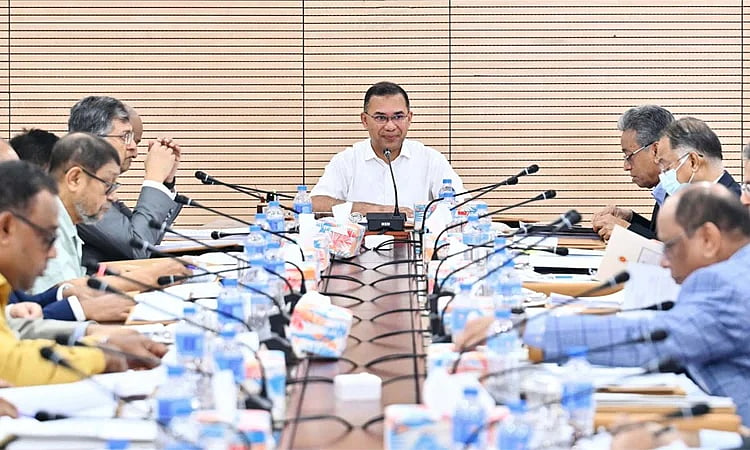
The approval came at the 5th meeting of the ECNEC held at Bangladesh Secretariat with Prime Minister and ECNEC Chairman Tarique Rahman in the chair.
Of the approved 13 projects, 10 are new, two are revised and one involves extension of its implementation period.
State Minister for Planning Zonayed Abdur Rahim Saki briefed reporters after the meeting at the NEC Conference Room in the city’s Sher-e-Bangla Nagar area.
Under the Tk 24.9 billion Rampal project, a 442-megawatt peak (MWp) solar power plant will be constructed at Rampal in Bagerhat, aimed at increasing renewable energy generation, diversifying the country’s primary fuel sources and reducing carbon emissions.
The Rampal 442 MWp Solar Power Plant Construction Project was proposed by the Power Division and will be implemented by the Bangladesh Power Development Board (BPDB). The project will be financed by BPDB from its own with Tk 3.74 billion and from Power Sector Development Fund Tk 21.23 billion.
The Power Sector Development Fund loan would carry a 2 per cent interest rate, with a one-year grace period and a 16-year repayment period.
The Planning Commission recommended that the project be implemented from September 2026 to March 2029.
In its assessment, the Planning Commission said the project would increase renewable-energy-based electricity generation and contribute to the government’s target of raising renewable energy’s share of the total energy mix to 20 per cent by 2030.
Once the project is implemented, it would add 442 MW of electricity to the national grid. Currently the solar power generation in the country is 797 MW out of the total ongrid power generation capacity of 28,827 MW.
“The project will increase electricity generation based on renewable energy, which will help achieve the target of generating 20 per cent of electricity from renewable sources by 2030,” said the Planning Commission official.
The Planning Commission said the project would strengthen energy security by diversifying primary fuel sources and reduce carbon emissions.
The proposed plant will be built on 918.50 acres of land in Block-B of Rampal that BPDB had already acquired. The Planning Commission said the use of BPDB-owned land would eliminate the need for fresh land acquisition and reduce project costs.
Electricity generated by the solar plant will be transmitted through the existing transmission infrastructure associated with the nearby Rampal coal-fired power plant. The project summary said this would allow the plant to be implemented relatively quickly and at lower cost.
BPDB acquired a total of 1,834 acres in Rampal in 2012 for development of a coal-fired power plant. The land was divided into Block-A, covering 915.50 acres, and Block-B covering 918.50 acres.
Bangladesh-India Friendship Power Company (Pvt) Ltd’s Maitree Super Thermal Power Plant was built in Block-A, while Block-B remains under BPDB.
Land development and boundary-wall construction have already been completed in Block-B, according to the project document.
The proposed solar plant will use solar photovoltaic modules with a minimum capacity of 640 watts peak. The project will also install grid-tied inverters with a cumulative capacity of 360 MW, a pooling substation, a three-kilometre double-circuit 230-kV transmission line and three 230-kV bays, including one spare bay.
The largest component of the project cost, Tk 12.38 billion, or around 50 per cent, will go to solar photovoltaic modules and mounting structures.
Electrical equipment, including inverters, transformers and SCADA systems will cost Tk 7.32 billion.
The project summary said a feasibility study was conducted by the Infrastructure Investment Facilitation Company (IIFC) and found the project acceptable.
The project was included in the Annual Development Programme (ADP) for fiscal 2026-27 as an unapproved “green page” project.
The project is also aligned with the Five Year Strategic Framework for Reform and Development and the Sustainable Development Goal 7, which seeks to ensure access to affordable, reliable, sustainable and modern energy for all.
The day’s meeting also approved seven projects under the Ministry of Local Government, Rural Development and Cooperatives.
The projects are - improving road infrastructure and drainage in 18 wards under five newly incorporated regions of Dhaka South City Corporation; upgrading important infrastructure in Rangpur City Corporation; rehabilitating damaged roads in Rangpur City Corporation, and constructing roads, drains and footpaths in zones one to eight of Gazipur City Corporation.
The other projects under the ministry include a project for women’s skills development and entrepreneurship creation through cooperatives; rural infrastructure development in Sirajganj, Bogura and Naogaon districts; and the Important Urban Infrastructure Development Project (2nd phase), which was approved in its second revised form.
The ECNEC also approved the third revised project for procuring 35 commercial and eight auxiliary vessels for Bangladesh Inland Water Transport Corporation (BIWTC) and constructing two new slipways under the Ministry of Shipping.
Under the Ministry of Railways, the committee approved the Railway Capacity Expansion Project for procuring 30 metre-gauge diesel-electric locomotives for Bangladesh Railway.
It also approved a project under the Ministry of Foreign Affairs to renovate and modernise the purchased chancery building in Paris, France, to make it suitable for use.
Two projects under the Ministry of Road Transport and Bridges also received approval. One involves constructing the Second Karatoya Bridge at the 15th kilometre of the Bhajanpur (Nijbari)-Atorkhari-Mainaguri-Amtali-Mirgachh-Panchagarh (Z-5060) road.
The other is the second revised Thanchi-Rimakri-Madak-Likri Road Construction Project.
Meanwhile, the ECNEC meeting was informed about a project costing less than Tk 500 million that had already received approval from the Planning Minister.
The project involves re-excavating the Nandahar and Harabati rivers and Nunogola and Kharowa canals in Joypurhat district.
Ministers and State Ministers concerned attended the meeting while Planning Commission members and secretaries concerned were present.