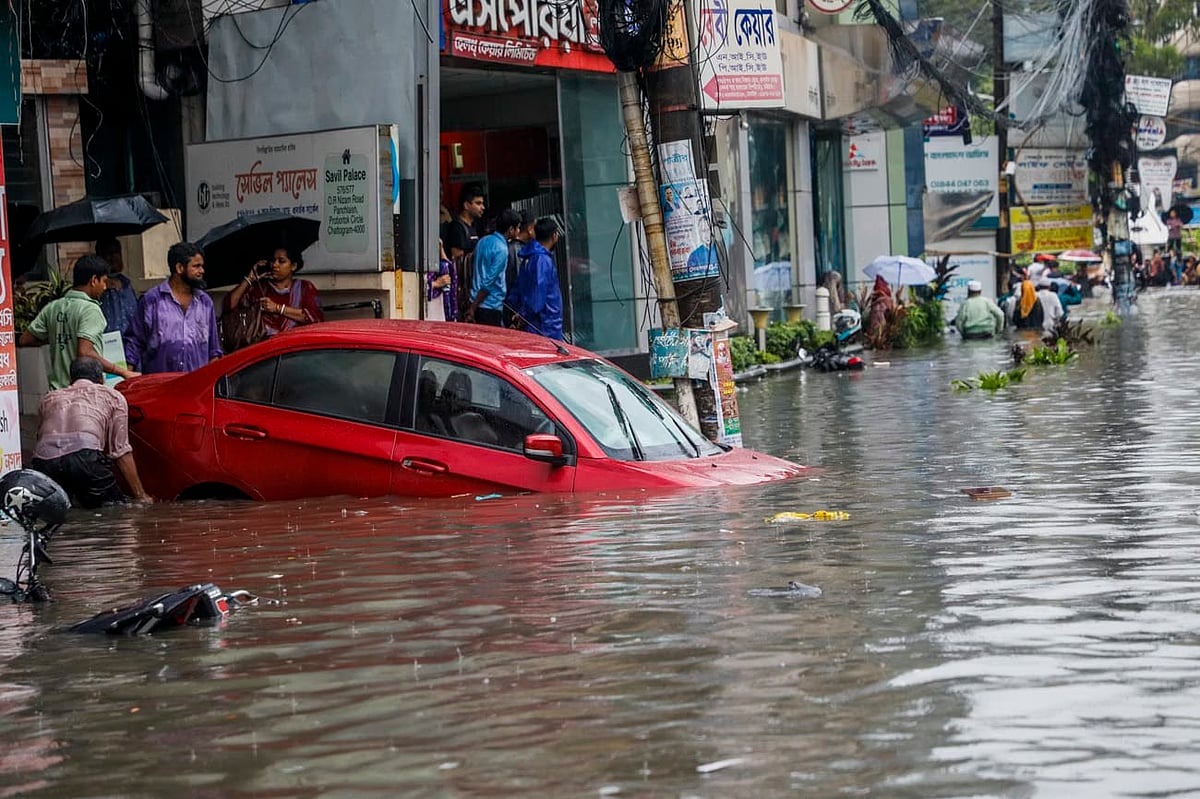
Chattogram still under water despite Tk 140b projects
Major projects to tackle waterlogging in Chattogram city have been underway for nearly a decade. Under four projects by three government agencies—covering canal dredging, expansion, regulator construction, roads, and embankments—more than Tk 140 billion has been allocated. Of this, Tk 100 billion has already been spent. The goal was to free the city from recurring monsoon flooding. In reality, however, key areas of the city have again gone under water with the season’s first heavy rainfall.
Following several hours of rain after noon last Tuesday, at least 20 areas—including Probortok, Chawkbazar, Agrabad, Katalganj, Muradpur, GEC, Bahaddarhat, Halishahar, New Market, and Tin Puler Matha—were submerged. Water levels ranged from knee-deep to waist-deep, and in some places even chest-deep. In many areas, it took six to eight hours for water to recede. On Wednesday, similar suffering was seen in areas such as Probortok, Katalganj, and Panchlaish.
Questions have arisen as to why Chattogram city keeps going under water despite such large expenditures, years of work, numerous meetings, and countless decisions?
Experts say the problem begins with flawed project planning. Addressing a complex issue like waterlogging requires comprehensive field surveys, analysis of water flow, consideration of tidal patterns, and an integrated assessment of canals, drains, and water bodies—none of which were adequately carried out. Not all city canals were included in the projects. Many key recommendations from the 1995 drainage master plan were also left out. As a result, despite progress in the projects, the overall drainage system of the city has not improved as expected.
These projects were initiated during the tenure of the Awami League government. From the outset, experts raised concerns about planning and implementation, warning about inadequate field surveys, limited canal inclusion, and lack of coordination. However, these warnings were not given due importance at the policymaking level, leading to continued suffering for city residents.
Over the past decade of Awami League reign, at least 50 large meetings have been held involving ministries and service agencies, resulting in more than 200 decisions. But most of these decisions remained on paper. The previous interim government also prioritised the issue, holding multiple meetings and conducting site visits. Still, visible improvements on the ground have been limited. Within months of the new government taking office, the issue has already been raised in the national parliament.
On Wednesday, Chattogram-10 MP Saeed Al Noman raised the issue on a point of order, saying waterlogging is now the city’s biggest problem and people are effectively floating in water. In response, Prime Minister Tarique Rahman expressed regret over the suffering of residents and said the government is working to resolve the issue as quickly as possible.
Large projects, incomplete drainage
Currently, four major projects are being implemented by three government agencies to address waterlogging. Two are under the Chattogram Development Authority (CDA), one by the Chattogram City Corporation, and one by the Bangladesh Water Development Board. The total cost stands at Tk 142.57 billion, of which Tk 104.08 billion had been spent as of last March. However, none of the projects has been fully completed.
The largest of these is the CDA project titled “Re-excavation, expansion, renovation and development of canals to resolve waterlogging in Chattogram city,” approved in 2017 and implemented by the Bangladesh Army’s 34 Engineer Construction Brigade. On paper, the project is about 90 per cent complete. Yet residents question why key parts of the city continue to be submerged in chest-deep water.
According to CDA data, 36 canals are included in these projects, of which work on 30 has been completed. Most of the remaining canals are near completion, although work continues on the Hijra and Jamalkhan canals. Temporary embankments were built in these canals during construction, which CDA officials admit obstructed water flow during the season’s first heavy rainfall.
CDA Chairman Md Nurul Karim said some benefits of the projects are already visible, noting that waterlogging affected fewer areas last year compared to previous years. However, he acknowledged that not all canals could be included due to financial constraints. Only 36 canals were taken up in the first phase; the rest will need to be incorporated gradually. He added that without the Army’s support, progress in many areas would have been difficult. Even after project completion, 20 to 25 per cent of the city may still face waterlogging unless canals outside the projects are also dredged and expanded.
38 canals outside the projects
Despite the large-scale initiatives, not all canals in the city are covered. CDA says there are 74 canals in Chattogram, of which 61 have been included in various plans over time. However, only 36 canals are part of the current major projects, leaving 38 outside. Experts warn that neglecting these canals will prevent residents from fully benefiting from the projects.
A visit on Thursday to Forest Canal, Noyakhal, Krishnakhali Canal, and Kuaish Canal in the Kalurghat area revealed poor conditions. Many canals that once carried tidal water and quickly drained rainwater have now shrunk into narrow channels. Some are filled with silt; others are clogged with plastic, polythene, bottles, and household waste. Water flow has slowed to the point of stagnation in places.
The water appears dark and foul-smelling. Industrial waste has further polluted it, making it thicker and more contaminated. Rotting debris floats on the surface, while algae blocks water flow in some areas. Encroachment is also evident, with structures built along canal banks and waste pipes from factories discharging directly into them. As canals shrink, water pathways narrow, causing overflow into roads and residential areas during rainfall.
Standing beside Krishnakhali Canal in the Mohra area, local resident Mohammad Sarwar said, “We used to catch fish here. Tidal water would flow in and out, and the canal was much wider. Now it is almost dead, with waste being dumped from surrounding buildings.”
Beyond CDA-listed canals, the Department of Agricultural Extension has also identified several others in urgent need of dredging, including Kazir Bill Canal in Panchlaish and Muslimabad and Charpara canals in Patenga.
Canals are the backbone of the city’s drainage system, carrying rainwater from roads, residential areas, commercial zones, and low-lying lands to rivers or large water bodies. When canals are filled, encroached upon, or clogged with waste, drainage pathways are blocked, causing waterlogging even after light rainfall.
Design flaws and maintenance gaps
Experts say a major limitation of the CDA project is its lack of comprehensiveness. Not all canals were considered together. Many recommendations from the 1995 “Chittagong Storm Water Drainage and Flood Control Master Plan” have been overlooked.
That master plan proposed excavating three new main canals and 15 branch canals, rehabilitating existing canals, removing encroachments, installing 36 tidal regulators at canal mouths connected to the Karnaphuli River and the Bay of Bengal, building 19 silt traps to prevent hill sediment, and preserving eight retention ponds to store excess water. However, the current projects have largely excluded retention ponds, reducing the city’s capacity to hold excess water.
Before project implementation, water used to stagnate for up to 8–9 hours in 113 locations. Later, both the number of waterlogged areas and duration of flooding decreased somewhat. Last year, waterlogging occurred in 29 locations, mostly receding within 2–4 hours. This year’s target was to reduce the number to 10 locations. However, due to embankments in the Hijra and Jamalkhan canals, at least 20 areas were submerged during the first heavy rainfall. Officials believe removing these embankments could improve drainage.
Professor Muhammad Rashidul Hasan of the Urban and Regional Planning Department at Chittagong University of Engineering and Technology said waterlogging cannot be solved through isolated projects; it requires integrated urban management. Without effective coordination in planning, implementation, and maintenance, projects will fail in the long term.
Alongside infrastructure development, regular maintenance, proper waste management, and coordination among agencies are essential.
Controversy over minister’s remarks
Images and videos of waterlogging spread widely on social media last Tuesday. The next day, State Minister for Local Government, Rural Development and Cooperatives Mir Shahe Alam sparked controversy during a visit, saying, “Chattogram city is not floating on water. It is the same as it is in the dry season.”
He added that although some water accumulated due to sudden heavy rainfall, it drained in time, and the water he personally walked through extended no more than 30 feet.
His remarks drew strong criticism online. Residents said the minister visited in the evening after areas had been submerged for two days and that his comments did not reflect reality. One Facebook user wrote, “Chattogram is not floating on water; water is floating on Chattogram.”
19-member committee formed
To address the issue, the government on Thursday formed a 19-member coordination committee. According to an order from the Local Government Division, the mayor of Chattogram City Corporation will serve as convener and the chief executive officer as member secretary.
The committee’s main responsibilities include keeping canals and drainage systems operational, monitoring project progress, and ensuring coordination among relevant agencies. Representatives from the Army’s 34 Engineer Brigade, CDA, City Corporation, Water Development Board, WASA, Port Authority, and other stakeholders have been included.