A young woman, 22 was sitting quietly on a chair in the room, the signs of worry clearly visible on her face. A little girl wandered around her. It was around 11:15 am and the room was buzzing with activity.
This reporter met the young woman on 23 September at the Legal Aid office of the Satkhira District Court. She said she had come from Assasuni upazila to file an application regarding 'meher' and alimony.
She was married eight years ago, when she was in class eight. The five year old girl with her is her only child. Four days ago, her husband sent her a notice of divorce.
Her husband works at a brick kiln for six months of the year and remains unemployed for the remaining six months. The young woman said, “It is his habit to abuse me. Since marriage, he has never provided for our daughter’s expenses or mine.”
The reason she had to visit the Satkhira district court’s legal aid office is the new provision introduced by the interim government making mediation mandatory before filing cases under seven different laws. This provision was made through the enactment of the Legal Aid (amendment) ordinance, 2025.
One of the laws in which a specific section is subject to mediation is Section 5 of the Family Courts Act, 2023. So far, the amended ordinance has been enforced in 12 districts: Faridpur, Mymensingh, Rangpur, Dinajpur, Satkhira, Kushtia, Cumilla, Noakhali, Rangamati, Sylhet, Moulvibazar and Sunamganj.
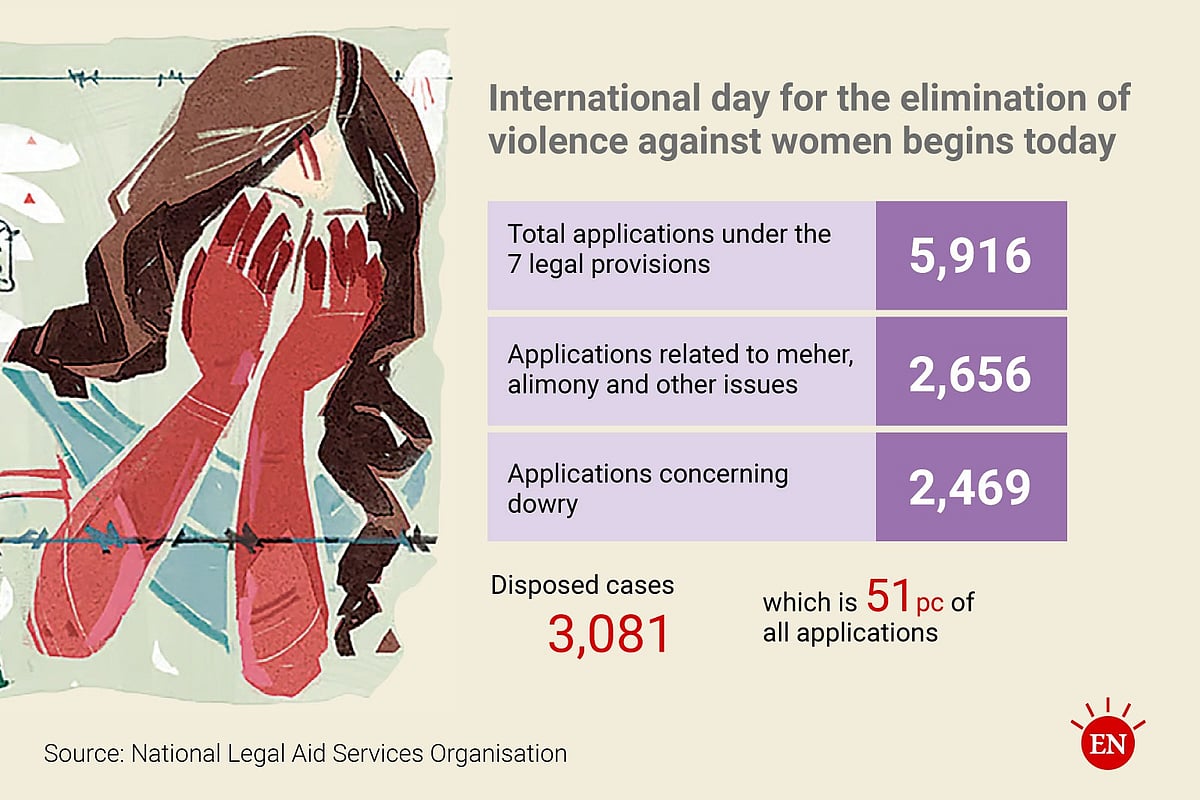
The International day for the elimination of violence against women begins today, Tuesday, 25 November. The period will be observed with various programmes until 10 December.
According to the National legal Aid services organisation, between 18 September and 18 November, two months after the amended ordinance came into effect, the Legal Aid offices in these 12 districts have seen a surge in complaints from women.
A total of 5,916 applications were submitted under various sections of the seven laws, of which 5,125, around 87 per cent, were related to family disputes and dowry issues. A total of 3,041 complaints, or 51 per cent, have been settled.
Against this backdrop, the international day for the elimination of violence against women begins today, Tuesday, 25 November. The period will be observed with various programmes until 10 December.
Breakdown of complaints by law
Of the seven laws under which the Legal Aid office is receiving complaints, two specifically involve women as victims. One of these is Section 5 of the Family courts act, 2023.
Under the heading “Jurisdiction of the Family Court”, this section states that, subject to the provisions of Muslim family law, the family court shall have jurisdiction to accept, hear and dispose of cases concerning five matters: divorce, restitution of conjugal rights, meher, alimony and the guardianship and custody of children.
The interim government amended the Legal Aid Act and issued an ordinance on 1 July making mediation compulsory under specific sections of nine laws. Under the “Legal Aid (Amendment) Ordinance, 2025”, victims must apply for settlement through mediation at the Legal Aid Office before filing a case under the specified sections.
Under the amended ordinance, applications for mediation at the Legal Aid office must be filed before bringing cases related to these matters before the Family court. A total of 2,656 applications have been submitted under section 5 of this Act.
Under Sections 3 (punishment for demanding dowry) and 4 (giving or receiving dowry, etc.) of the Dowry Prohibition Act, 2018, a total of 2,469 applications have been filed.
Under other laws, the following applications have been submitted: 13 under the provision concerning disputes mentioned in the House Rent Control Act, 1991; 13 under the provision on partition-related disputes within the jurisdiction of the Assistant Judge Court; 133 under Section 96 (pre-emption rights) of the State Acquisition and Tenancy Act, 1950; 17 under Section 24 (pre-emption-related disputes) of the Non-Agricultural Tenancy Act, 1949;14 under Section 8 (mediation/settlement) of the Parents Maintenance Act, 2013.
When asked about the rate of successful settlements, Satkhira District Legal Aid officer (Judge) Liton Das told Prothom Alo that settlements were achieved in 50 per cent of cases. For cases where mediation fails, a “mediation failure certificate” is issued, enabling the aggrieved party to file a case in court.
Some women benefited, some disappointed
A 19-year-old woman from Tala upazila in Satkhira submitted a mediation application on 21 September, lodging complaints against her husband and father-in-law under Sections 3 and 4 of the Dowry Prohibition Act.
Speaking to Prothom Alo over the phone on 22 November, the woman’s elder sister said that her sister’s husband and father-in-law would demand dowry sometimes 10,000 taka, sometimes 20,000 taka. After filing the complaint with Legal Aid, a date for mediation and settlement was set for 6 October.
The husband did not appear at the first meeting. He attended the second meeting, held 15 days later. A settlement was eventually reached and her sister was taken back into the household. The husband assured the Legal Aid officials that he would no longer cause any “trouble”.
A woman from Satkhira Sadar told Prothom Alo over the phone on 22 November that she submitted an application on 21 September claiming that her husband had failed to provide alimony. She has two children. Her husband remarried four years ago without her knowledge and lives in Munshiganj, where he runs a shop.
She added that her husband attended the scheduled mediation meeting on 12 October and pledged before the Legal Aid officials that he would provide her alimony. However, after taking 13,000 taka from her family, he left and has not contacted them since.
If half the cases remain unresolved, the initiative of pre-litigation mediation through Legal Aid cannot be considered very effective. Similar inefficiencies already existed in family courts and in civil and criminal courts. He also noted that the pressure on Legal Aid from these cases will continue to grow over time and that the organisation lacks the capacity and preparation to handle the increasing workload.Fauzul Azim, Legal analyst and former District Judge
The woman, who is in her forties, broke down in tears while speaking. “I struggle so much to raise my son,” she said. “I work in other people’s homes. My body aches from the hard labour.”
When asked about the rate of successful settlements, Satkhira District Legal Aid officer (Judge) Liton Das told Prothom Alo that settlements were achieved in 50 per cent of cases. For cases where mediation fails, a “mediation failure certificate” is issued, enabling the aggrieved party to file a case in court. He noted that most settlements take place in matters related to family disputes and dowry allegations.
Strong reaction against mandatory mediation
The interim government amended the Legal Aid Act and issued an ordinance on 1 July making mediation compulsory under specific sections of nine laws. Under the “Legal Aid (Amendment) Ordinance, 2025”, victims must apply for settlement through mediation at the Legal Aid Office before filing a case under the specified sections.
If mediation fails, either party may then proceed to court. Mediation is to be conducted by the Chief Legal Aid Officer, a Legal Aid Officer or as applicable, a Special Mediator.
Women do want mediation but do not have a trusted space for it. Therefore, he believes this pre-litigation mediation process is essential. He added that strengthening this system would require increasing the manpower at Legal Aid offices.Liton Das, Satkhira District Legal Aid officer (Judge)
The government published a gazette on 15 September and related rules were first issued on 17 September. According to these rules, mediation must be concluded within 21 working days.
However, complaints under Section 138 of the Negotiable Instruments Act, 1881 (regarding cheque dishonour involving amounts not exceeding 5 lakh taka) were excluded from mandatory mediation in response to concerns from Legal Aid officials that it would create an excessive burden of cases.
Originally, the amended ordinance also applied to Section 11(g) of the Prevention of Repression of Women and Children Act (ordinary injury caused due to dowry).
Women’s rights and human rights activists strongly opposed this, arguing that forcing a woman to negotiate a settlement with the accused before filing a case in such criminal matters was unacceptable. As a result, this section, along with one other, was excluded and mediation is now mandatory under seven laws in 12 districts.
No success if not prepared
Preventing violence against women is essential for achieving the Sustainable Development Goals (SDG) declared by the United Nations. SDGs 5 and 16 emphasise ending violence against women and establishing accountable institutions to ensure justice.
SDG 5 calls for ending all forms of violence against women, eliminating harmful practices and ensuring full participation of women in economic and public life. SDG 16 focuses on building peaceful and inclusive societies, ensuring access to justice for all and establishing effective and accountable institutions.
Legal analyst and former District Judge Fauzul Azim told Prothom Alo that if half the cases remain unresolved, the initiative of pre-litigation mediation through Legal Aid cannot be considered very effective. Similar inefficiencies already existed in family courts and in civil and criminal courts.
He also noted that the pressure on Legal Aid from these cases will continue to grow over time and that the organisation lacks the capacity and preparation to handle the increasing workload. He emphasised the need for training and preparing skilled mediators.
However, according to Satkhira District Legal Aid officer (Judge) Liton Das, women do want mediation but do not have a trusted space for it. Therefore, he believes this pre-litigation mediation process is essential. He added that strengthening this system would require increasing the manpower at Legal Aid offices.