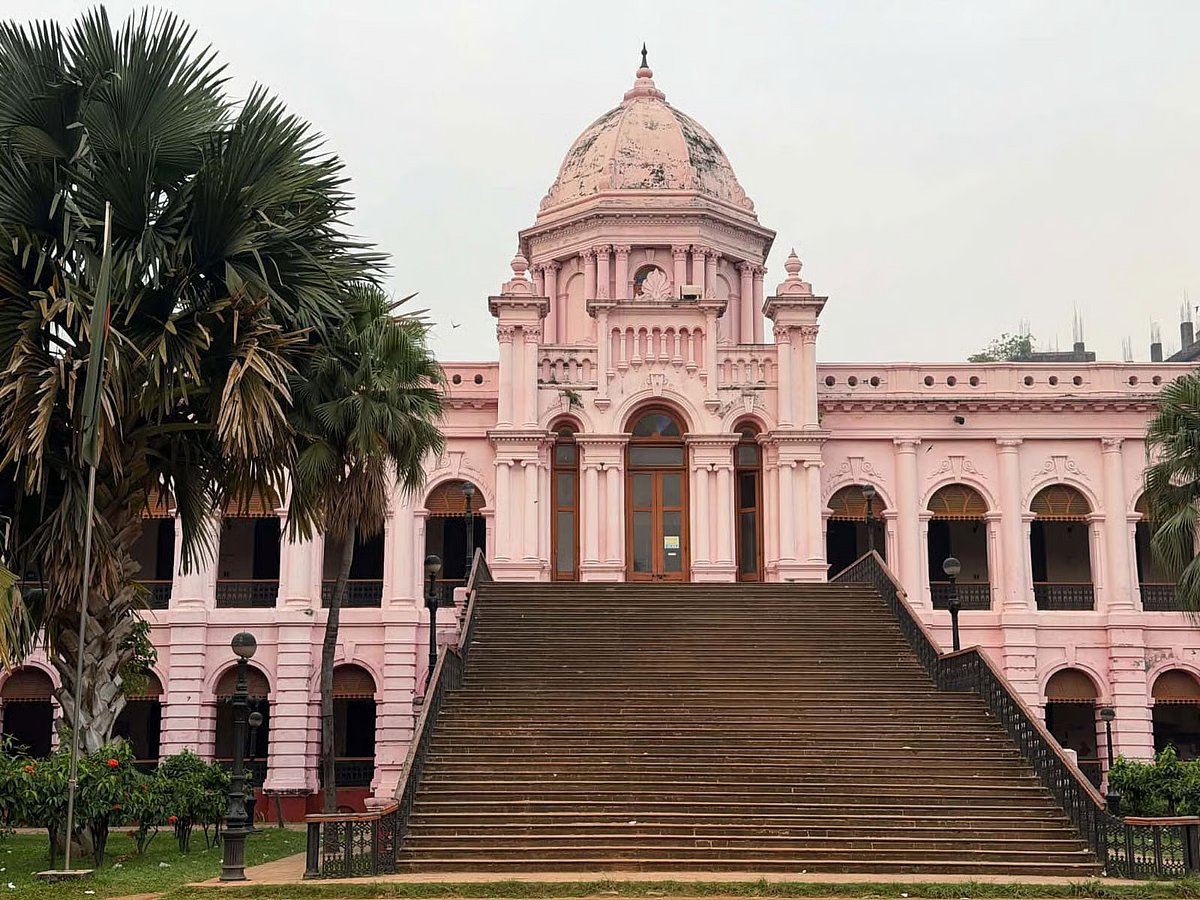
5 safes at Ahsan Manzil, 2 opened, 3 remain a mystery
Ahsan Manzil, the former residence of the Nawab family of Dhaka, now serves as a museum. Five iron safes from the Nawab household stand in gallery no. 9.
The family once used the safes as a central vault or private treasury.
Three of the five safes have never been opened, leaving visitors curious about what they might contain. Various stories about the safes also circulate in Old Dhaka.
Ahsan Manzil operates as a branch of the Bangladesh National Museum. Dibakar Sikder, assistant keeper of the Ahsan Manzil Museum, told Prothom Alo that the locked vaults arouse considerable curiosity among visitors, but no one has ever opened them.
“I sometimes wonder what is actually inside the vaults, too. But there is no scope to find out,” he said.
Ahsan Manzil
Ahsan Manzil stands on the banks of the Buriganga River in Dhaka.
According to Banglapedia, Khwaja Alimullah, founder of the Nawab family of Dhaka, bought a garden house on the banks of the Buriganga from the French in 1830. He renovated the property and turned it into a residence. His son, Abdul Ghani, later built a new structure there in a modern architectural style and named it Ahsan Manzil after his own son, Khwaja Ahsanullah.
Construction of Ahsan Manzil began in 1859 and ended in 1872. In 1952, the government acquired the Dhaka Nawab Estate under legislation abolishing the zamindari system. Nawab Khwaja Habibullah then left the palace and moved to Paribagh.
In 1985, the government took over Ahsan Manzil and undertook renovation work. The Bangladesh National Museum assumed control of the property in 1992.
When were the chests made?
The exact date when the five chests arrived at Ahsan Manzil remains unknown. However, museum officials believe that the Nawab family of Dhaka enjoyed considerable wealth in the mid-19th century. They believe the family imported the safes from London during that period to store money and valuable jewellery.
According to the inscriptions on the chests and the museum’s registration records, a British company named “Chabs” manufactured them. The safes reached Ahsan Manzil through the company’s Calcutta agent, “The Thomson & Co”.
Founded in 1835, Chabs became well known for manufacturing security equipment, including safes.
How large are the chests?
Despite being more than a century old, the chests show no signs of rust. The museum authorities say their locking mechanisms are extremely complex.
The largest chest stands 254 centimetres tall and measures 148 centimetres in width. It contains 94 lockers.
Three of the remaining four chests share the same dimensions: 180 centimetres in height and 65 centimetres in width. The last chest is slightly larger, measuring 180 centimetres tall and 99 centimetres wide.
A visit to the museum reveals that the largest chest is about the size of a wardrobe. The others are smaller, roughly comparable in size to shoe racks.
How the chests were discovered?
In 1987, the Ministry of Land formed a committee to catalogue the items at Ahsan Manzil. Its members included a branch chief of the Land Administration Board, an assistant commissioner from Dhaka Division, the chief manager of the Dhaka Nawab Court of Wards and expert officials from the Bangladesh National Museum.
In May 1987, the committee prepared an inventory of items found in locked rooms known as the Toshakhana and the Crockery Room at Ahsan Manzil.
Museum records state that the committee discovered a locked room with an iron entrance door. The windows had also been walled up with bricks, although an opening fitted with iron bars remained.
On 18 May 1987, the team cut through the iron bars and entered the room, where they discovered the safes.
Rumours of diamonds and jewels spark newspaper speculation
Although officials discovered the chests, they could not find the keys. A government-appointed committee therefore arranged to cut open one of them. Using a gas cutter, they opened the safe and found 94 lockers or drawers inside.
According to museum records, the committee first used a gas cutter to open locker no. 94, only to find it empty. They stopped work for the day and sealed both the room and the safe. They assigned security duties to members of the Ansar, security guards and armed police.
However, officials feared that using a gas cutter to open more lockers could damage the chest. To preserve it as a historical artefact, they discussed whether skilled craftsmen could open the drawers without using machinery.
Meanwhile, newspapers published various reports about the chest after officials opened the first locker. The Daily Ittefaq and the Daily Inqilab both published reports on the subject on 19 May 1987.
A report on the front page of Ittefaq stated, “Government officials have discovered a massive iron safe containing nearly 100 drawers after breaking into the Toshakhana at Ahsan Manzil, the Nawab family’s residence in Dhaka. The operation to enter the room began early in the morning, with workers breaking through the wall and iron bars.”
Inqilab published a report under the headline “In search of the priceless treasure”. It stated, “In the quest for a treasure beyond compare, efforts have finally begun to open the historic chest at the Nawab family’s residence in Dhaka. After several hours of continuous work by two gas-welding technicians, only one door of the safe was cut open yesterday. However, the inner cabinets in this section could not be opened, and nothing was recovered.”
The Inqilab report also stated that the safe had remained unopened for nearly 30 years, from 1957 to 1987, following the death of Nawab Habibullah.
Speculation spread that the chest might contain gold, diamonds or other valuable possessions. People also began travelling to Ahsan Manzil from distant places to see it for themselves.
Abdus Sattar Mia worked as a security guard at Ahsan Manzil in 1987 and continues to work there today. Speaking to Prothom Alo on 10 October, he recalled, “There was tight security on the day they cut open the chest. There were police everywhere. They did not allow us to enter the room. When the officials came out, they told us there was nothing inside.”
Abdus Sattar Mia added, “Whenever we went outside, people would say that a lot of gold and diamonds had been found there. They would ask us about it.”
Findings of the 11-member committee
As public discussion and curiosity about the contents of the chests continued to grow, the government formed a high-level, 11-member committee on 24 May 1987.
The government appointed the vice-chancellor of the Bangladesh University of Engineering and Technology (BUET) as the committee’s chair. Officials from the Land Administration Board, the Office of the Dhaka Divisional Commissioner, the Dhaka District Administration, Dhaka Metropolitan Police, the Bangladesh National Museum and BUET assisted the committee.
The committee worked to open the chest on 25 and 27 May and 1 and 2 June 1987. Craftsmen first tried to make keys but failed. They then drilled into locker no. 85, only to find it empty. The attempt damaged the front of the chest.
The committee subsequently decided to open the lockers from the back. Using chains and specialised tools, the team removed the rear iron plates and framework to inspect the interior. They found every locker empty.
The committee then suspended plans to open the other chests. It recommended repairing the damaged chest and restoring it to its original condition.
The chests were too heavy to remove from the room. The museum authorities therefore brought an experienced craftsman to the site to repair the damaged chest and restore it to its former condition.
On 28 November 1987, the Ministry of Land transferred the chests to the Bangladesh National Museum at nominal prices for preservation and display as historical artifacts. The largest chest was valued at Tk 27,000 and the medium-sized one at Tk 10,000. The authorities valued each of the remaining three chests at Tk 500.
According to museum records, officials opened another chest on 24 September 1991 in the presence of a magistrate by breaking its lock. They found nothing inside. The remaining three chests have never been opened.
Land acquisition and the decline of the Nawab family
Following the death of Nawab Salimullah, Khwaja Habibullah, as the eldest son, ascended the throne on 10 June 1915 in accordance with the Nawab family’s hereditary tradition. After Abdul Ghani, Ahsanullah and Salimullah, Habibullah became the fourth Nawab.
The family’s financial position had already begun to deteriorate, and it worsened further during Habibullah’s time. On 14 May 1952, the government acquired the Nawab Estate under legislation abolishing the zamindari system. However, the family residence, Ahsan Manzil, and the estate’s khas land (land retained under direct government or estate control, rather than leased out) remained outside the acquisition.
Lack of maintenance gradually reduced the once-grand palace to a dilapidated state. Illegal occupants and homeless people later began living there.
In 1974, the authorities decided to sell the palace at auction to prevent its destruction. The government of the time rejected the proposal and instead ordered officials to renovate Ahsan Manzil and turn it into a museum and tourist attraction. The renovation project began in 1986 and was completed in 1992.
Like the three unopened chests at Ahsan Manzil, a vault at Sonali Bank has also never been opened.
Government records state that in 1908, Nawab Salimullah borrowed 1.4 million rupees by pledging 109 precious stones, including a diamond known as the Daria-i-Noor. The stones are believed to be inside a vault at what is now Sonali Bank.
Despite several attempts to open the vault, no one has succeeded. No one knows whether the diamond is still inside.