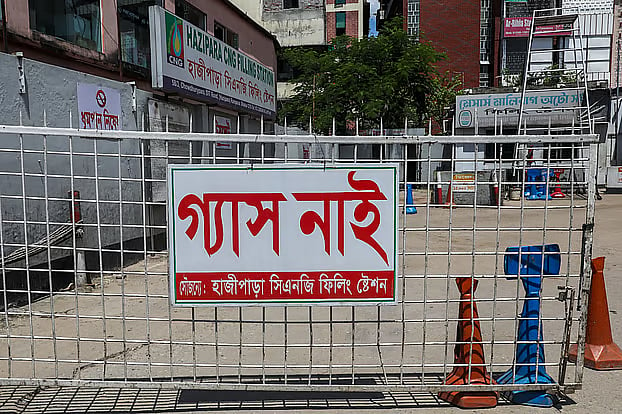
No relief soon, gas crisis to continue for few more days
The ongoing gas crisis is expected to continue for a few more days as gas supply is unlikely to increase this week. Meanwhile, power generation has declined, leading to increased load shedding. Production-oriented industrial factories are also facing difficulties. Not only this, many are unable to light their cooking stoves, while long queues are growing at CNG filling stations.
Sources from the Energy and Mineral Resources Division said that it may take about two weeks to fully restore the liquefied natural gas (LNG) terminal that remains shut. US-based company Excelerate Energy has requested time until 10 August.
However, the undamaged boiler of the terminal may be brought back into operation next week, which could increase gas supply by around 300 million cubic feet per day, officials said.
There are two floating terminals in Maheshkhali, Cox's Bazar, to supply regasified imported LNG. One is operated by Excelerate Energy and the other by the private company Summit. Gas supply from Excelerate Energy’s terminal was suspended after a fire broke out there last Tuesday, exacerbating the country’s gas shortage.
LNG accounts for 35 to 40 per cent of the total daily gas supply, with a maximum daily supply of 1,050 million cubic feet from this source.
As a result, the total daily gas supply is now below 2,150 million cubic feet. Previously, the situation was being managed by supplying 2,700 million cubic feet against a daily demand of 3,800 million cubic feet. With LNG supply dropping to less than half, all types of gas consumers are facing a severe crisis.
According to Petrobangla sources, following the fire at the Excelerate terminal, 560 million cubic feet of gas was obtained from LNG last Thursday. By Sunday, this figure dropped below 500 million cubic feet.
As a result, the total daily gas supply is now below 2,150 million cubic feet. Previously, the situation was being managed by supplying 2,700 million cubic feet against a daily demand of 3,800 million cubic feet. With LNG supply dropping to less than half, all types of gas consumers are facing a severe crisis.
Sources from the Bangladesh Oil, Gas and Mineral Corporation (Petrobangla) stated that an expert team from the UK and the UAE began working on the terminal last Thursday. As of yesterday, Sunday, the undamaged boiler could not be started. Many components, including electrical cables were burnt and are being imported.
It will take three to four days to complete the work after the imports arrive. Efforts are underway to start the undamaged boiler before that. However, the exact timeline for completing the technical work could not yet be confirmed.
State Minister for Power, Energy and Mineral Resources, Aninda Islam Amit told Prothom Alo that the technical team is working on the issue and the Energy Division is monitoring the situation regularly.
Hoping that gas supply may increase by next week, he said, for now, there is no other alternative.
The government, however, is working on alternatives to reduce future import dependency on energy, with an emphasis on domestic gas exploration and production, the state minister stated.
Industries, CNG stations struggle amid gas shortage
Industrialists fear that if this situation persists, they may face difficulties in paying workers’ wages and allowances. There is also a risk of failing to deliver export orders within scheduled deadlines, which could lead to cancellations by international buyers.
Meanwhile, long queues of vehicles have persisted at CNG stations in different parts of Dhaka for the past four days.
Rashidul Hasan, president of the Narsingdi Chamber of Commerce and Industry, told Prothom Alo that production in factories has dropped by 75 per cent.
Gas supply may increase by next week. For now, there is no other alternative. However, the government is working on alternatives to reduce future import dependency on energy, with an emphasis on domestic gas exploration and production.
Gazipur has about 3,500 small and large industrial factories, a significant portion of which rely on gas. About 2 million workers are employed in these establishments. Due to the lack of adequate gas pressure for a week, many factories have reduced production and in some places, workers are being kept idle.
Sohel Rana, director of Sadma Group in Gazipur, said that with three to four PSI (per square inch gas pressure) of gas supply, it is possible to maintain 60 to 70 per cent of production. However, currently the gas pressure is so low that workers and operators remain idle most of the time. Production has decreased by up to 60 per cent.
Residential customers and vehicle drivers in Brahmanbaria and surrounding areas are suffering due to the gas crisis and low pressure at both residential connections and CNG filling stations. While CNG stations require gas pressure of 12 to 15 PSI for normal operations, they are currently receiving only two to four PSI.
Khorshed Alam, director of the Bangladesh Textile Mills Association (BTMA), told Prothom Alo that almost all mills are closed. In some areas, there is no electricity along with the gas shortage.
He suggested that the government announce the duration of the crisis so that instead of keeping workers without work, they can be granted leave.
Residential customers and vehicle drivers in Brahmanbaria and surrounding areas are suffering due to the gas crisis and low pressure at both residential connections and CNG filling stations. While CNG stations require gas pressure of 12 to 15 PSI for normal operations, they are currently receiving only two to four PSI. At times, the pressure drops to zero to 2 PSI. As a result, gas supply has had to be suspended several times, causing longer queues of vehicles.
Risk of distress due to import dependency
According to data from the Bangladesh Power Development Board (BPDB), electricity generation from gas has decreased by approximately 1,500 megawatts. Last Saturday night, the BPDB said it enforced 1,500MW electricity. More than 1,200MW of load shedding was also recorded on Sunday. The situation may worsen if temperatures continue to rise.
Md. Zahurul Islam, Member (Generation) of BPDB, told Prothom Alo that gas supply had declined due to the closure of the LNG terminal, reducing gas-based power generation by 1,000 to 1,500 MW. The shortfall varies depending on gas availability. Efforts are being made to increase production from oil-fired power plants to make up for the deficit.
Gas supply had declined due to the closure of the LNG terminal, reducing gas-based power generation by 1,000 to 1,500 MW. The shortfall varies depending on gas availability.Md. Zahurul Islam, Member (Generation) of BPDB
Titas Gas Transmission and Distribution PLC, which supplies gas to Dhaka and surrounding areas, said in a notice on Sunday that severe low pressure would persist among all categories of its customers until the situation improves.
Shahnewaz Parvez, Managing Director of Titas Gas told Prothom Alo that the company already had a supply deficit. After the LNG terminal shutdown, Titas’s supply decreased by another 300 million cubic feet per day. As a result, it is not possible to provide gas close to the demand level anywhere.
Industries are suffering the most, and customer dissatisfaction is increasing, he added.
Residents of Mohammadpur in Dhaka are facing the worst situation. They have been experiencing a gas shortage for nearly 20 days. Initially, gas supply was disrupted in several residential areas after water entered pipelines due to waterlogging. The problem has still not been resolved in Shekhertek. Meanwhile, reduced gas supply has lowered pressure in other areas as well.
Without increasing gas pressure, removing water from the pipelines will be difficult. Some households have started buying electric stoves, while low-income families are trying to cook with firewood on clay stoves.
Experts say the country’s gas sector has long been vulnerable. LNG supply from terminals can be interrupted by natural disasters, rough seas or accidents. Such incidents have occurred multiple times in the past. Previously, Summit’s terminal remained out of operation for three and a half months in 2024 after being hit by a cyclone.
This situation could have been avoided if a land-based terminal had been constructed. That aside, imports can be disrupted at any time. Due to rising global prices, the government did not purchase LNG from the open market for seven consecutive months starting in July 2022. This risk of import dependency will remain.
Residents of Mohammadpur in Dhaka are facing the worst situation. They have been experiencing a gas shortage for nearly 20 days.
Maqbul-E-Elahi Chowdhury, former member (Gas) of the Bangladesh Energy Regulatory Commission, told Prothom Alo that the current situation is the result of neglect over the last two and a half decades. The energy sector cannot run on foreign dependency.
Despite high success rates with limited well-drilling, domestic gas exploration has been neglected. Exploration must be intensified nationwide, and gas production must be increased by quickly renovating existing wells, he said.