Polls may be questioned if election commission fails to act firmly: SHUJAN
Shushashoner Jonno Nagorik (SHUJAN) secretary Badiul Alam Majumdar has questioned the election commission’s ‘leniency’ in the case of many candidates in the 13th parliamentary election and described growing intolerance and violent tendencies in political conduct as alarming.
Badiul Alam Majumdar said the election commission must take firm action immediately, otherwise the election could become questionable.
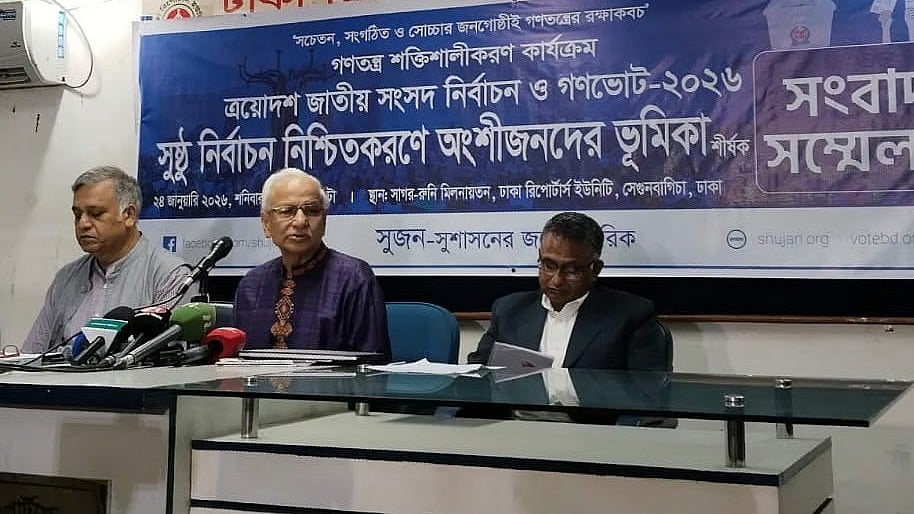
He made the remarks at a press conference organised by SHUJAN at the Sagar-Runi Auditorium of the Dhaka Reporters Unity on Saturday.
SHUJAN organised the press conference titled ‘The 13th parliamentary election and referendum-2026: the role of stakeholders in ensuring a fair election’.
Badiul Alam Majumdar said he had recently held exchanges of views with members of civil society, the media and people from various walks of life across seven divisions and several districts, and that these observations came from those discussions.
Expressing concern over the role of the election commission, he said, “As far as I remember, a member of the election commission said about a candidate, ‘I validated the nomination, now please pay the bank money.’ What kind of statement is this! It clearly means the person was a loan defaulter. Out of sympathy, the election commission validated the nomination. After that, they advised the candidate to pay the money. The Election Commission is a constitutional institution. This is in no way acceptable. I think the Election Commission needs to be questioned whether it will behave like this in the future. If such behaviour continues, then we are in for a lot of trouble in the days ahead.”
The SHUJAN Secretary said if the election commission does not strictly enforce the law now and fails to curb intolerance and violence, this election will also inevitably be controversial. In this case, political parties, candidates, the election commission and the government must act responsibly. A fair election in line with public expectations will not be possible unless a culture of democratic coexistence is established.
Badiul Alam Majumdar also expressed concern over the risk of disinformation using artificial intelligence. He said attempts could be made to mislead voters by spreading false information using AI, such as claiming that a candidate has died or withdrawn on election day, which could influence the election. He urged the election commission to remain vigilant. He also said there is scope for controversy over postal ballots, which could call the entire election result into question.
At the press conference, SHUJAN central coordinator Dilip Kumar Sarkar read out a written statement. The statement said the primary responsibility for conducting elections lies with the election commission and that a fair election is not possible if this constitutional institution does not remain neutral. It noted allegations that the election commission has relaxed rules in allowing candidates to contest despite complaints of loan default and dual citizenship.
The statement further said that after reviewing candidates’ annual income and asset information, there is a strong public perception that many candidates have concealed information. The question is whether the election commission has properly verified affidavit information with the help of relevant institutions, and whether it showed leniency towards influential candidates. Even a small degree of truth in these perceptions would render the election questionable.
Call to refrain from voting for those involved in crime
Addressing voters, Dilip Kumar Sarkar urged them to exercise their voting rights as an important civic duty and said they must not vote in exchange for money or anything else, or out of blind emotion. He said voters should carefully learn about political parties and candidates and vote for honest, capable parties and candidates committed to public welfare. He called on voters not to vote for corrupt individuals, terrorists, extortionists, perpetrators of crimes against humanity, misogynists and abusers, drug traders, smugglers, loan defaulters, bill defaulters, communal elements, land grabbers, environmental destroyers, black money holders or any dishonest, unqualified and anti-people individuals.
Tendency to win at any cost evident
Dilip Kumar Sarkar said a tendency to win at any cost is evident in this election. Because the amended RPO requires contests to be held under party symbols, candidates are switching parties to secure nominations, resulting in long-time and dedicated party leaders being deprived.
He said grassroots opinions were ignored in nominating candidates and added that another recommendation of the electoral system reform commission was to create a panel of three potential candidates for each constituency through secret ballots of general party members, from which the central nomination board would select candidates. However, no change was made to the RPO in this regard. While the existing RPO contains provisions to consider such panels, no political party formed panels based on grassroots opinions and no party nominated candidates from such panels, which he said is a clear violation of the law. The election commission has taken no action on this issue.
Recommendation to form election expenditure monitoring committee ignored
Expressing concern that the recommendation to form an election expenditure monitoring committee was not implemented, Dilip Kumar Sarkar said the electoral system reform commission had recommended barring habitual loan and bill defaulters from contesting elections. Specifically, it proposed that time-barred loans should be fully repaid at least six months before nomination submission. SHUJAN believes the proposal should have been included in the RPO to ensure strictness against loan defaulters contesting parliamentary elections.
Five per cent women candidates not nominated
On the nomination of women candidates, Dilip Kumar Sarkar referred to the July National Charter and said it clearly states that in the first general election after the signing of the July National Charter 2025, every political party will nominate at least 5 per cent women among candidates for the existing 300 parliamentary seats, although this will not be included in the constitution. However, women account for only 3.38 per cent of nominated candidates. This clearly shows that parties failed to honour their commitments under the July National Charter, and instead prioritised patriarchal attitudes and other considerations in nominations, which he described as disappointing.