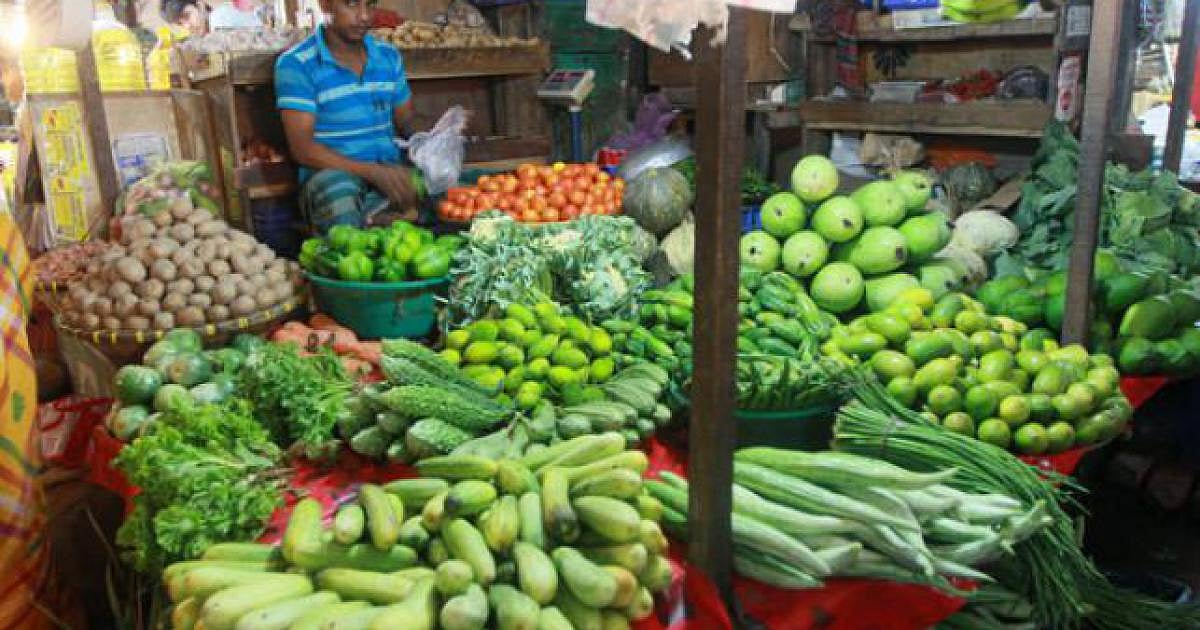
Rising commodity prices put pressure on ordinary people
Habibur Rahman, a resident of Jatrabari in the capital, works at a private publishing house and earns a monthly salary of Tk 58,000. Of this, Tk 38,000–39,000 is spent on house rent, his two children’s education, medicine, and transportation. He sends Tk 10,000 each month to his elderly parents in the village. The remaining Tk 9,000–10,000 is used for daily groceries.
Even a few months ago, Habibur managed to run his household—albeit with difficulty—on this income. But for the past four to five months, he has been struggling to meet expenses as the prices of essential goods have risen. To cope, his family has reduced consumption of beef and fruits. Previously, he would occasionally go out with his wife and children on holidays; that has now stopped. Even then, he cannot manage expenses and has had to take loans every month.
Speaking to Prothom Alo, Habibur said, “Prices of everything—from vegetables to clothing and medicine—have gone up. Earlier, I could manage monthly groceries with Tk 6,000–7,000; now it takes Tk 9,000–10,000. Over the past week, prices of farm eggs, sugar, eggplant, and pointed gourd have increased. Sonali chicken now costs over Tk 350 per kg. This additional expense has become unbearable for me.”
After speaking with him yesterday morning, visits to markets in Joar Sahara, Mohakhali, Mohammadpur Krishi Market, and Town Hall kitchen market revealed that, in the past week, prices of coarse and medium rice, loose flour (atta), refined flour (maida), and soybean oil have also increased.
Market observations show that over the past one to two months, prices of several other items have also risen at the retail level, including aromatic rice, detergents, and soap. Prices of tilapia, rohu, pangas fish, and beef have also gone up compared to earlier.
Traders say that after the start of the Russia–Ukraine war in 2022, prices of many goods rose simultaneously. Since then, the country has been experiencing prolonged high inflation. Recently, the fuel crisis linked to conflict in the Middle East has further pushed up prices, increasing the burden on consumers.
Fuel prices add to the strain
Within two months of taking office, the BNP-led government raised the prices of gas and fuel oil. This month alone, LPG prices increased twice by nearly Tk 50 per kg. As a result, the price of the commonly used 12 kg LPG cylinder has risen to Tk 1,940—an increase of Tk 600 per cylinder. In practice, consumers often pay even more in the market.
The government has also increased consumer-level prices of all types of fuel: diesel by Tk 15 per liter, kerosene by Tk 18, octane by Tk 20, and petrol by Tk 19. These increases have raised agricultural production and transportation costs, which are now impacting commodity prices.
Laiju Begum, a domestic worker in Adabor, Dhaka, uses LPG cylinders at home. She said, “I live in a rented house without pipeline gas. I rely on cylinders. In the past few days, the price has gone up by Tk 600. Prices of other essentials are also rising. I don’t know how to manage all this.”
Rising prices of eggs and chicken
Eggs and poultry are major sources of nutrition for ordinary people. Over the past two weeks, egg prices have increased by about Tk 20 per dozen, now selling at Tk 130. Retailers say wholesalers raised prices due to higher transport costs.
Sonali chicken continues to sell at high prices. Yesterday, hybrid Sonali chicken was sold at Tk 320–330 per kg and regular Sonali at Tk 350–360 per kg. In mid-February, prices were Tk 300–320 per kg. After Eid, prices had surged to Tk 420 before easing slightly. Broiler chicken is currently selling at Tk 180–190 per kg.
According to the Department of Agricultural Marketing, compared to the same period last year, Sonali chicken prices have risen by 45 per cent and broiler chicken by 7 per cent.
In Dhaka markets yesterday, small-sized rohu fish sold for Tk 280–350 per kg, while tilapia and pangas were priced at Tk 200–220 per kg.
High prices of vegetable
Currently, hardly any vegetable other than potatoes is available below Tk 50 per kg. Most vegetables are priced between Tk 60 and Tk 100, while a few—such as eggplant and spiny gourd—exceed Tk 100.
The Department of Agricultural Marketing publishes daily retail prices of 15 vegetables. Compared to last year, prices of nine vegetables are now higher, while four have decreased. The largest increases are seen in local tomatoes, pumpkins, and bitter gourds. Yesterday, tomatoes sold for Tk 50–60 per kg, pumpkins for Tk 40–50, and bitter gourds for Tk 80–100.
Abbas Akand, a vegetable seller at Mohammadpur Krishi Market, said that supply of summer vegetables has started increasing, which should reduce prices. However, higher transport costs are preventing any decline.
At retail shops, loose sugar is now selling for Tk 105–110 per kg, up by Tk 5 from two weeks ago. Over the past week, prices of medium rice varieties (BR-28 and Paijam) have increased by Tk 2–3 per kg, now selling at Tk 55–60. Coarse rice (Swarna and China IRRI) is priced at Tk 50–53. According to the Trading Corporation of Bangladesh (TCB), prices of coarse and medium rice have risen by more than 4 per cent over the past month.
Causes behind price hikes
Retailers and wholesalers cite three main reasons for rising prices of essential goods. First, global prices of several commodities and raw materials have increased in recent months, raising production costs. Second, supply shortages have driven up prices of some goods. Third, recent fuel price hikes are now affecting the market.
For nearly two months, there has been a shortage of bottled soybean oil in the market. Consumers often have to visit multiple shops to find it. Edible oil producers want to raise prices, but the government has not yet approved this. However, companies have already increased prices at the dealer level, forcing consumers to pay more.
Jalal Dewan, a grocery seller at Joar Sahara market, said, “Bottled soybean oil is almost unavailable. Companies are selling it to us at the maximum retail price. How can we sell it to customers at a lower price?”
People struggling under inflation
When prices rise, ordinary people suffer the most. If incomes do not increase in line with inflation, households struggle to manage expenses. Government data show that the country has been under sustained high inflation for three consecutive years, generally ranging between 8.5 and 9 per cent.
A recent World Bank report notes that Bangladesh has remained in the “red” category for food inflation risk for nearly three years. This indicates that food security risks are not decreasing and could worsen further due to the Middle East crisis.
AHM Shafiquzzaman, president of the Consumers Association of Bangladesh (CAB), said that simultaneous increases in the prices of multiple goods have put consumers—especially low-income groups—under severe pressure. Rising fuel prices are pushing up overall costs, including transportation. However, he added that some dishonest traders are exploiting the situation to raise prices further, leaving consumers worse off.