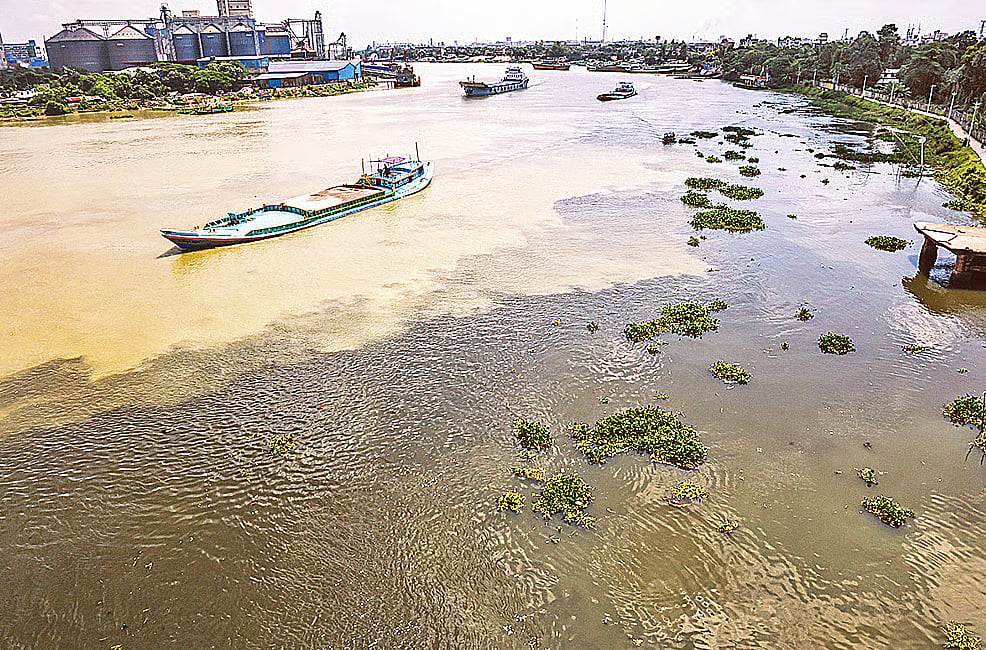
River pollution and encroachment raise growing health risks
Char Kundania village stands on the bank of the Dhaleshwari River. Travelling from the capital Dhaka towards the Padma Bridge along the highway, one has to cross the Buriganga Bridge. Two more bridges follow nearby, one after another: Dhaleshwari 1 and Dhaleshwari 2.
The Dhaleshwari flows beneath the two bridges. Char Kundania is one of several villages that have grown on a Char between two streams of the Dhaleshwari.
Dilbar Hossain, a resident of Char Kundania, says the Dhaleshwari is no longer what it used to be. He is over 60. One of his sons lives in Kuwait, while two sons stay at home and run a poultry farm. His two daughters are married. He is not solely responsible for running the household. However, he occasionally goes fishing in the Dhaleshwari.
He has bought a new boat to prepare for regular fishing in the river during the Bengali month of Agrahayan (late autumn), and showed this reporter three new ‘Thyata’ (fishing tools) that he had had made in Srinagar.
Last Friday morning, sitting in his yard, Dilbar Hossain told this reporter about the Dhaleshwari. He said he had regularly gone fishing in the river since childhood. He used to bathe in the river as well. The family used to make a living by selling fish. At times, he caught fish worth Tk 10,000–15,000 in a single night.
When asked what kinds of fish he used to catch and which ones are no longer found, Dilbar Hossain listed boal, aor, shol, gojar, rohu, catla, baim, bele, tengra, icha, golda, jatka, poa and kajri. He said, “I used to catch them with nets and with Thyata too. There are no fish now.”
The changes in the Dhaleshwari are not simply a story of declining fish stocks. Concerns have grown over the quality of water and fish in various rivers across the country because of industrial waste and other forms of pollution.
Studies have found harmful metals in fish samples from some rivers. Researchers believe health risks are increasing as people come into contact with polluted river water or consume contaminated fish. Against this backdrop, World Rivers Day is being observed today, Sunday, 27 September.
Dilbar’s account is only a glimpse of the problem
Dilbar Hossain has grown older and, having lived by the river, has witnessed the changes in the Dhaleshwari. He says, “The river was much deeper, and there was a current. Now the river has silted up and there is no current.”
The situation is at its worst during the dry season. The flow of the Dhaleshwari becomes weaker then. And foul water comes from the Buriganga, making it difficult to go into the river. At that time, fish die and float to the surface.
The crisis in the Dhaleshwari that illiterate Char Kundania villager Dilbar Hossain has witnessed is also reflected in a report by the National River Conservation Commission.
Its 2019 annual report recommended that authorities pay special attention to the Dhaleshwari so that, like the Buriganga, it does not become devastated by pollution and encroachment or reach a critical state.
The problems with the Dhaleshwari indicated by Dilbar Hossain’s account are merely the tip of the iceberg. Some details of the problems can be found in the annual reports of the National River Conservation Commission. Various studies have shown that river pollution is becoming a public health problem.
Former chairman of the National River Conservation Commission Manjur Ahmed Chowdhury told Prothom Alo that the encroachment and pollution of rivers and waterways in the country are not only threatening aquatic biodiversity but have now become a major threat to public health.
Studies have shown that polluted water causes various waterborne diseases, including diarrhoea, cholera, dysentery, typhoid and hepatitis. As rivers become increasingly degraded, the risks of these diseases also increase, he added.
According to the River Conservation Commission, there are 1,008 rivers in the country. On average, 16 rivers flow through each district. Sunamganj has the highest number of rivers, with 97.
Pollution situation
The River Conservation Commission’s 2019 annual report outlined the causes of river pollution and the condition of rivers in major cities and industrial areas across the country.
There are 11 industrial areas in and around Dhaka: Tongi, Mirpur, Tejgaon, Shyampur/Kadamtali, Demra, Narayanganj, Savar, Ashulia, Gazipur, Ghorashal and Tarabo. There are also some areas in Badda/Satarkul, Kaliakair and Rupganj.
The commission’s report said that no waste treatment facilities had been arranged for 7,000 industrial units. Around 60,000 cubic metres of waste from textile, dyeing, printing and pharmaceutical industries are discharged into Dhaka’s canals and rivers every day.
Besides industrial waste, vessels are a major source of river pollution. Every day, fuel, oil and contaminated liquid waste discharged from thousands of ships, steamers, launches and motorised boats are dumped into rivers without treatment.
Citing the results of tests on water from the Dhaleshwari River, the report said liquid waste from tanneries is discharged into the Dhaleshwari. It contains high levels of chromium.
Md Khalequzzaman, an associate professor at the Department of Public Health and Informatics at Bangladesh Medical University, has conducted research on pollution in several rivers. He told Prothom Alo, “We found chromium in river water. Chromium causes cancer in humans.”
Contaminated fish
Fish are among the major victims of river pollution. Studies have found that some rivers do not contain enough dissolved oxygen for fish or other aquatic animals to survive. In other rivers, although there is some oxygen, the levels of different heavy metals are high. These heavy metals enter the bodies of fish.
Seven scientists and researchers from Griffith University in Brisbane, Australia, Noakhali Science and Technology University, the Bangladesh Atomic Energy Commission and China University of Geosciences in China conducted a study on 15 fish species from the Meghna River.
These are the fish that are commonly eaten. They sought to determine the presence of heavy metals in the fish. Their research paper was published in the journal Toxics in 2023.
The fish included tilapia, koi, catla, rohu, grass carp, bighead carp, kalibaus, bata, pabda, poa, chiring, riksha, guliya, loitta and coral. The metals tested for included lead, chromium, copper, zinc, manganese, iron, mercury, nickel, calcium (an alkaline earth metal that is not generally classified as a heavy metal), cobalt, selenium (a non-metal/metalloid) and rubidium (a mild/light alkali metal).
The findings showed that the levels of iron, zinc, copper, mercury and nickel in the fish were higher than the limits approved by the World Health Organization (WHO). The researchers said fish are an important part of the diet of people in Bangladesh. Eating fish containing heavy metals poses a health risk to them.
However, no studies have been found showing that anyone has developed a specific illness after eating fish from polluted rivers.
Psychological trauma
The presence of heavy metals in river water or fish is not the only threat to public health. Every year, many people in Bangladesh fall victim to river erosion. They are displaced from their homes. This creates deep and long-lasting psychological trauma.
Again, when a river dries up or becomes toxic, people living along its banks may feel a sense of disconnection from the river even if they themselves are not displaced. These two types of psychological problems are rarely discussed.
In 2019, three researchers from Rajshahi University and Islamic University in Kushtia surveyed 611 families in Rajbari and Tangail. Of these, 509 families had been affected by river erosion, while 102 were ordinary families.
The researchers found that members of families affected by river erosion experienced significantly higher levels of depression, anxiety and psychological stress than others.
Crisis of culture
When a river becomes polluted, dries up because of siltation or is encroached upon, people suffer not only economically or environmentally but also lose an artistic refuge.
Boat races and river trips are declining because of river encroachment and pollution. A boat race is not merely a sport; it is a grand celebration of collective strength, festivity and rhythm on the river.
The sight of birds on the chars or fishermen casting their nets to catch fish in the river symbolises the perfect coexistence of nature and people. When nature remains in its natural state, the beauty of the ecosystem is not limited to the pleasure of seeing it; it also gives people a sense of fulfilment.
Former chairman of the River Conservation Commission Manjur Ahmed Chowdhury said the loss of this aesthetic value of rivers is dangerous. In a society where people are deprived of the opportunity to experience such natural beauty, there increases mechanisation, psychological unrest, and aesthetic barrenness.
Therefore, preserving the beauty of rivers is not only necessary for environmental protection but also an urgent need to safeguard people’s mental health, he added.