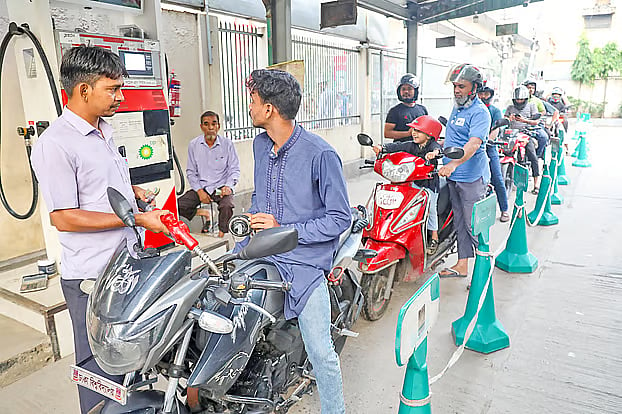
Fuel crisis: Long queues disappear, filling station owners cite multiple reasons
Filling stations are now showing a largely normal picture, unlike before. Some remain empty for most of the time, while at others vehicles are refuelling and leaving as usual.
At busier stations, a number of vehicles line up in an orderly manner to take fuel. Filing station owners say that pressure has eased over the past three to four days mainly because supply has increased.
Oil marketing companies also report that demand for fuel at stations has begun to decline.
To understand why the crowds have reduced, discussions were held with the Bangladesh Petroleum Corporation (BPC), oil marketing companies Padma, Meghna and Jamuna, and officials at petrol pumps.
They state that several factors have worked together to ease the congestion.
Two of the main reasons are increased supply of fuel in the market and the recent price hike.
In addition, an indefinite ceasefire has reduced uncertainty. Government drives against illegal hoarding and the introduction of a fuel pass system have also played a role.
On 28 February, the United States and Israel carried out a joint strike on Iran. From the following day, the global fuel market became unstable.
Filing station owners say that pressure has eased over the past three to four days mainly because supply has increased. Oil marketing companies also report that demand for fuel at stations has begun to decline
That instability affected filling stations in the country, leading people to queue for fuel. Lines of vehicles and people grew longer each day. This crowding, which had continued for nearly two months, has now suddenly disappeared.
In Dhaka, people mainly queued for octane and petrol, while outside the capital there were also queues for diesel. Between 1 and 4 March, sales doubled compared with normal levels.
Fearing a shortage, the government introduced rationing. Reduced supply intensified public anxiety. Although rationing was lifted after a few days, diesel and petrol supply in March remained lower than the previous year, while octane supply was increased.
However, in April the supply of petrol, octane and diesel declined again, and queues did not subside.
On 18 April, the government issued a gazette notification increasing fuel prices. After the hike, fuel reached its highest price in the country’s history.
Diesel rose from Tk 100 to 115 per litre, octane from Tk 120 to 140 and petrol from Tk 116 to 135.
The following day, from 20 April, authorities increased fuel supply in the market. Thereafter, queues at filling stations gradually began to diminish.
Mohammad Nazmul Haque, president of the Petrol Pump Owners’ Association, told Prothom Alo, “When there is a shortage of fuel, the tendency to hoard increases. People become fearful and purchase more than usual. Once supply increased, these tendencies declined and the situation returned to normal. Therefore, we must maintain the increased supply.”
When there is a shortage of fuel, the tendency to hoard increases. People become fearful and purchase more than usual. Once supply increased, these tendencies declined and the situation returned to normal. Therefore, we must maintain the increased supply.Mohammad Nazmul Haque, president of the Petrol Pump Owners’ Association
Supply exceeds allocation
According to BPC, diesel supply in March fell by about 10 per cent compared with the previous year. In April last year, average daily diesel sales stood at 11,862 tonnes.
This year, up to 21 April, average daily sales were 11,479 tonnes. After 20 April, authorities decided to increase supply by 10 per cent compared with last year, setting an allocation of 13,048 tonnes per day.
In practice, however, supply exceeded this level. Over the past 10 days, average daily supply reached 13,463 tonnes. Demand for diesel is now declining.
Diesel accounts for 63 per cent of the fuel supplied by BPC in the country, and it is used in transport, agriculture, industry and residential generators.
BPC data also show that octane is mainly used in private cars and motorcycles. About 50 per cent of the country’s octane demand is met through imports, while the remainder is produced domestically from imported raw materials.
In March last year, average daily octane supply stood at 1,193 tonnes. Due to increased demand linked to the conflict, supply rose by 26 tonnes per day this March, reaching 1,219 tonnes.
There will be no problem regarding fuel supply. We have invited tenders to procure oil for the July–December period.BPC Chairman Md Rezanur Rahman
However, in April this year, supply declined compared with last year. In April last year, average daily octane sales were 1,185 tonnes, whereas up to 17 April this year, depots supplied an average of 1,129 tonnes per day.
To stabilise the situation, authorities allocated an average of 1,422 tonnes per day. In reality, over the past 10 days, supply averaged 1,780 tonnes daily.
This indicates that octane supply in the market increased by around 50 per cent compared with normal levels, despite the additional allocation being only 20 per cent.
Petrol is used in motorcycles alongside octane. Some owners also use petrol in older private cars. It is further used to operate CNG autorickshaws, human hauler (leguna) vehicles and grass-cutting machines.
This fuel is produced entirely within the country. In April last year, average daily petrol sales stood at 1,374 tonnes. This year, up to 17 April, average daily sales declined to 1,253 tonnes.
Authorities decided to increase supply by 10 per cent, setting a daily sales target of 1,284 tonnes.
However, over the past 10 days, average daily sales reached 1,581 tonnes, reflecting a 15 per cent increase in supply compared with the previous year.
Mofizur Rahman, managing director of Padma Oil Company, told Prothom Alo, “People’s fears have subsided. We have supplied additional fuel to all pumps. The fuel pass system has been introduced. A combination of several government initiatives has reduced the crowds. Demand at pumps has declined, and they are now lifting less fuel than their allocation.”
BPC data also show that octane is mainly used in private cars and motorcycles. About 50 per cent of the country’s octane demand is met through imports, while the remainder is produced domestically from imported raw materials.
Fuel pass, enforcement drives and ceasefire
Industry insiders state that the indefinite ceasefire has reduced fears regarding fuel supply shortages. To ease public suffering related to fuel, the government has implemented several measures simultaneously. Authorities have strengthened monitoring at pumps and conducted awareness campaigns to counter rumours about fuel shortages.
The price increase has also discouraged illegal hoarding. The introduction of the fuel pass system at filling stations has prevented the same vehicles from repeatedly refuelling.
Enforcement drives against illegal stockpiling continue. At the same time, increased market supply has enabled people to purchase fuel with greater ease.
At present, there is no fuel shortage in the country. Following the increase in supply, queues at filling stations have declined and the situation is returning to normal.
After sales on 28 April, diesel stocks stood at 181,000 tonnes. Authorities are unloading 75,000 tonnes of diesel from three vessels, with a further 33,000 tonnes awaiting discharge.
Demand for diesel in May is estimated at 370,000 tonnes, while suppliers have confirmed deliveries of 329,000 tonnes.
According to BPC sources, demand for octane in May is projected at 37,000 tonnes. Of this, 24,000 tonnes will come from domestic sources, while approximately 26,500 tonnes are expected through imports.
Current octane stocks stand at 42,933 tonnes, and petrol stocks at 17,640 tonnes. Regular supplies of petrol continue from domestic sources. Additional imports of diesel and octane through direct procurement could further increase stock levels.
BPC Chairman Md Rezanur Rahman told Prothom Alo, “There will be no problem regarding fuel supply. We have invited tenders to procure oil for the July–December period.”