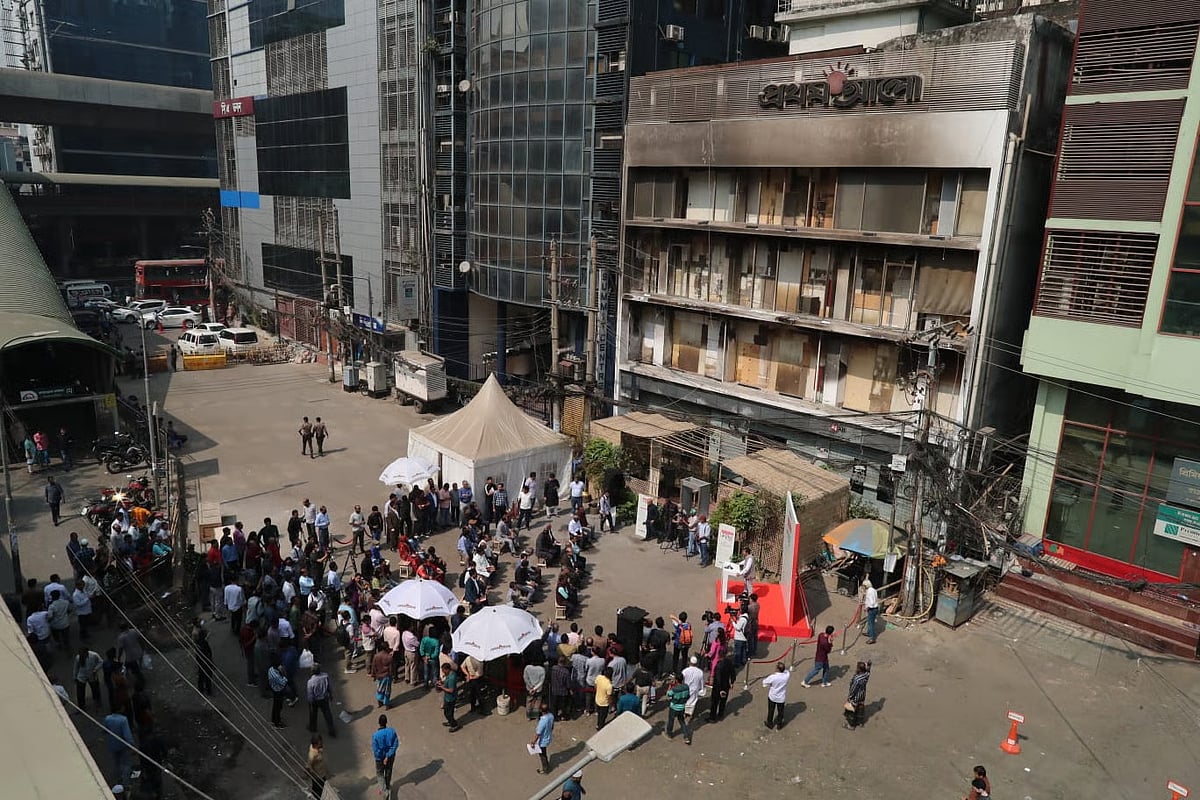
Art exhibition at fire-ravaged Prothom Alo building: A call for unity in support of independent journalism
Light spread from the fire-damaged Prothom Alo building. On Wednesday morning, in bright spring sunshine, the exceptional art exhibition ‘Alo’ formally began at this building. At the inaugural ceremony, leaders of the journalist community expressed their resolve to build firm unity among journalists across the country to strengthen independent journalism and democracy.
At 11:00 am today, newspaper owners, editors, journalist leaders, and media workers from across the country attended the inaugural ceremony in front of the Prothom Alo building in Karwan Bazar, Dhaka. Renowned artist Mahbubur Rahman created the artworks.
On the night of 18 December 2025, around 10:45 p.m. a group of vindictive extremists attacked the Prothom Alo office. They went on a rampage, breaking the shutters and large glass doors of the office. After entering, they looted, vandalised items, and set fire. Then they attacked the Daily Star building as well, carrying out extensive vandalism and arson there too.
As a result of this all-out attack on Prothom Alo, its online news service was suspended that night. For the first time in the 27-year history of Prothom Alo’s publication, the printed newspaper did not appear on 19 December. However, even amid this catastrophic situation, Prothom Alo rose again. Within just 17 hours, online operations resumed. On the morning of 20 December, readers across the country received the printed newspaper.
The exhibition titled ‘Alo’ by artist Mahbubur Rahman, based on the fire-ravaged building, will continue until 28 February. It will remain open to all visitors every day from 11:00 a.m. to 1:00 p.m. and from 3:00 p.m. to 5:00 p.m.
Welcoming guests, Sajjad Sharif, Executive Editor of Prothom Alo and host of the inaugural ceremony, said, “The presence here today of editors, journalist leaders, and media workers is highly significant. We will not only see a devastated building here; we will also see the vile attack meant to silence thought—and the efforts to overcome it. This exhibition will inspire us to remain vocal for our right to speak.”
At the beginning of the programme, artist Mahbubur Rahman said he wanted to portray the emergence of new vitality from within the ruins. The burned objects here seem to speak of the heartbeat of this workplace and the pain of being scorched. He presented both that pain and the institution’s resurgence in an aesthetic way.
In the discussion, Mahfuz Anam, Editor of The Daily Star, said the arson attack on Prothom Alo and The Daily Star was not just an attack on two institutions; it was an attack on independent journalism—an attack on freedom of thought. This attack was not accidental; there was a specific plan and objective behind it.
Addressing the new government, Mahfuz Anam urged that the incident be investigated with due seriousness. Those who planned and carried out the attack must be exposed before the public. He also recalled the courage and dedication of journalists and staff of both institutions who resumed work swiftly and kept the news flow running despite the disaster.
AK Azad, President of the Bangladesh Newspaper Owners' Association, said the way the Prothom Alo building was burned was extremely painful. But an institution cannot be destroyed by burning it down. This burnt building has now been transformed into an artwork. Journalists did not flee in fear after the attack; they faced the situation and rose again with courage.
He said, “There may be future attacks on newspapers and media. Journalists must be prepared to resist such situations. We must remain united. We have already taken initiatives for broader unity. A recent media conference was successfully held. Such activities will continue. We must strengthen our unity further.”
After viewing the exhibition, poet Hasan Hafiz, President of the National Press Club, said in his remarks that amid the terrible barbarity carried out at Prothom Alo, the artist has combined destruction and creation at the same time. The exhibition is very astonishing and expresses deep significance.
He urged that the video footage and contents of this exhibition be presented to the world in both Bangla and English. He also said, “We will expect from the new government that they will give importance to establishing media freedom and a culture of tolerance in the country.”
Dewan Mohammad Hanif, General Secretary of the Editors’ Council, said, “Journalism faces various kinds of attacks and pressure at different times. But a direct attack on a newspaper office is a rare incident. Nothing could be more disgraceful in a society than an attack on a newspaper office. In 1971, the office of the Dainik Sangbad was attacked. Last December, Prothom Alo and The Daily Star were attacked. This has created a very bad impression about our country before the world.”
He added that the initiative Prothom Alo has taken through this exhibition to preserve the history of the attack is extremely important.
Kader Gani Chowdhury, Secretary General of the Bangladesh Federal Union of Journalists (BFUJ), said, “Here we are seeing the skeleton of a media institution. An attempt was made to destroy Prothom Alo and The Daily Star. But life has emerged from this skeleton. As shown in the exhibition, the journalist community must also awaken. We must forget divisions and build strong unity. There is no alternative to unity.”
He urged the government to help create a free environment for journalism, saying society falls into darkness without media freedom.
Matiur Rahman, Editor of Prothom Alo, expressed thanks and gratitude to artist Mahbubur Rahman for the exhibition, to the journalist leaders and media workers who took part in the inaugural ceremony, and to all those who stood beside Prothom Alo after the attack and issued statements expressing solidarity.
He said, “Through this exhibition, the artist has expressed a deep vitality and optimism even amid destruction. We must now move forward with this hope and strength. For many years, divisions and conflicts had prevailed among journalists. But whatever the past, whatever happened, we must rise from there and strengthen our internal unity for independent journalism and security. We will remain connected with one another. If any attack comes upon anyone, we will protest it with our utmost capacity. Prothom Alo will do this in the future. At the same time, we must practise journalism with integrity. We must remember that truth is our greatest strength.”
Others present at the event included Kamal Ahmed, head of the Media Reform Commission of the former interim government; Shahidul Islam, President of Dhaka Journalists’ Union; KM Mohsin, President of Photojournalists Association; Mynul Hasan Sohel, General Secretary of Dhaka Reporters Unity; Imrul Kayes, General Secretary of DCAB; Daulat Akhter, President of Economic Reporters Forum; senior journalists Shafiqul Karim, Farid Hossain, Syed Abdal Ahmed, Zahid Newaz Khan, Masud Kamal, Rezanur Rahman; senior photojournalists Rafiqur Rahman and Nasir Ali Mamun; Samakal Editor Shahed Muhammad Ali; Ajker Patrika Editor Kamrul Hasan; AFP Bureau Chief Sheikh Sabiha Alam; Reuters Bureau Chief Ruma Paul; ATN Bangla Director (News) Hasan Ahmed Chowdhury Kiron; and many others.