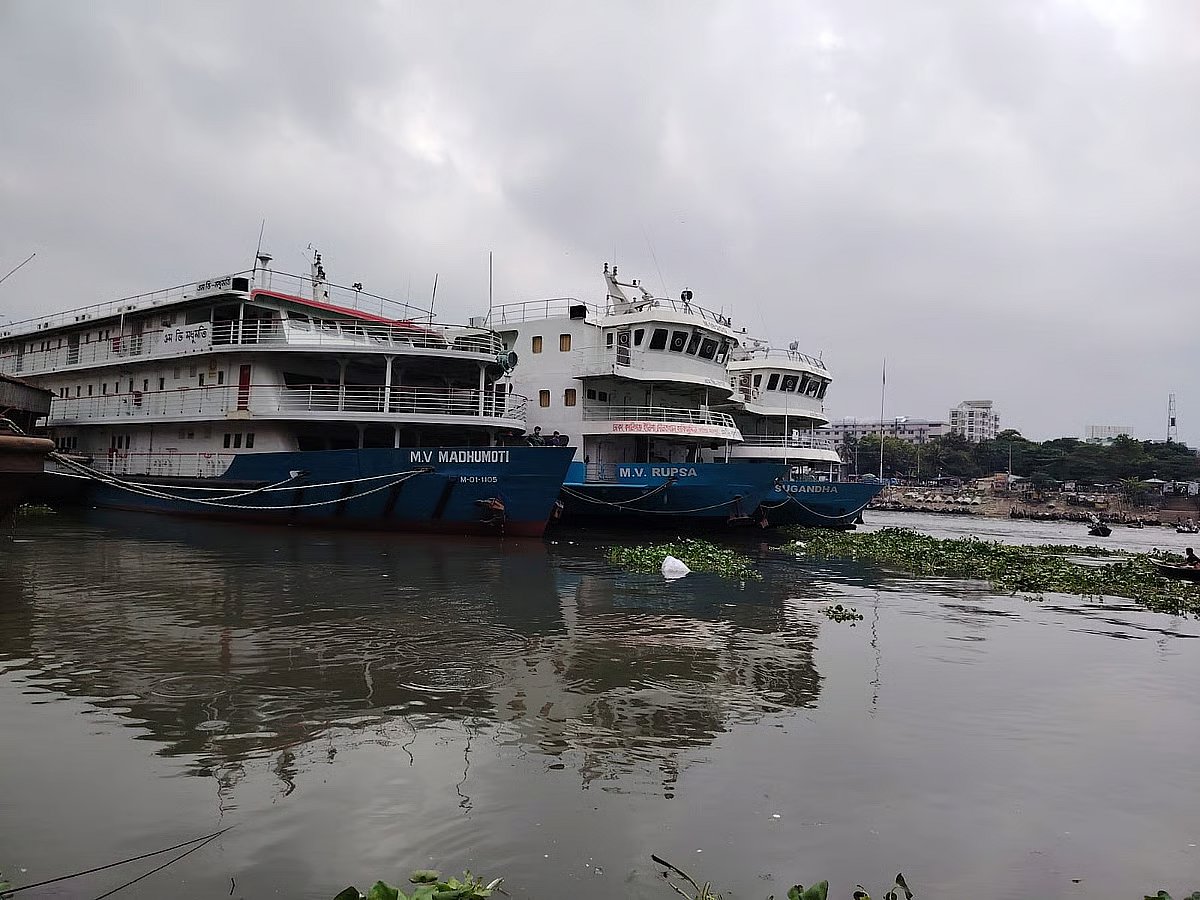
3 of 4 idle BIWTC vessels to become floating hospitals
Two newly acquired passenger vessels meant to operate on the Dhaka–Barishal route have been lying idle at Sadarghat’s Badamtali Ghat for nine months. The Bangladesh Inland Water Transport Corporation (BIWTC) purchased the two vessels from Western Marine Shipyard Limited at a cost of Tk 680 million.
Added to the BIWTC fleet in February this year, the MV Rupsha and MV Sugandha remain out of service due to a shortage of passengers and mechanical defects. Purchased with the expectation of generating profit, the two ships are instead incurring regular maintenance costs for BIWTC.
Two older passenger vessels in the corporation's fleet—MV Bangali and MV Modhumoti—have also been deteriorating while sitting idle at Badamtali Ghat for a long time. These two vessels were procured from Western Marine Shipyard in 2014 and 2015 at a cost of Tk 540 million. Authorities are now considering converting three of these four vessels into floating hospitals.
Sources within the Ministry of Shipping and BIWTC note that while officials show keen interest in purchasing passenger vessels, there is little urgency regarding their management.
Industry insiders point out that BIWTC claims private sector vessels have also shut down following the opening of the Padma Bridge, leading to a drop in its own revenue. Yet the corporation has shown no visible initiative to explore alternative waterways. Lacking any long-term strategic planning, BIWTC continues to incur financial losses every year.
Government plans to convert vessels into floating hospitals
All four vessels were purchased during the previous Awami League government at a combined cost of Tk 1.22 billion. To curb losses, the BNP (Bangladesh Nationalist Party) government now wants to repurpose the four idle vessels.
According to Ministry of Shipping sources, plans are underway to transform three of the ships into floating hospitals, while the fourth will be reserved for hosting various programmes of the Ministry of Shipping and other government ministries.
Sources within the Ministry of Shipping and BIWTC note that while officials show keen interest in purchasing passenger vessels, there is little urgency regarding their management.
On 17 November, a tripartite meeting regarding the utilisation of the four vessels was held in the conference room of the Ministry of Shipping at the Secretariat. Officials from the Ministry of Shipping, the Ministry of Health, and BIWTC attended the meeting with State Minister for Shipping Rajib Ahsan in the chair.
Discussions at the meeting centred on launching three floating hospitals to deliver healthcare to residents of haor, island, and char regions. One vessel will be developed as a specialised hospital for ophthalmology (eye care), another for maternal and child healthcare, and the third one for orthopaedic surgery—with each vessel also housing general medicine physicians in its outpatient department.
The meeting further agreed that while converting the passenger vessels into floating hospitals, their core structural design must remain unaltered. Only one staircase may be modified into a ramp for patients, while existing open spaces can be partitioned to create rooms as needed.
It was also decided that appropriate accommodation, dining, and sanitation facilities must be arranged for the assigned physicians and nurses, alongside a dedicated hospital waste management system. Patients receiving treatment will be charged a nominal service fee, and the Directorate General of Health Services (DGHS) will prepare an estimated budget for medical equipment and ancillary facilities at the earliest.
Contacted for comment, Shipping Secretary Ataur Rahman Khan told Prothom Alo that the vessels cannot be left sitting idle day after day, and alternative uses—such as deploying them as floating hospitals in remote areas—are under active consideration.
"We can only provide the vessels; the physicians and nurses will have to come from the Ministry of Health, so much depends on their goodwill as well. Which three ships will be converted into hospitals has not yet been finalised," he added.
Challenges in hospital conversion
Sources at the Ministry of Shipping note that converting passenger ships into floating hospitals presents several challenges. Questions remain over whether physicians and nurses will be willing to deploy to remote areas aboard floating facilities, alongside arranging proper boarding and lodging.
According to the sources, the authorities must also determine who will supply the human resources and bear their salaries and allowances, as well as secure funding for fuel and vessel maintenance. The exact conversion cost and the specific regions where the hospitals will operate are yet to be finalised.
We can only provide the vessels; the physicians and nurses will have to come from the Ministry of Health, so much depends on their goodwill as well. Which three ships will be converted into hospitals has not yet been finalised.Shipping Ministry Secretary Ataur Rahman Khan
BIWTC Chairman Abdul Bari Danny told Prothom Alo that efforts are underway to convert the idle vessels into floating hospitals to provide healthcare to ordinary people in remote regions.
He noted that the appeal of water transport declined after the Padma Bridge opened, as more people prefer travelling by road, causing revenue to fall and prompting the search for alternative uses.
According to BIWTC sources, the corporation signed a Tk 680 million contract with Western Marine in 2015 during the Awami League tenure to build two vessels for the Dhaka–Barishal route. Although scheduled for delivery by 2018, Western Marine failed to hand them over on time. After extensive correspondence, BIWTC finally took delivery of the two ships on 23 February this year.
Originally named Bongotori and Bongomata, the incumbent government renamed them MV Rupsha and MV Sugandha.
BIWTC stated that a private operator briefly ran the two vessels and reported multiple faults, including engine defects, which were subsequently repaired.
A visit to Sadarghat’s Badamtali area on 21 November found the two new vessels, MV Rupsha and MV Sugandha, sitting idle. On the third deck of both ships, two categories of passenger seating—standard and upgraded chairs—along with newly bought dining furniture, separate VIP lounge seating, VIP cabins, first- and second-class cabins, and deck facilities were seen gathering dust and deteriorating from disuse.
Moored beside them was the unused MV Modhumoti, alongside 10 idle water buses.
Saber Hossain, who oversees the vessels, told Prothom Alo that MV Bangali has been sent to a dockyard in Narayanganj for repairs.
Unplanned procurement of vessels
Relevant officials point out that BIWTC procured vessels one after another without proper foresight. No feasibility study was conducted prior to buying MV Bangali and MV Modhumoti a decade ago, nor was any contingency plan made for what would happen to them once the Padma Bridge opened.
A report by the Ministry of Planning identified several reasons behind their losses: their jetty at Badamtali is located far from Sadarghat’s main terminal, discouraging passengers from walking the extra distance, and general commuters remain largely unaware of these two vessels.
Following the launch of the Padma Bridge and the resulting drop in passenger numbers, both ships were laid up to stem further losses, the planning ministry report added.
Since the Padma Bridge opened in 2022, many private vessels have ceased operations, and private launch owners on the Dhaka–Barishal route struggle to find passengers.
Asked why the procurement of MV Rupsha and MV Sugandha was not halted or redirected when earlier vessels were already sitting idle due to losses, BIWTC Director (Commercial) SM Ashikuzzaman told Prothom Alo that the two new ships were originally slated for delivery in 2018, but Western Marine delayed due to financial difficulties.
The construction of the two vessels was already well advanced by the time the Padma Bridge opened, leaving little room to consider alternatives, he added.