Prothom Alo investigation
Children bought and sold in the name of adoption, bargains go on Facebook
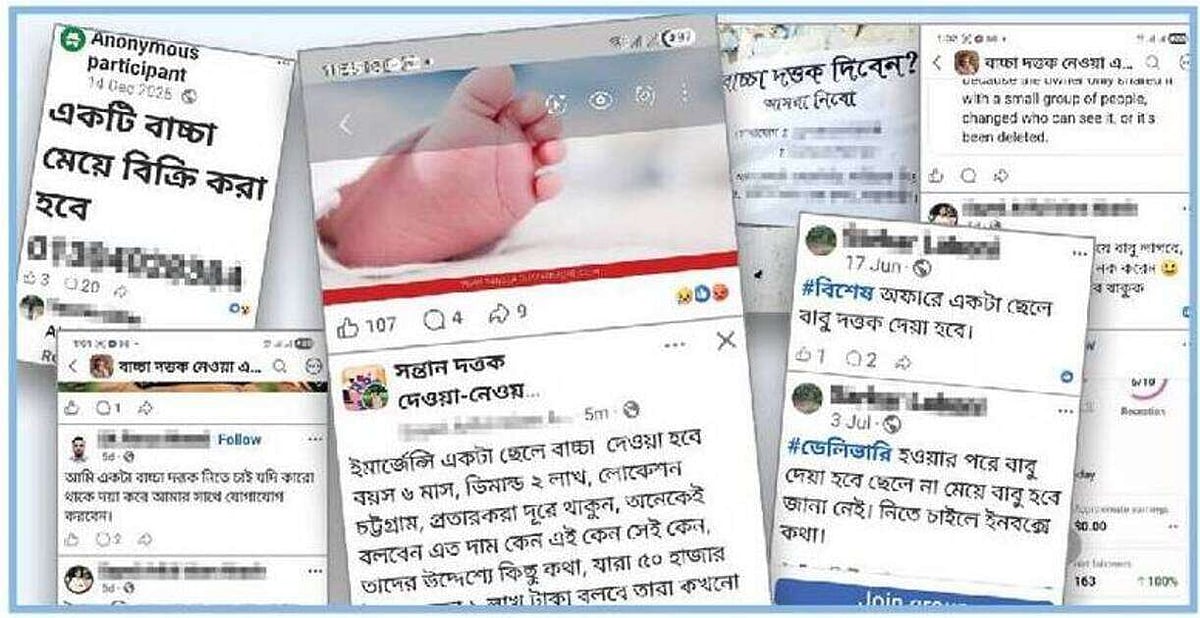
A post on Facebook offered a child for sale at a high price: “A baby boy will be supplied on an emergency basis; age six months; demand Tk 200,000; location Chattogram.”
I came across the post in a group, apparently for child adoption, called ‘Sontan Dottok Dewa-Neowa Hoy’. The person who posted it warned people to stay away from fraudsters. The person wrote that those asking for Tk 50,000 or Tk 100,000 would not actually give away the child.
Using this argument, the person wrote on 13 September, addressing potential buyers, “This is a 100 per cent real post, knock only after understanding everything.”
The ‘Bachcha Dottok Neowa Ebong Dewar Group (Baby Adoption and Giving Group)’ on Facebook has more than 5,000 members. Last year, an anonymous participant posted a phone number and wrote, “A baby girl will be sold.”
Last June, someone wrote in the ‘Dottok Deowa O Neowa (child adoption)’ group, “A baby boy will be given for adoption at a special offer.” Similar notices are widespread across many Facebook groups with similar names. There are also many posts in these groups seeking babies for adoption.
Thus, on Facebook, negotiations over buying and selling children through bargaining and placing orders are taking place from the time a child is still in its mother’s womb. Outside Facebook, we also visited an institutional initiative involving adoption in exchange for money.
These activities are taking place outside the purview of the law and government monitoring. It is also hard to find out data on how many children are being bought and sold in this way.
From 12 August to 16 September, working with Prothom Alo fact-checker Md Sohag Mia, we verified and examined 39 public Facebook groups. Although most had a few hundred members, some had nearly 20,000 members.
To investigate the situation, we joined three groups and negotiated through inbox messages and mobile phone calls, either identifying ourselves or concealing our identities. We regularly followed two groups.
It was noticeable that boys were priced higher than girls. Only a handful of posts mentioned successfully obtaining a child. Several posts mentioned the risk of fraud and people’s experiences. Some posters were also called fraudsters. Some people posting were active in multiple groups.
Some posts sought to buy medical reports from different stages of pregnancy. In several groups, discussions mainly centred on sperm donation or surrogacy. There were also offers of sexual services in those groups.
Through one group, we found a female agent. Speaking over mobile phone on condition of anonymity, she said they find pregnant women from various hospitals who are unwilling to keep their babies. If the pregnant women agree to give up their babies, an organised group takes care of them until delivery. A newborn boy costs Tk 300,000, while a girl costs Tk 200,000. The agents receive commissions.
Meanwhile, Abdul Alim of Kushtia wrote in a group that he had been cheated three times. Speaking to Prothom Alo over mobile phone, he said that the last time, he had agreed on a price for a newborn. A woman showed him the baby on a WhatsApp video call. She then asked for Tk 10,000 in advance for travel expenses.
Abdul Alim said that after he trusted her and sent the money through bKash, the Facebook group disappeared. All the numbers, including the WhatsApp number, were blocked. He regrets that there is no one to stop or monitor the fraudsters.
Calls for children in Facebook groups
We closely reviewed 288 posts from a dozen groups. Of these, 34 posts were from people seeking children for adoption, while 63 posts offered children for adoption. Along with mentioning boys and girls, there were also references to demand and supply for “baby”, “newborn”, “child” and “twin babies”.
Here are some examples of the calls made at this online marketplace: “I want a baby boy, it is very urgent.” “I need a baby in October or November.” One person sought a 10-day-old or one-month-old baby boy with a budget of Tk 50,000.
A woman wrote that she would make an agreement with a woman who was five or six months pregnant. She would bear the cost of a Caesarean section and take the baby to Italy. Another person sought a “beautiful, fair, cute baby girl” aged three to four months to take to Australia.
A child seller wrote, “A baby girl will be given for adoption, the family has a ‘demand’, no advance payment is required. You will come, see the baby, talk, complete the paperwork, take the baby, and leave.”
Those interested in taking a baby are asked to send a message in the inbox, after which a contact phone number is also provided. We spoke over mobile phone, WhatsApp and Messenger with eight people interested in giving away children, either identifying ourselves as journalists or concealing our identities.
Whose child, who is selling
The person who posted about the “baby boy needed urgently” for Tk 200,000 is active in several groups. Identifying ourselves as journalists, we first spoke to him through Messenger and later contacted him on his mobile phone number.
Speaking on condition of anonymity, he said he had posted on Facebook at the request of the baby’s mother. He said he was not involved in selling the baby. The mother’s phone number was not included anywhere in the post. He provided a number.
The post mentioned “location Chattogram”. When we called on 13 September, a woman said she lived in Narsingdi. When told that I wanted to take the child, she asked me for Tk 100,000. She said, “From giving birth to raising the baby for six months and buying diapers, Tk 50,000 has already been spent.”
But why would she sell the baby? Her answer: “My husband has left. I have another child. There are family problems.”
She did not give her name or address, nor did she ask for my name or identity. She said she would give the address if I called after going to Narsingdi, or would deliver the baby to my address if I provided it.
When I asked to see the baby, the woman sent a photo of a child and a vaccination card on WhatsApp. The card listed the father’s name as Rakib Hasan. The address was in Kapasia, Gazipur. The woman’s WhatsApp account was also in the name of Rakib Hasan.
When we called the person who had posted in the Facebook group, he now said someone from Feni was willing to pay Tk 170,000. But the full Tk 200,000 was required. Later, he said again that his intention was to help the mother. He would not receive any share of the money from this.
In a group, a person named “Kader Kader” posted a photo of himself with a child aged around one and a half to two years and wrote that it was his own child. He said his wife would leave him. To pay his wife’s dower, he would give his son up for adoption in exchange for Tk 350,000.
In another post, the person provided his phone number. We spoke to him without revealing our identity as journalists. He said there was nothing wrong with giving one’s own child up for adoption.
Retired senior district and sessions judge Fowzul Azim was the chief research officer of the Law Commission. He said posts such as “child adoption”, “newborn needed”, “want to take a child” and “this amount of money in exchange” should be viewed as potential risks of child trafficking or exploitation. Law enforcement agencies should initially verify the matter.
Selling, buying or transferring a child for the purpose of using the child in illegal and immoral activities is punishable by severe penalties under Sections 372 and 373 of the Penal Code, 1860. The Prevention and Suppression of Human Trafficking and Migrant Smuggling Act, 2026, has included adoption for an “unlawful purpose” as exploitation.
Fowzul Azim told Prothom Alo, “If such commercial advertisements or bargaining are actually linked to the transfer of a child, an investigation should examine who is receiving the money, whether there are any intermediaries or organised groups involved, and for what purpose the child will be used in the future.”
According to Shahnaz Huda, a professor of law at the University of Dhaka, the biggest danger is that after children are bought and sold in this way, there is no monitoring of where they go or what they are involved in. She said, “Some people may be giving birth to children specifically to run this kind of business. Government monitoring of the matter has become essential.”
Legal guardianship of children can be obtained
Bangladesh does not have a general civil adoption law applicable to everyone. Family laws in the country are based on religion. Muslim family law has no provision for adoption.
Lawyers said Hindus, Buddhists and Christians can adopt children according to their religious practices. Regardless of religion, legal guardianship of a child can be obtained through the family court.
In addition, under the Children Act 2013, there is an opportunity to transfer responsibility for alternative care of disadvantaged children through the Child Welfare Board. There are provisions for monitoring only in these two cases.
Officially, legal guardianship is granted through courts only to children living in the six government-run Shishumoni Nibash (child home) facilities under the Department of Social Services. Jublie Begum, former deputy superintendent of the Azimpur Shishumoni Nibash in Dhaka, said childless couples want children by any means. As a result, child-selling networks are becoming active in various places, including Facebook.
Several private organisations or institutions also work to transfer legal guardianship of disadvantaged children. There are also institutions that arrange adoptions illegally.
‘Adoption’ for an institutional fee
On 11 July, a notice on the wall of a corridor on the ground floor of Dhaka Medical College Hospital caught my eye among various notices.
“Do you want to give a baby up for adoption? We will take one.” There were two phone numbers and an address written below the notice. Following the address, we went to the office of Al-Bukhari Caregiving Services Limited in Jatrabari on 30 August.
The company’s website and Facebook page mention assistance with “infertility patient treatment” services, including IUI, IVF and surrogacy. Under the heading “Legal guardianship of children”, it also says that the company assists with the adoption of newborns or orphaned children.
We began talking in a small office room on the second floor, saying that we wanted to adopt a baby. At one point, we identified ourselves as journalists and spoke at length with the company’s Managing Director, Md Abdul Ahad. He said they also provide surrogacy services in India.
The company has its own forms for giving and taking children. The “Application for Adoption/Legal Guardianship” states that the company will work as a consultancy coordinating organisation.
The form says the party wishing to take a baby will pay the company a fee of Tk 35,000. Abdul Ahad, however, verbally asked for Tk 50,000. The company takes this fee as management expenses and facilitates communication between the two parties.
In addition, the family giving up the baby has to be paid an amount according to their demand. If the child is delivered by Caesarean section, the cost of the procedure also has to be covered. Altogether, the cost comes to around Tk 200,000.
The company provides a detailed consent form and agreement document. When the two parties sign the agreement, two people from the company sign as witnesses.
Abdul Ahad said the document is notarised at a computer shop. After the signatures and formalities, the baby is handed over. But the company’s responsibility ends there. They do nothing regarding legal guardianship in court. He said he had sought advice from the local police station and the Department of Social Services about what needed to be done. He did not receive any clear guidance. Now they are keeping the documents on their own.
According to Abdul Ahad, many organisations take money to arrange the adoption of children. There are also some fake organisations. He said the demand for giving and taking children for adoption is very high.
Abdul Ahad let us speak from his mobile phone to a man who had adopted a baby boy through the company a few days earlier. The man said he had spent Tk 160,000. He would now prepare the child’s birth registration and other documents identifying the child as his own.
At one point, a woman called Abdul Ahad. When he put the call on speaker, we heard that the woman was close to giving birth. She did not have the means to raise another child. She said she would give her unborn baby boy up for adoption in exchange for Tk 100,000 and the cost of the surgery.
Practice needs to be restrained
Syed Harun Or Rashid, joint commissioner of the Detective Branch (DB) of the Dhaka Metropolitan Police, is posted at the Cyber Security and Support Centre. He is aware of fraud in the name of giving children up for adoption on Facebook, although he has not received any specific complaint about child selling in this manner.
The joint commissioner said that regardless of the purpose, conducting such activities on Facebook is a crime. However, their social media monitoring team has so far not brought anyone under the law for opening groups in the name of adoption and engaging in child-selling activities.
The market has flourished both on Facebook and outside it, taking advantage of the demand for adopting children. On the other hand, there is the need to give children up for adoption and the supply of children. But there is no appropriate and adequate law or monitoring mechanism. Taking advantage of this situation, the practice has become unrestrained.
Law expert Professor Shahnaz Huda said, “A universal law needs to be enacted for the adoption or transfer of the country’s orphaned and vulnerable children to families. With a legal framework in place, it will be easier to stop child selling. Monitoring is needed.”
Law researcher and former judge Fowzul Azim added that law enforcement agencies need to increase monitoring of the issue immediately. A framework for adoption also needs to be developed under government supervision, covering all aspects of child protection, including monitoring, he added.