Bangladesh
Male infertility largely excluded from reproductive health programmes: icddr,b study
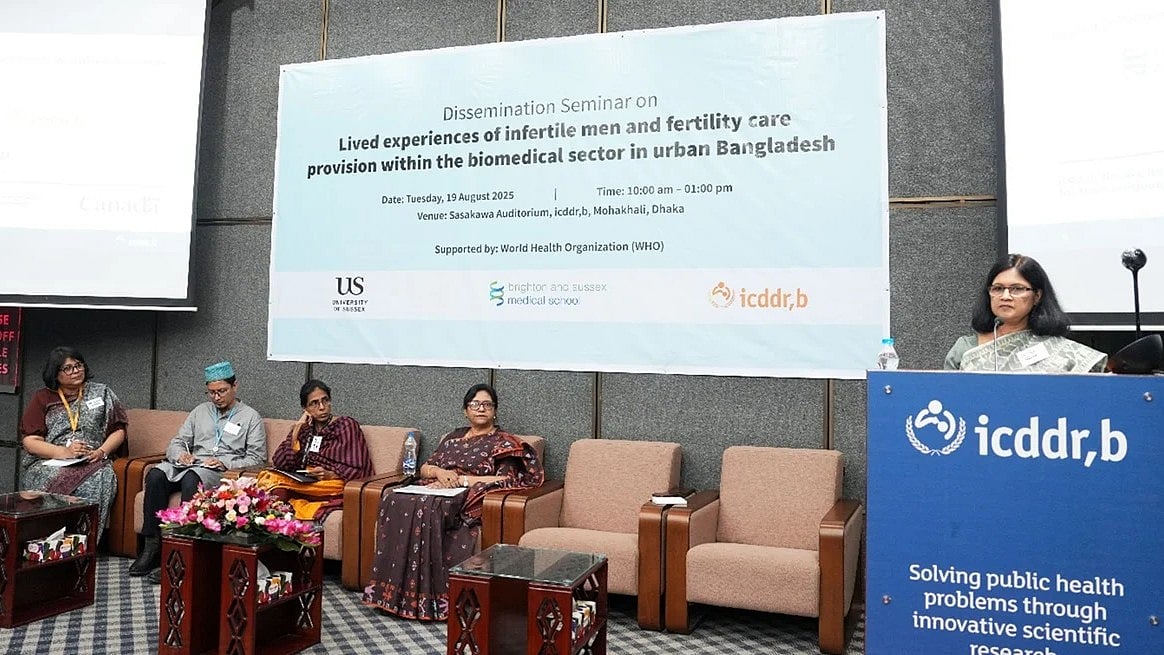
Globally, infertility affects men and women equally, yet it is often seen primarily as a women’s issue.
This misconception leads to delayed diagnosis and treatment for men, while their emotional and psychosocial needs remain overlooked.
In Bangladesh, the neglect is even more evident as there is no national prevalence data, and male infertility is largely excluded from reproductive health programmes, according to the findings.
Standard protocols or referral pathways are missing, and stigma, limited awareness, and misinformation continue to hinder timely diagnosis and care.
To address this issue, icddr,b organised a dissemination seminar on “Lived Experiences of Infertile Men and Fertility Care Provision within the Biomedical Sector in Urban Bangladesh” on 19 August 2025 at the Sasakawa Auditorium, icddr,b, Mohakhali in Dhaka, says a press release.
The event shared the preliminary findings of the qualitative study and key policy messages with the relevant stakeholders such as government officials from Directorate General of Health Services (DGHS) and Directorate General of Family Planning (DGFP) of Ministry of Health and Family Welfare (MOHFW), World Health Organisation (WHO) Bangladesh representative, infertility specialists, healthcare providers, academicians, and representatives from UNICEF, BRAC and media.
icddr,b was conducting this study in collaboration with the Brighton & Sussex Medical School supported by the WHO through the University of Sussex, United Kingdom.
The seminar began with welcome remarks from Dr Md Sharful Islam Khan, Head, HIV and AIDS Programme, Health System and Population Studies (HSPSD), icddr,b, who highlighted the importance of addressing male infertility as both a public health and social justice issue, emphasising the need to ensure inclusion of men in reproductive health policy.
Dr Papreen Nahar, Principal Investigator and Principal Research Fellow, Brighton & Sussex Medical School, University of Sussex, UK, presented an overview of infertility, emphasising the need to include men in infertility evaluation to address barriers to accessing biomedical treatment.
The icddr,b research team, Dr Foyjunnaher Sultana, Ms. Mushtari Muhsina, Md Musfikur Rahman, and Md Zamiur Rahaman, presented findings on systematic review of male infertility in LMICs, desire for fatherhood, treatment-seeking among childless men, and patients’ perspectives on barriers.
Dr Sohana Shafique (Co-PI), project coordinator and Lead, Urban Health and UHC, HSPSD, icddr,b, shared the providers’ perspective.
Dr James Kiarie, Head, Contraception and Fertility Care Unit, Human Reproduction Programme, WHO Geneva, and Dr. Md Nurul Islam Khan, Programme Officer, WHO Bangladesh, in their remarks urged stakeholders to support this initiative and improve infertility care programmes in Bangladesh.
Special guests Syed Kamrul Islam, Director Primary Health Care (PHC), DGHS, and Dr. Nazma Akter, assistant director (Planning & Research), DGHS, stressed the need for integrating male infertility within existing reproductive health and primary care systems.
Health experts and stakeholders from DGHS and other government entities reflected on the importance of addressing infertility in Bangladesh’s health policy.
Speaking as the chief guest, Ashrafi Ahmad, additional secretary and Director General, DGFP, MOHFW, also underscored the urgent need for more research and policy attention.
Key findings of the study are: 1. Fatherhood is central to men’s identity, making infertility a source of distress, stigma, and relationship strain. 2. Infertility is framed mainly as a women’s issue, so men often suppress their emotional and psychosocial needs 3. Male infertility is largely absent from policies, funding, and health system priorities, resulting in delayed care. 4. Services are costly, urban-focused, and women-centered, limiting access for men. 5. Male infertility is rarely integrated into reproductive health, family planning, or mental health programmes.
The study recommends recognising male infertility as a public health and gender equality issue, expanding affordable, male-inclusive services beyond cities, tackling stigma through awareness campaigns, and integrating mental health and partner support into infertility care and strengthening data collection and research capacity.