Hilsa production declines for 4 reasons, prices high even in peak season
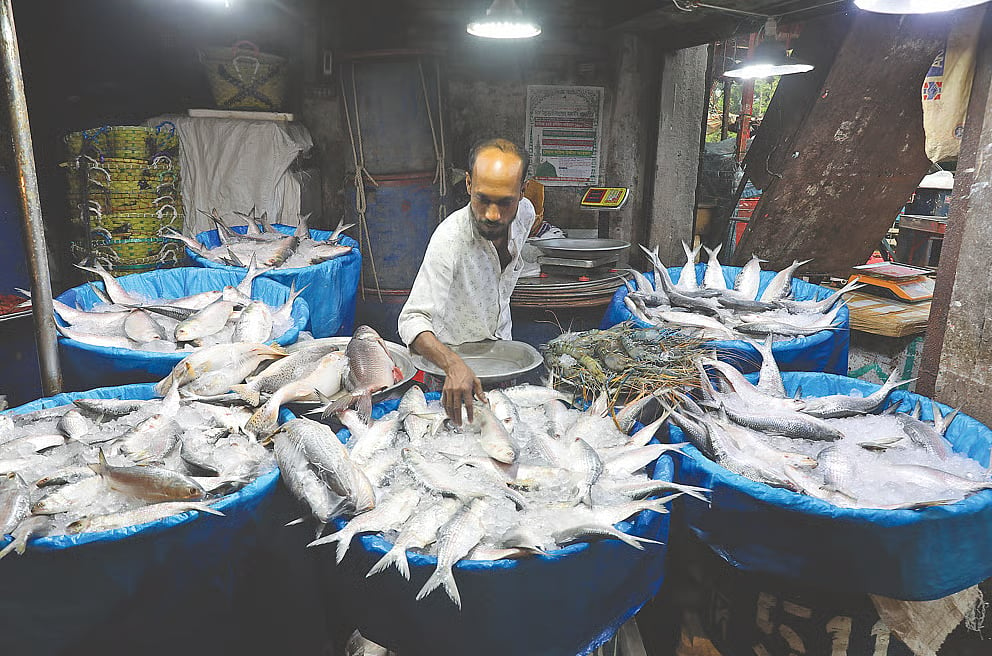
The fish market on the ground floor of the Karwan Bazar kitchen market in the capital was bustling with hilsa vendors.
At five shops, they sat with hilsa on display, waiting for customers. A customer, Altaf Hossain, was bargaining over the price of hilsa.
He said, “I have come to buy hilsa for the second time this year. I thought I would buy a one-kilogram fish. They are asking Tk 2,400. I bought one last time for Tk 1,800. What happened this year?”
Altaf Hossain bought two 750-gram hilsa from fish trader Shukkur Ali’s shop. He could not afford a one-kilogram fish because it wasn't in my budget. Two baskets at Shukkur Ali’s shop contained 250-gram hilsa.
He said, “This year, there is greater demand for this type of hilsa. The price of hilsa will never come down again. This year, all types of hilsa are Tk 400 to Tk 500 more expensive than last year.” He has been in the fish trade for 20 years and said he had never seen hilsa prices this high.
He said he had not sold one-kilogram hilsa for less than Tk 2,200 this year. Yesterday, Sunday, he sold them for Tk 2,400 each.
An investigation into the reasons behind the high price of hilsa found that its production, or catch, has declined for the past two years. The situation has raised concerns among researchers.
Hilsa researcher Md Anisur Rahman has called for an investigation into the reasons behind the decline. He said, “What I have been seeing for the past two years is alarming. Both people and nature are responsible for this.”
Researchers currently believe that the spread of nets with extremely fine mesh in the sea, excessive fishing, pollution and underwater shoals are contributing to the decline in hilsa production.
“There are no fish in the river”
The fish wholesale market in Chandpur, known as the capital of hilsa, used to remain bustling from July onwards.
Abdul Bari Jamadar, president of the Chandpur Fish Traders Cooperative Society Limited, said that even three years ago, the market received an average of 2,000 maunds of hilsa every day after July.
This year, the daily supply has not exceeded an average of 250 maunds. Last year, the average was around 400 maunds. He has been in the profession for 30 years and said he had never seen such a shortage of hilsa.
The hilsa trader believes that pollution in hilsa habitats, underwater shoals and the spread of nets with extremely small mesh in the sea are causing the decline in hilsa numbers. Such nets, locally known as behundi nets, are banned.
The Mahipur Fish Landing Centre in Kalapara, Patuakhali, is one of the country's major wholesale markets for hilsa. Fish trader Fazlu Gazi has been in the fish trade for more than two decades. He owns four trawlers. The port mainly receives hilsa caught at sea.
Very few trawlers have managed to bring back more than 20 to 30 maunds of fish from the sea this year. Last year, most trawlers could bring back 20–30, and sometimes 40, maunds of fish, the trader said.
This year, another major problem has been the repeated weather warning signals at sea. In his view, the main reason for the shortage of hilsa is simple: “There are no fish in the river. If there are no fish, where will we get them from?”
“People walk away after hearing the price”
High prices have also led to lower hilsa sales this year. Demand for smaller hilsa has increased compared with larger fish.
Another trader, Sarafat Ali, was sitting at Karwan Bazar with hilsa, waiting for customers. His three baskets contained hilsa weighing 1kg, more than 1kg, 600g and 250g. He said, “There are fewer fish this year, and there are fewer customers too. People walk away after hearing the price.”
Sarafat Ali said demand for 250–300g hilsa had increased significantly this year. He had never sold so many small hilsa before. He believes that people are buying smaller fish to meet their demand because prices are high.
I have come to buy hilsa for the second time this year. I thought I would buy a one-kilogram fish. They are asking Tk 2,400. I bought one last time for Tk 1,800. What happened this year?Private-sector employee Altaf Hossain
A review of data from government agencies and consumer rights organisations over the past decade shows that hilsa prices have risen steadily.
However, the pace of increase accelerated significantly after 2022. The rise reached an unusually high level in 2025 and has continued into the current year.
According to data from the Consumers Association of Bangladesh (CAB), the average price of hilsa weighing 500g to 1kg was Tk 505 in 2014.
Market data show that in 2016, 1kg hilsa generally sold for between Tk 950 and Tk 1,000. By 2023, the price had risen to Tk 1,200.
According to the Department of Agricultural Marketing, the annual average retail price of hilsa of all sizes was Tk 705.50 per kilogram in 2018. The average price reached around Tk 1,050 in 2022. It rose to Tk 1,095.90 in 2023 and increased further to Tk 1,168.56 in 2024.
Based on these figures, the annual average price of hilsa increased by around 67 per cent over the four years from 2020 to 2024. However, as the annual average includes hilsa of all sizes, the market price of good-quality 1kg fish was considerably higher.
Sarafat Ali said demand for 250–300g hilsa had increased significantly this year. He had never sold so many small hilsa before. He believes that people are buying smaller fish to meet their demand because prices are high.
Hilsa prices rose again in 2024. According to a survey by the Bangladesh Trade and Tariff Commission, fish weighing 1–1.5kg sold for Tk 1,600 –Tk 1,800 that year. Hilsa weighing 750g–1kg was priced at Tk 1,100–Tk 1,150, while fish weighing 500–750g sold for Tk 800–Tk 1,000.
The same survey recorded a sharp rise in prices in August 2025. Hilsa weighing 1–1.5kg sold for Tk 2,500 –Tk 2,600. The price of 750g–1kg hilsa reached around Tk 1,500, while fish weighing 500–750g sold for Tk 1,200–Tk 1,400.
“The hilsa trove is being destroyed”
An analysis of data from the Department of Fisheries shows that Bangladesh produced 200,000 tonnes of hilsa in the 2007–08 financial year. Production increased every year thereafter. It reached a record 571,342 tonnes in the 2022–23 financial year.
However, hilsa production has declined for two consecutive years since then. Production fell by 7 per cent to 529,487 tonnes in 2023–24, compared with the previous financial year. It then declined by around 12 per cent to 500,000 tonnes in 2024–25.
The authorities will calculate this year’s production figures later. However, traders fear that production could be 30-40 per cent lower than last year.
I did not expect the rate of hilsa production to start declining so rapidly. Urgent research is now needed on this issue.Md Anisur Rahman, Hilsa researcher
Anisur Rahman has made significant contributions to hilsa research in Bangladesh. He finds this year’s sharp decline in hilsa catches and the resulting high prices astonishing.
In his words, “I did not expect the rate of hilsa production to start declining so rapidly. Urgent research is now needed on this issue.”
He said the excessive use of behundi nets, overfishing and the prevalence of underwater shoals could all be contributing factors, with pollution potentially playing the most significant role. However, researchers need sufficient evidence to establish the causes and must develop appropriate plans to increase production accordingly.
Researchers consider excessive fishing using extremely fine-mesh nets a major factor behind the decline in hilsa production.
To understand the current state of hilsa, several teams from the Fisheries Research Institute in Chandpur have begun working in hilsa habitats across the country.
One team recently travelled to Hatiya and observed behundi nets spread across a vast area at the mouth of the estuary.
Tayefa Ahmed, chief scientific officer of the institute, told Prothom Alo that fishermen had set up nets in an area shaped like a mouth. She asked, “If such a vast network of nets covers the mouth, how can hilsa move through the area?”
Many people have attributed the decline in hilsa production this year to assumptions. However, Tayefa Ahmed provided concrete evidence.
According to their research, only 20-30 per cent of the hilsa caught this year have eggs in their stomachs. Two or three years ago, the proportion was close to 50 per cent. This indicates that the number of mature hilsa is declining.
Anisur Rahman believes that the decline in catches of larger hilsa indicates an overall decline in hilsa production. He said, “Our sea is the trove of hilsa. It can be said that this trove is being destroyed.”