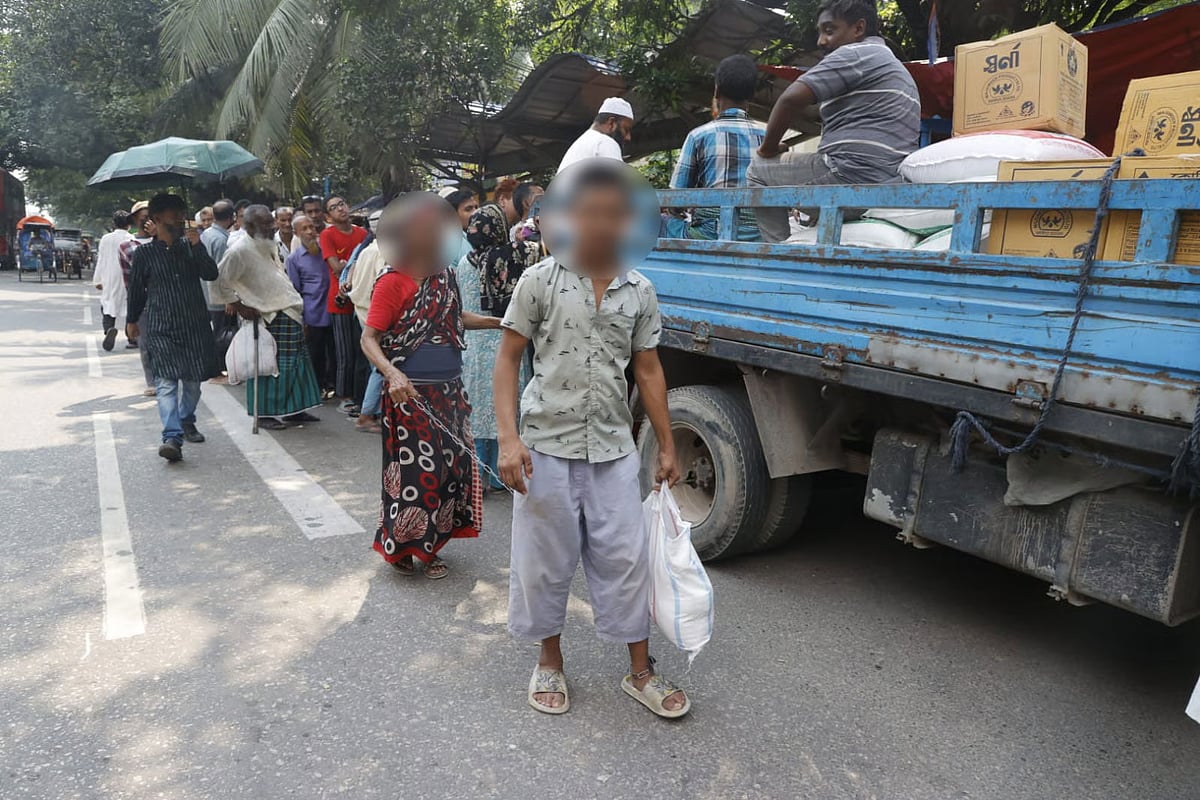
Woman in TCB queue with grandchild tied by chain
Around 200 men and women gathered on a road in front of Sony Cinema Hall in Dhaka’s Mirpur at around 1:00 pm yesterday, Tuesday. They were waiting for a Trading Corporation of Bangladesh (TCB) truck expected to arrive to sell essential goods at subsidised prices. But among the crowd, one scene stood out.
Seventy-year-old Salema Begum was holding a chain, and that chain was tied to the leg of 15-year-old teenager Saiful Islam. She brought her grandson, tied with a chain, to buy oil and lentils from the TCB truck.
Saiful Islam is a person with special needs by birth and cannot understand his own well-being or safety. He has gone missing three times before. After the most recent incident last year, when he went missing from Mirpur and was later found by police in Narayanganj, Salema Begum now keeps him chained to prevent him from getting lost again. As there is no one at home to watch him, she had no choice but to bring him along while coming to buy TCB goods.
Struggle of an impoverished household
Salema Begum works as a cook in a mess in Mirpur-1 area, with her elder daughter helping her. Saiful is her grandson. Her husband Amir Hossain works as a vegetable shop employee. Together they earn around Tk 25,000 per month. In addition, Salema receives Tk 1,900 every three months as an old-age allowance.
But this income is not enough to cover household expenses, forcing them to seek help from others for medical or other needs. That is why, whenever possible, she stands in line for TCB truck sales to save some money.
When asked, housemaid Salema Begum said with frustration, “Whatever we earn is not enough for a family of five. Sugar, lentils, and soybean oil are very expensive. That’s why whenever I get a chance, I stand in line for the TCB truck.”
From TCB trucks, subsidised edible oil, sugar, and lentils are sold. One consumer can buy a maximum of two litres of oil, one kilogram of sugar, and two kilograms of lentils. The prices are Tk 130 per litre of oil, Tk 80 per kg of sugar, and Tk 70 per kg of lentils. If all items are purchased together, the total cost is Tk 480. In the retail market, the same goods cost around Tk 700–720, meaning a saving of Tk 220–240.
However, Salema Begum said buying goods from TCB trucks is not an easy task. She left home at 11:00 am in search of the truck. First, she went by rickshaw to the front of Mirpur Bangla College and waited for about an hour.
As the truck did not arrive, she went again towards Mirpur-2. On the way, seeing a crowd in front of Sony Cinema Hall, she got down there. Everyone had gathered to buy TCB products, but even by 2:15 pm the truck had not arrived. Eventually, she became frustrated and decided to return home.
At around 2:30 pm, another TCB truck stopped near Mirpur Heart Foundation after turning from the Sony Cinema Hall intersection. Seeing this, the crowd rushed towards it. Within moments, chaos broke out with pushing and shoving.
In the rush, Salema could neither stand in the women’s line nor the men’s line with her grandson. Helpless, she stood beside the truck for a long time. Later, on the request of people present, the dealer sold her goods without her standing in line as a special consideration.
After purchasing the goods, Salema Begum told Prothom Alo, “There was no cooking oil at home. If I buy two litres from a shop, it costs Tk 400. Here I bought it for Tk 260. In total (including lentils and sugar), I saved around Tk 250. When these are finished, I will come again.”
Pressure of rising prices on people
Inflation in the country rose again above 9 percent in April, mainly driven by increased fuel prices. Prices of vegetables and other goods in the market remain high. It is hardly possible to buy vegetables for less than Tk 60. One litre of bottled soybean oil costs Tk 200.
Recently, egg prices have increased to Tk 150 per dozen. Prices of tilapia, pangash, broiler chicken and others have also increased. In this situation, many low and limited-income people stand in TCB truck queues to save money.
TCB last conducted truck sales during Ramadan across the country. After that, it resumed sales again from Monday for Eid-ul-Azha, which will continue for 10 days until 21 May 21, except Fridays.
During this special operation, TCB will sell goods to about 2.88 million beneficiaries, distributing 13,939 tonnes of products. Along with truck sales, TCB also regularly sells goods to card-holding families.
Jostling and chaos a regular occurrence
According to TCB, each truck carries goods for around 400 buyers, but more people usually arrive, leading to frequent pushing and shoving in queues. In most cases, no proper serial system is maintained, which increases chaos further.
Yesterday, at Mirpur Heart Foundation, Nazma Begum, a cleaner at a private organisation, came to buy goods from a TCB truck but could not stay in line for long due to pushing and shoving. She eventually left and returned to work. She told Prothom Alo, “I took a one-and-a-half-hour leave from office, but due to the chaos I could not stay in line. Now I am returning empty-handed.”