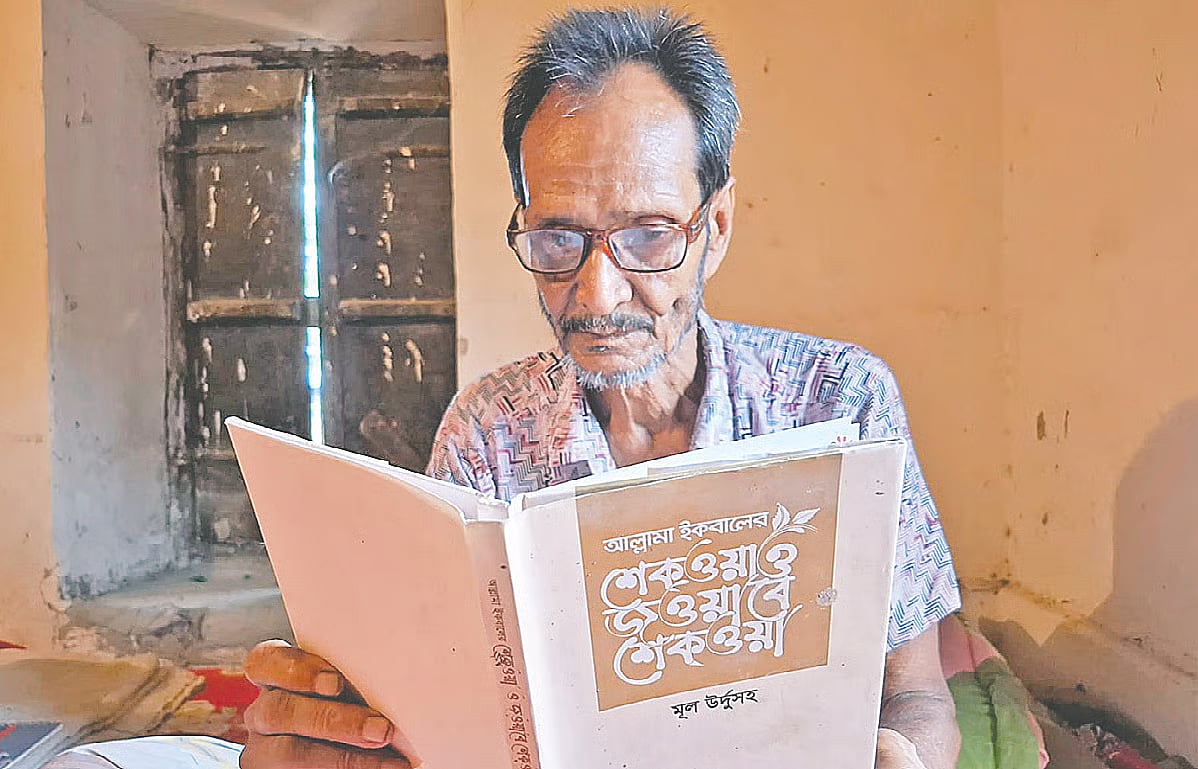
Farmer by day, writer and songmaker by passion
Sohorab Ali realised during his school years that the world of learning was far wider beyond the syllabus. So he left formal education and immersed himself in reading. He is 72 now with world literature, philosophy and history becoming the core of his study. Remaining a farmer he spent all his life thinking of an exploitation-free society and continues to write protest songs for farmers and workers.
Farmer Sohorab Ali is from Madaripur (Jamsherpur) village in Tanore upazila of Rajshahi. He buys thick volumes on history and philosophy, not only to read himself but also to share with other farmers. Even those farmers who never attended school have been turned into readers by him. His aim is to shape farmers into truly educated individuals.
So far, he has written more than fifty protest songs. “Kaste, haturii aar gaity haate, dol bendhe chhuti eki shathe / Shifting bhenge mora gori imarat, amader nalisher nei adaalat”- countless such songs composed by him are performed by local singers at various events.
His songs are rich, but like his wandering lifestyle, the lyrics are scattered everywhere. Some were written on cigarette packets, others on torn pieces of paper. Many were thrown away by his wife. Only those composed and preserved by local singers have survived.
Songs written on scraps of paper
I first met Sohorab Ali last year during the Nabanna festival in Madaripur village. Guests were served payesh (dessert) in banyan leaves with spoons made of palm leaves. Local singer Rezaul Islam (Babu) performed one of Sohorab’s protest songs, “Kaj kore khete chai, lanchona keno pai, jobab dibe ki go bishwobashi” there.
Both the lyrics and melody were entirely new. Tracing the song’s origin led me to Sohorab. At the same event, another singer schoolteacher Ataur Rahman sang one more of Soharab’s songs, ‘Bar bar ashe plabon kheye jaay shonar dhan’.
Poet and novelist Moin Sheikh, from Tanore in Rajshahi, knows Sohorab well. He says Sohorab writes only about life. His songs are rich, but like his wandering lifestyle, the lyrics are scattered everywhere. Some were written on cigarette packets, others on torn pieces of paper. Many were thrown away by his wife. Only those composed and preserved by local singers have survived.
Sohorab has a collection of more than six hundred books. Of them, only about a hundred remain in his home and the remaining 500 are with readers across the region.
Sohrab’s books in readers’ homes
Just as Sohorab writes songs to inspire farmers to improve their lives, he also puts books into their hands. Satyendranath Pramanik, who never went to school, became a reader by borrowing books from him. In Sohorab’s words, Satyen is his most devoted reader and he is now able to read philosophy and even explain it.
During a recent visit to Madaripur village, Sohrab was found sitting on a bed in his earthen house, reading Allama Iqbal’s Shikwa and Jawab-e-Shikwa. His shelf held books like Syed Abul Hai’s Bharatiya Darshan, Aroj Ali Matubbar’s collected works, Rousseau’s The Social Contract, Rubaiyat of Omar Khayyam, Rabindranath’s Japan Jatri, and Revati Barman’s translation of Capital by Karl Marx.
When asked why he remained a farmer despite being an avid reader all his life, Sohorab quoted a line from Begum Rokeya’s ‘The Peasant’s Sorrow’ that roughly translates to ‘On this harsh earth the peasant has come only to endure…’ He added, “As the son of a farmer, perhaps I was shaped by this way of life.”
Sohorab has a collection of more than six hundred books. Of them, only about a hundred remain in his home and the remaining 500 are with readers across the region.
The man recounted how, after two years, a reader in Rajshahi finally returned Aroj Ali Matubbar’s ‘Chintaar Jagat’ on this 30 August. On the same day, he also collected Haider Akbar Khan Rono’s ‘Forashi Biplob theke October Biplob’ from a reader in Machmoil village in Bagmara upazila of the district. He travelled from Tanore to Rajshahi city only to retrieve those two books. Much of his library lives in other people’s homes like this.
Thinkers who influenced him include Marx, Engels, Lenin, Stalin, Mao Zedong, Ho Chi Minh, Che Guevara, Fidel Castro, Washington, Abraham Lincoln, Master Da Surya Sen, Pritilata Waddedar, and Subhas Chandra Bose.
A small story that changed a life
Sohorab said when he was in school, a story in Harlal Ray’s Bengali grammar textbook, ‘Chorer Atmakahini’ (Autobiography of a Thief) opened his eyes. In the story, a child asks to see a thief, and after seeing him, says, “Where is the thief? He is just a human.” “That was the first time I learnt that I too was human,” the thief narrates.
Such stories shaped Sohorab’s humanistic worldview from childhood. As a child, he used to steal rice from his home and give it to the poor families living nearby in Haripara, who often had nothing to eat. He also spoke of the character Jean Valjean from Victor Hugo’s Les Misérables, who was sentenced to 19 years in prison for stealing bread. He said the story still brings tears to his eyes.
Sohorab started reading in primary school. After SSC, he abandoned formal education and began what he calls “real study.” Thinkers who influenced him include Marx, Engels, Lenin, Stalin, Mao Zedong, Ho Chi Minh, Che Guevara, Fidel Castro, Washington, Abraham Lincoln, Master Da Surya Sen, Pritilata Waddedar, and Subhas Chandra Bose. He has studied their lives in depth. “I read countless novels in my youth,” he said. “Now I can’t pull myself away from philosophy.”
Sohorab Ali has two sons and two daughters. The younger son and daughter are graduates hile the elder two studied up to HSC. All are married. He has no regrets about remaining a farmer all his life. He still lives in his 150-year-old ancestral earthen house. Eleven others from the extended family have moved on to build large homes elsewhere, he alone has remained here.