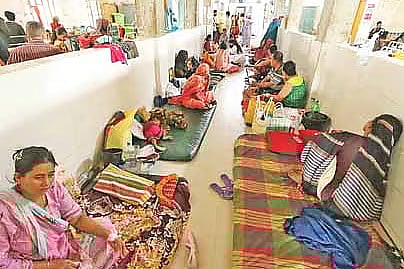
Patients with critical health issues are left with no treatment in Rangamati as the modern sadar hospital of the district has no intensive care unit (ICU), coronary care unit (CCU), and dialysis facilities, even after 0ver four decades of its establishment in 1984.
In the district, patients with heart disease, kidney ailments, or other serious issues are referred to the Chittagong Medical College Hospital, which is about 60 kilometers from Rangamati Sadar. In some cases, patients are even sent to hospitals in Dhaka. According to physicians, 100 to 150 patients are referred every month, which is about 3 to 5 patients a day.
Families of patients from remote hill areas struggle with the costs and stress of traveling to Chattogram or Dhaka, in addition to accommodation, food, and mental toll.
The 100-bed sadar hospital – locally known as the General Hospital – serves approximately 650,000 people from 10 upazilas in the district. It frequently accommodates 200 to 250 inpatients. Due to the shortage of beds, many patients receive treatment on the floor.
During a visit to the hospital on the morning of 8 July, it was seen that every bed in the women and children wards was occupied, with some more patients lying on the floor. In the children’s ward, makeshift bedding was spread across the floor, where family members were staying with their sick children.
One patient’s husband said his wife was suffering from breathing difficulties. When he brought her to the hospital, there were no available beds due to overcrowding, and she was placed on the floor. However, physicians were attending to her regularly.
Four years ago, the hospital’s two-story building was expanded with a makeshift third floor under a tin roof, where women, children, and maternity patients are now treated.
Speaking about the situation, Shawkat Akbar, the hospital’s resident medical officer (RMO), told Prothom Alo that 1,000 to 1,200 patients are seen daily in the outpatient department, with another 200–250 inpatients. The hospital is operating with limited staff – only 22 physicians are working against 31 positions. The most severe shortage is in third- and fourth-class positions.
The CCU building is now a college
In 2009, a six-story building was constructed next to the hospital to house the CCU for cardiac patients. But it was never used for medical purposes. Since 2015, it has been used as a temporary campus for Rangamati Medical College. A decade has elapsed since then, but the permanent campus has not yet been constructed. The project was approved with a deadline of June 2028. Students and teachers are now doubtful about the fate of their permanent campus.
In February 2021, the foundation stone was laid for an 11-story hospital building meant to introduce ICU, CCU, and dialysis services and expand bed capacity. The then-MP Dipankar Talukder inaugurated the project under the Directorate General of Health Services and Public Works Department.
Construction of the first six floors is complete, and the hospital authorities are yet to take its possession. The building is unlikely to be handed over within this year. The total construction works were supposed to be completed by June 2023, but it did not happen.
According to physicians, just completing the building is not enough. Without medical equipment, furniture, and trained personnel, no services can begin there. Approval for staffing for the additional beds is also needed.
Reliance on Chattogram, 60 km away
Eight months ago, Atif Chakma, a resident of remote Jurachhari, began experiencing severe abdominal pain. His family took him by boat to Rangamati Sadar Hospital, hoping for relief. But after initial treatment, he was referred to Chittagong Medical College Hospital, forcing the family to rush there again.
Ripon Chakma, a relative, told Prothom Alo that the boat ride from Jurachhari to Rangamati takes two to three hours. After that, they had to make the long trip to Chattogram, where Atif received treatment for four days and eventually recovered.
Russel Chakma, a shopkeeper from Kalindipur in Rangamati town, has been undergoing treatment for kidney disease for the past 18 months. Twice a week, he travels to a private hospital in Chattogram for dialysis, spending around Tk 12,000 each week on treatment and travel. Each round trip takes 5–6 hours.
It’s extremely difficult to travel this way with sickness, he said, adding, “If the Rangamati General Hospital had dialysis facilities, it would save both the physical burden and Tk 7,000–8,000 a week.”
RMO Shawkat Akbar said if ICU, CCU, and dialysis services were available at the hospital, it would benefit the people of the area. Now, they are forced to refer such patients to Chittagong Medical College Hospital.