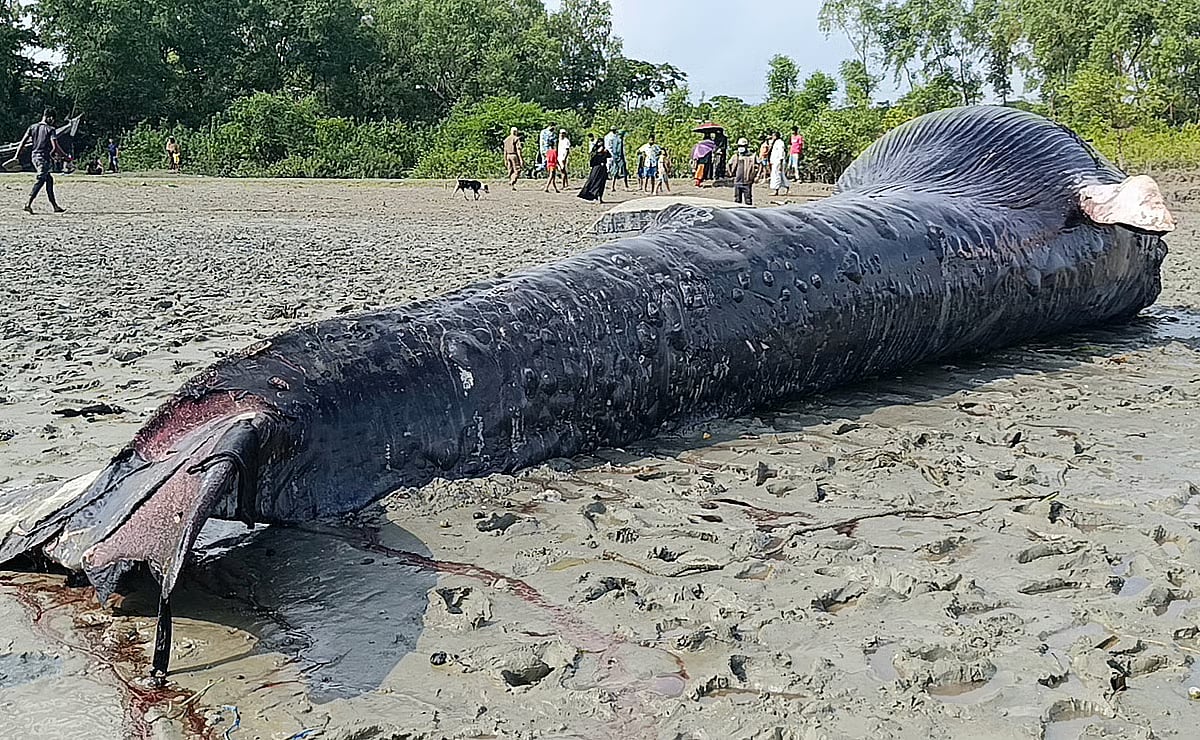
30-foot-long whale washes ashore in Andharmanik River
A 30-foot-long dead whale has washed ashore on the banks of the Andharmanik River in Taltali upazila of Barguna.
The whale was found near the ferry ghat in the Charpara area of Barabagi union around noon on Wednesday.
Members of the Forest Department and Coast Guard recovered the whale after being informed.
According to local residents and Forest Department sources, the dead whale had drifted into the Andharmanik River from the Bay of Bengal.
Local residents later brought it from the middle of the river to the riverbank. However, as the whale had died several days earlier and had begun decomposing, causing a foul smell, it was pushed back into the river.
After receiving the information, officials from the Nishanbaria Forest Department beat recovered the dead whale from the river. The Forest Department said the whale is approximately 30 feet long and may weigh between five and six tonnes.
Photographs of the whale were sent to Mir Mohammad Ali, a teacher and researcher at the Faculty of Fisheries and Marine Science at Sher-e-Bangla Agricultural University. Based on the photographs, he said it initially appears to be a baleen whale. This is the type of whale most commonly seen in the Bay of Bengal.
Baleen whales are marine mammals that have fringed plates called baleen in their mouths instead of teeth. They use these plates to filter seawater and feed on tiny organisms such as krill and plankton. The blue whale, the largest animal in the history of the Earth, belongs to this group.
Baleen whales are enormous, ranging in length from about 20 feet to as much as 100 feet in the case of blue whales. They feed by filtering water through their hard but flexible baleen plates, which are made of keratin. They have two blowholes on top of their heads.
Confirming this information, Taltali Range Officer Ziaur Rahman of the Patuakhali Forest Department told Prothom Alo that the huge whale that washed into the river is decomposing and emitting a foul smell. It will be buried to prevent environmental pollution, he said.
Describing the whale as black in colour, Taltali Upazila Nirbahi Officer (UNO) Atish Sarkar said a Forest Department team had gone to the site after receiving the report. Coast Guard members were also there. Necessary measures were being taken regarding the dead whale, he said.
Mir Mohammad Ali said it is not possible to determine the cause of the whale’s death at this stage, but several possibilities could be considered.
The whale may have become entangled in a fishing net, collided with a large vessel, ingested plastic or been affected by marine pollution, or entered shallow waters while being carried by currents after becoming ill.
There have also been previous instances of whales entering rivers during high tide and becoming stranded when the tide receded, he said.
An on-site examination would be necessary to determine the actual cause of death. If samples are collected from the whale’s body and its skeleton preserved, they could be valuable for research and educational purposes.