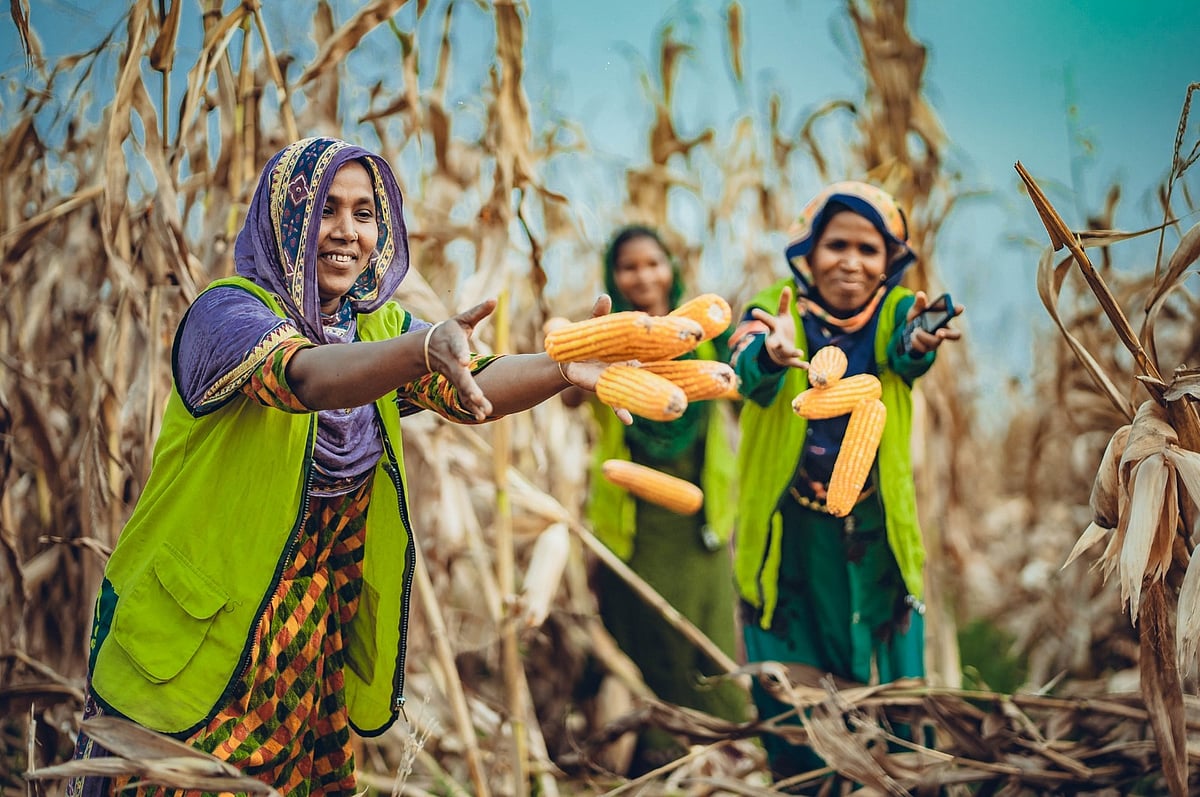
Children attending schools, agriculture insurance brings light to women's lives
When floods come, Sharmin Akhter of Bondober Union in Roumari Upazila, Kurigram, lives in fear. Repeated floods destroy her crops. Yet every year she starts again with hope. When the harvest is good, she plans to build a better home and admit her son to school. But even last year, her onion crop was destroyed by a flash flood. However, this time she did not suffer losses like before. She had insured the crops on her 21 decimals of land—and received its benefits.
Sharmin Akhter said, “I had always heard that people get life insurance. But I heard from some local brothers that there is insurance for crops, too. At first, I couldn’t believe it. Still, with some doubt, I insured my crops. Last year, I grew onions on 21 decimals of land, and the flash flood destroyed them. I received 8,000 taka in compensation through insurance. I had a dream of sending my son to school. That dream has now come true. With that money, I admitted my son to school. This year I planted Aman paddy on 21 decimals of land. I think farmers across the country should come under agricultural insurance.”
Meghna Khatun is a resident of Astamir Char in Chilmari Upazila. She lost everything due to erosion from the Teesta River. After that, she found shelter in Astamir Char. Working hard from dawn to dusk, she grew golden crops on the char. But every year, natural disasters destroyed her rice, jute, or maize. Despite backbreaking work, her financial condition did not improve. Every year, a portion of her crops would be lost due to flash floods or severe drought.
Meghna’s family was living hand to mouth. But with other women in the village, she formed the “Jugnidhi Women’s Climate and Livelihood Development Committee” and introduced crop insurance in her area. As a result, char residents now grow crops throughout the year despite risks. Financial risk in crop production has decreased. The economic condition of families is improving.
Recently, we spoke to Meghna Khatun. She said, “In the char areas, we farm all year round. Alongside various vegetables, we regularly cultivate onion, garlic, and chili. The timing of crop cultivation in chars is slightly different from the mainland. So, growing rice and maize in chars is somewhat uncertain. For example, two years ago, we planted maize a bit early on 15 acres. Due to a severe drought, about eight acres of high land maize were destroyed. This caused nearly one lakh taka in financial losses. This year, through our own committee, we locally introduced crop insurance. I’ve planted maize on all 15 acres with peace of mind.”
Sharmin Akhter and Meghna Khatun are among many who have received support from the United Nations Capital Development Fund (UNCDF) and UNDP’s Local Government Initiative on Climate Change (LoGIC) project. They were informed about crop insurance and its benefits through this project. In that area alone, 18 people have received this benefit. The LoGIC project also operates similar activities in other parts of the country. The project is a joint initiative of the Government of Bangladesh, Sweden, Denmark, UNCDF, and UNDP, implemented by the Local Government Division under the Ministry of Local Government, Rural Development, and Cooperatives (LGRD).
According to government sources, Bangladesh first announced its intention to launch crop insurance at the International Microinsurance Conference held in Dhaka in 2019. The government launched crop insurance the following year in 2020. The state-owned Sadharan Bima Corporation played a leading role, initially piloting crop insurance in Rajshahi, Sirajganj, Noakhali, and the haor areas of Mithamain in Kishoreganj. Later, the NGO Oxfam Bangladesh provided financial assistance to help implement crop insurance in collaboration with the government.
Experts say there is no alternative to popularizing crop insurance across the country. The limited technology and weak supply systems of insurance institutions must be improved. Concerns about farmers receiving their insurance claims must also be addressed. A separate chapter on agricultural insurance should be added to the national agriculture policy.
According to the Bangladesh Bureau of Statistics, the total crop production in the country has surpassed 100 million tonnes. Natural disasters like floods, droughts, heavy rain, salinity, cold waves, and pest infestations cause major losses to farmers. Crop insurance can act as a support system to help farmers recover from such losses.
Government data shows that floods, storms, and heatwaves cause an average of $3 billion in economic losses annually in Bangladesh. Most of these losses are borne directly by farmers. There is no safety net to help them recover, which is why many are losing interest in agriculture. In this situation, experts have called for the urgent expansion of crop insurance in the country.
In neighboring India, crop insurance has been in place for many years. According to Indian media, around 290 million Indian farmers are currently under crop insurance, and every year 55 million more farmers are added. In the last five years, the Indian government has paid around ₹9 trillion in insurance claims.
Professor Farid Khan from the Economics Department of Rajshahi University said that agricultural insurance is essential to protect farmers from unexpected risks in farming. Direct government support is needed in this regard. The government could initiate subsidized insurance schemes under which farmers can insure their crops, poultry, livestock, and fisheries against various risks.
He added, “Agriculture plays an undeniable role in strengthening Bangladesh’s economy. With state sponsorship and timely guidance, establishing a sustainable and permanent crop insurance system will help remove hardship from agriculture and bring back better days for farmers. Given the threats posed by climate change, launching free or subsidized crop insurance is now a necessity. We must remember: a risk-free agriculture today means a secure Bangladesh tomorrow.”