Narayanganj
Initiative to build a clean city
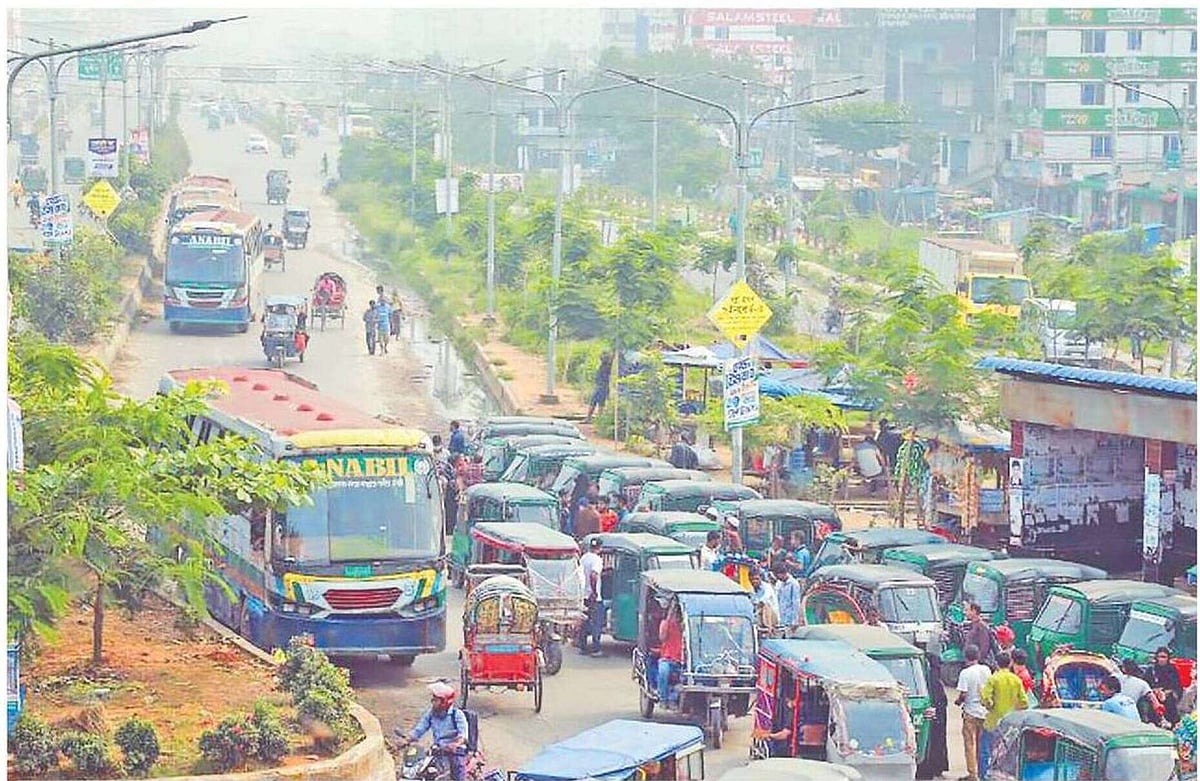
Standing beside the Dhaka–Narayanganj link road in the city’s Chanmari area, one can notices a different view. Where once dust flew and banners and festoons covered everything—now, the six-lane, eight-kilometer road divider is blooming with flowers such as oleander (Raktakorobi), ixora (Rangan), cherry, flame tree (Krishnachura), and pink trumpet. The branches sway with green leaves in the wind. Amid the busy highway, it feels like a touch of serenity.
Through the ‘Green and Clean Narayanganj’ programme, the face of this industrial city is changing. Deputy commissioner Mohammad Zahidul Islam Mian launched the initiative two months ago with the slogan ‘Clean City, Healthy Citizens’.
The programme includes planting hundreds of thousands of trees, installing modern dustbins, and removing waste from canals—breathing new life into the city.
Housewife Rasheda Akhter, a resident of Chanmari, told Prothom Alo, “Earlier, garbage used to pile up everywhere along the roads. Now, waste is collected by trolleys. With the removal of banners and the planting of flower trees, the city has become full of greenery and blossoms. It looks beautiful.”
Rickshaw puller Shahidul Islam added, “There are more trees now—it’s soothing to the eyes. Who wouldn’t love to live in such a city?”
Life returns to hundreds of thousands of trees
The tree-planting programme gave a new message of greenery in pollution-stricken Narayanganj. To prevent pollution, enhance beauty, and build a tourism-friendly city, the district commissioner launched a campaign two months ago to plant 100,000 trees along roads, parks, canal banks, the Hajiganj Fort, and in five upazilas across the district.
Saplings of 48 native and foreign species—including flame tree, cherry, jacaranda, pink trumpet, foxtail palm, coconut, palmyra, and betel nut—were planted. The initiative not only adds beauty but also brings back birds, shade, and biodiversity—bringing some tranquility to city life.
Anwar Hossain, a resident of Jalkuri, said, “We used to have lots of trees and greenery before, but they disappeared over time. Now, with the tree planting, we can breathe deeply again.”
AB Siddique, district president of Bangladesh Poribesh Andolon (BAPA), told Prothom Alo that the district commissioner’s initiative deserves praise for protecting the environment. The trees must be taken care of regularly. The administration should also be stricter against pollution.
Canal restoration and waste removal
Over the past two decades, 17 kilometers of the city’s 92 kilometers of canals have become clogged with illegal encroachments, industrial waste, and garbage, obstructing the natural flow of water. Even light rainfall would submerge homes and streets up to the knees or waist, causing suffering for hundreds of thousands of people.
Initiatives were taken under to free canals from illegal occupation and remove waste under the slogan ‘Narayanganj City, Our Home; Let’s Be Aware, Let’s Keep It Clean.’ With financial support of Tk 9.6 million from the Water Development Board, 11 kilometers of nine canals at 56 spots were restored, and 3,500 truckloads of waste were removed using excavators and carried away by drum trucks. As water flow improved, waterlogging problems reduced significantly.
Sohel Mia, a resident of Shibu Market in Fatulla, told Prothom Alo that previously, even a light rain caused waterlogging. Now that the canals are being cleaned, the water flow has increased and water drains quickly.
Green Umbrella in transport sector
With the slogan “Training brings confidence, uniform brings dignity, roads will be safe, passengers will be protected,” the district administration has introduced the “Green Umbrella” programme to bring discipline to the transport sector.
Five hundred bus drivers and assistants are receiving training, uniforms, ID cards, and benefits under the Green Umbrella Welfare Fund. A database is being developed with their personal and professional details.
Officials hope that by identifying professional drivers and ensuring quick response in emergencies, discipline will return to the transport system.
Rowshan Ali, general secretary of the Narayanganj Inter-district Bus-Minibus Owners’ Association, told Prothom Alo that the training, database, and welfare fund initiatives will benefit transport workers.
City free of banners- festoons
Previously, the city’s roads and intersections were covered with banners, festoons, posters, and placards, often causing accidents. After dusk, drug addicts would gather behind these displays. Through regular mobile court drives, the district administration removed 130 truckloads of banners and festoons. This not only enhanced the city’s beauty but also reduced road accidents and criminal risks.
Ahmed Ali, a resident of Isdair, said, “Earlier, the entire city was covered with banners. Now, the roads are clear, and the link road gleams under the night lights.”
Nirab Raihan, former convener of Anti-Discrimination Student Movement in Narayanganj, said, “From environmental protection to humanitarian efforts—the duty commissioner’s exemplary role is praiseworthy. I hope this continuity will expand further.”
Regarding the initiative, deputy commissioner Mohammad Zahidul Islam Mian told Prothom Alo that when he joined here, he saw garbage scattered everywhere. The temperature was very high, and there were very few trees. To build a liveable, green, and tourism-friendly city, he launched the Green and Clean Narayanganj programme.
With support from both government and private sectors, the city has already started to change in just two months. Once the trees grow, city residents will enjoy the full benefits, he added.