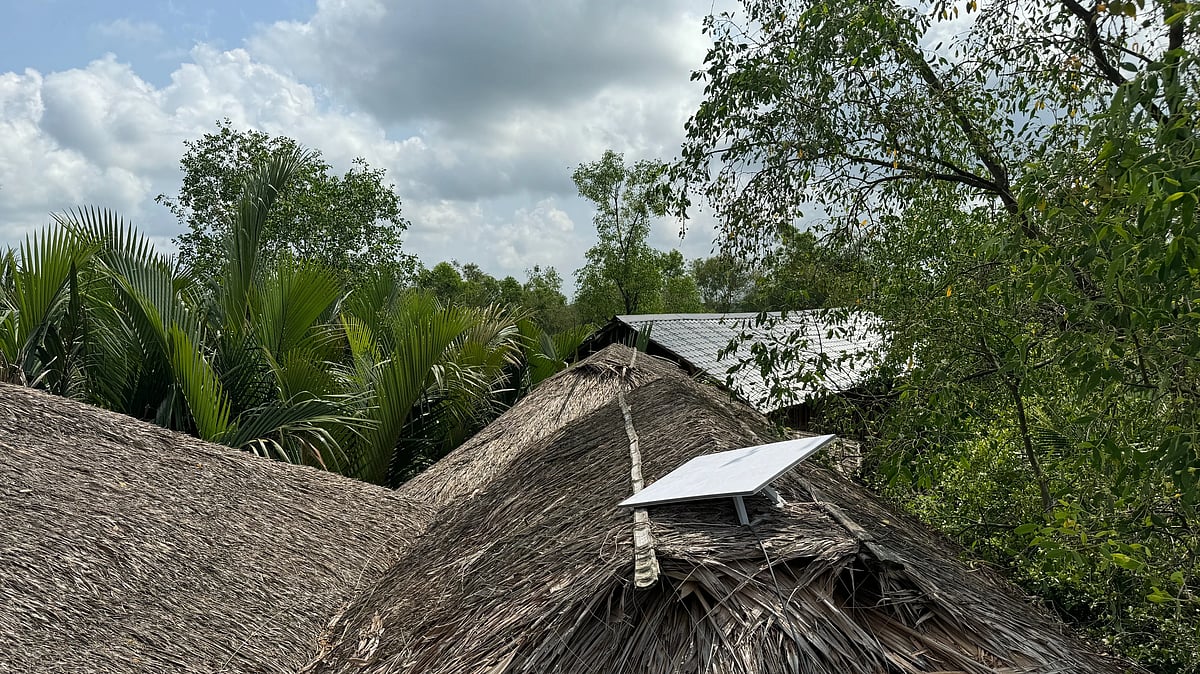
Elon Musk’s Starlink internet in deep Sundarbans
The Sundarbans, with its dense mangrove forests, salty tidal waters, and clusters of golpata (nipa palm) leaves, represents one of nature’s most primitive landscapes. In a place where human presence is limited, access to technology once seemed unimaginable. In particular, poor mobile network coverage in resorts and tourist centres deep inside the Sundarbans has long been a common inconvenience.
But that situation has now changed. Starlink, the satellite internet service owned by Elon Musk’s SpaceX, is creating new possibilities for communication in the Sundarbans.
For a long time, one of the biggest complaints from tourists visiting the Sundarbans was slow internet speed. Due to the limited number of mobile towers inside the forest and signal obstruction caused by dense vegetation, regular 3G or 4G internet is largely ineffective there.
However, Starlink has addressed this problem. Without any towers or underground cables, internet service is now being provided directly via satellites inside the Sundarbans.
Jahangir Hossain, managing director of Jangalbari Mangrove Resort located in Dakop near the Sundarbans, said, “We have been using Starlink internet in two resorts near the Sundarbans for the past few months. Earlier, we had to suffer a lot due to internet issues. Now we can easily manage all our institutional work, including booking management.”
“Most importantly, our guests can now stay connected with anywhere in the world even while being inside the forest. Sometimes we are getting speeds up to 150 Mbps. This was unimaginable in such a remote area like the Sundarbans,” he added.
Md Jwuel, a member of Sundarbans Youth Association, said that many young people now visit the Sundarbans and stay for several days. Due to Starlink internet, their interest in staying around the forest has increased significantly. Uploading videos, doing office work, or communicating via email with Dhaka is no longer a problem, he added.
Tourism trends have changed. People no longer want to be completely disconnected even while traveling, especially those who prefer “workation” — working while traveling. The use of Starlink in the Sundarbans has become a blessing for such tourists.
Tourism trends have changed in recent times. People no longer want to be completely disconnected from work while traveling, especially those who believe in “workation” or working while traveling. The use of Starlink in the Sundarbans has become a blessing for such tourists.
Alimul Hasan, a senior official working for a foreign organisation, recently visited the Sundarbans with his family for three days. Describing his experience, he said, “The natural beauty of the Sundarbans is unparalleled, but mobile internet here is so weak that even checking urgent emails is difficult. However, I was surprised after coming to this resort. The young staff here have taken the initiative to use Starlink. I was able to use internet speeds of around 80 to 120 Mbps while sitting at the resort. As a result, I had no problem doing office work or joining video calls with my family even while staying inside the forest.”
The Sundarbans region is frequently affected by natural disasters. During cyclones or tidal surges, mobile towers and electricity infrastructure are often damaged first, cutting off communication and hampering rescue and relief operations.
Researcher Rubina Haque from North South University’s public health department, who visited the Sundarbans, said that satellite internet like Starlink could play a major role in such crises because it does not depend on local infrastructure. Only a portable receiver and power backup are enough to maintain communication with the outside world even during disasters.
Although broadband internet exists in surrounding upazilas of the Sundarbans, users often remain dissatisfied with its speed and stability. Starlink is now opening a new door of possibilities by filling that gap.
Beyond tourism, this internet accessibility in remote areas of the Sundarbans is also supporting freelance work, online education, and e-commerce among local youth. Researchers related to the Sundarbans are also able to exchange important information through Starlink. However, due to its high cost, Starlink is still out of reach for ordinary people. Reducing the cost could further expand opportunities in this remote region.