Kishoreganj
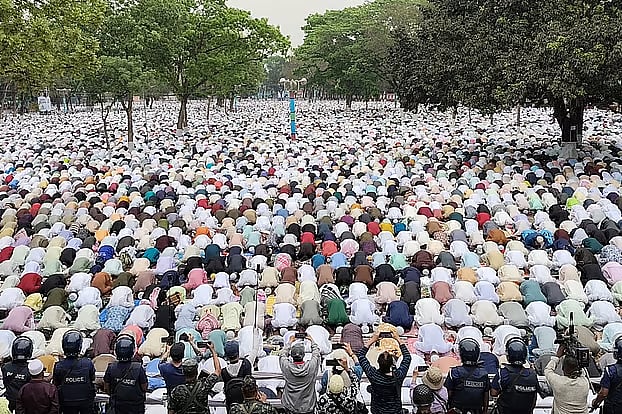
Massive turnout at Sholakia Eid congregation
During the Pakistani era, Ali Akbar Akand, 72, used to walk from Mymensingh district to Kishoreganj's historic Sholakia to perform Eid prayers.
This year too, he prayed at this historic Eidgah field. He has been coming to Sholakia for 57 years. To him, Sholakia is an emotional name. Without performing Eid prayers in this field, the joy of Eid feels incomplete.
Ali Akbar, a farmer by profession, resides in the Tarakanda Upazila of Mymensingh district. He mentioned that when he was around 14-15 years old, he would come to the Sholakia Eidgah field to pray, walking 70 to 80 kilometers, hand in hand with his uncle Ehen Ali.
Each time, he would arrive a day or two before for prayers. This year, he also came a day early.
Recalling memories, Akbar Ali said, "Sholakia is an emotion. When I used to walk 70 to 80 kilometers with the elders during my childhood, it was so enjoyable that I never felt tired from the long journey. I started at the age of 14. By Allah's will, I still come. However, I can no longer walk as I used to. Besides, with better transport facilities, walking isn't necessary."
Idris Ali, 70, also arrived a day earlier from South Balipara in Trishal Upazila, Mymensingh, to pray at Sholakia. He first prayed at this historical ground during the Pakistani era. Idris Ali said when he first came to Sholakia, he was about 15 years old. Although he doesn't remember everything clearly, he recalls having to walk most of the way after setting out with the elders, with only a small portion covered by a pedal rickshaw.
The round trip, including meals, cost him about Tk 20. This year, he was accompanied by his neighbour Hatem Ali, who has been his companion in coming to Sholakia Eidgah for almost 20 years.
Every year, old worshippers gather at Sholakia Eidgah, along with newcomers. This year, for the first time, Bashir Uddin from Palash in Narsingdi, Dulal Mia from Nabinagar in Brahmanbaria, Rois Uddin, Lalchan, Zahir Uddin, and Mohor Uddin from Tarakanda in Mymensingh came to this historic Eidgah to pray. They arrived a day earlier and stayed at the Char Sholakia Bagh-e-Jannat Mosque. They are very happy to have performed Eid prayers at Sholakia.
This year marked the 199th Eid-ul-Fitr congregation at Sholakia. The prayer started at 10am. The prayer was led by Mufti Abul Khair Mohammad Saifullah, the Khatib of the Big Bazaar Mosque in the district town. After the prayer, supplications were made for peace, prosperity, and the overall welfare of the country and the global Muslim community.
Mohammad Aslam Molla, president of the Sholakia Eidgah Committee and deputy commissioner, stated that millions of worshippers performed prayers with enthusiasm and comfort at Sholakia this time. As always, the country's largest Eid congregation was held at Sholakia. The grounds resonated with the ''Allahu Akbar'' chants of millions of worshipers praying for Muslim peace.
It was observed on the ground that from dawn, worshippers began arriving in groups from distant places. By 9 am, the field was filled to capacity. Many participants reported that this year witnessed a record number of worshippers at the historical Sholakia Eidgah.
The famous Sholakia Eidgah Maidan in Kishoreganj, accommodating around 300,000 people, overflowed, turning adjacent roads and fields into seas of people. This year, about 600,000-700,000 worshippers attended.
Following the tradition of the Sholakia field, the congregation began at 10 am with a blank gunshot. After a long wait, worshippers returned home with the satisfaction of Allah following the prayers. The congregation was attended by notable locals, including Md Shariful Alam, MP for Kishoreganj-6, and Md Mazharul Islam, MP for Kishoreganj-1.
State Minister Shariful Alam commented that the climate of fear has dissipated following the restoration of democratic rights through this year’s elections. Now, people of all classes, professions, and religions are enjoying the joy of Eid in a festive atmosphere.
Considering the unexpected extremist attack on Eid-ul-Fitr in 2016, additional security measures were implemented for the country's largest Eidgah, Sholakia, this year as well. The army, RAB, Armed Police Battalion (APBN), Range Reserve Force (RRF), five platoons of BGB, and 11 district police members were deployed.
More than fifty CCTV cameras, along with several drones, were in place to monitor the entire field. The movements of the arriving worshippers were observed through six observation towers. In addition, a volunteer team assisted the police inside and outside the field. For security reasons, no umbrellas or bags were allowed in the field. Worshippers offered the prayers using only thin prayer mats. Special trains were arranged for the transportation of the worshippers.
According to folklore, during the Mughal period, the revenue collected in this area amounted to one hundred thousand takas, which means ten million.
Over time, "Sh lakh" (10 million) evolved into the current "Sholakia." Another account states that in 1828, 125,000 worshippers performed Eid prayers together at the Sholakia Eidgah. Since then, the Eidgah has been known as the Sholakia Eidgah Maidan. These descriptions are also available in the book "History and Tradition of Kishoreganj."