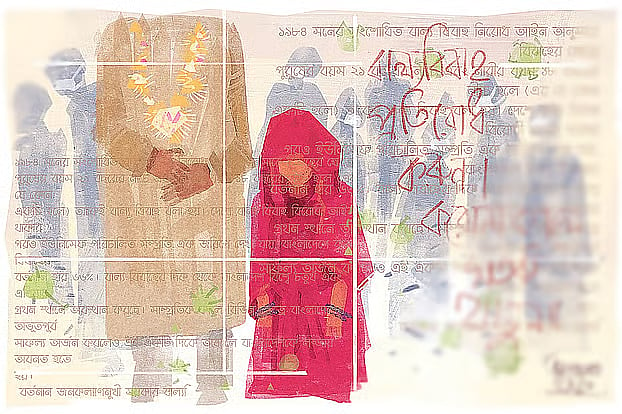
A decade ago, the administration ceremonially declared Kaliganj in Satkhira district a “child marriage-free upazila”. At the time, it also highlighted its success in preventing child marriages. However, one child marriage after another is now coming to light in Kaliganj.
In the past six months alone, 11 child marriages have been prevented in the upazila. However, there is no reliable data on how many child marriages have taken place beyond those prevented.
According to the Office of the District Women Affairs Officer in Satkhira, 132 child marriages were prevented in the district during the first nine months of this year, from January to September. Of the 17 child marriages stopped in September, five were in Tala upazila, four in Kalaroa, two in Satkhira Sadar, two in Kaliganj, two in Debhata, one in Shyamnagar and one in Assasuni.
Most recently, on Friday afternoon, the administration stopped the child marriage of a Class-X student in Kumira Union of Tala upazila. After receiving information that a 15-year-old girl was also being married off in the same union, officials from the Department of Women Affairs and police personnel went to the spot. However, before they arrived, the groom took the girl away in a vehicle. Later, on Monday, the parents involved in these two marriage arrangements were summoned to the office of the upazila nirbahi officer (UNO).
Tala UNO Jannatul Afroz Sorna told Prothom Alo that written undertakings had been obtained from the parents that they would not marry off the girls before they reached adulthood.
Earlier, on 25 October, information emerged about the child marriages of three students in Kaliganj and Sadar upazilas. In September, information was obtained about the child marriages of 13 students of a girls' school in Tala upazila and 16 students of a Dakhil madrasah in Sadar upazila.
Child marriage prevention activists say parents conceal such marriages in most cases. In many instances, even after the administration stops a marriage, parents secretly send their daughters back to their in-laws' homes.
Discussions with parents have revealed several reasons behind child marriages, including romantic relationships over mobile phones, concerns about girls' safety, financial hardship and social pressure.
Administrative officials say they try to stop child marriages whenever they receive information about them. However, cooperation from everyone, including parents, is necessary alongside the administration's efforts.
Girls married off secretly, sent to in-laws’ homes later
The guests had finished eating. Chairs and tables were arranged under a canopy in the courtyard of the house. Cooking pots and food containers were placed nearby. The arrangements were for formally sending a 15-year-old Class-VIII student to her husband's home.
However, after receiving information, officials from the Upazila Department of Women Affairs arrived at the scene. Their intervention stopped the arrangements to send her to her in-laws' home. Later, the parents were made to sign written undertakings and fined Tk 5,000 through a mobile court.
The incident took place in the afternoon of 2 November in Machhiara village of Tala upazila in Satkhira. The girl's father told Prothom Alo that he had arranged her marriage about a month earlier with the consent of both families. However, the girl had not gone to her husband's home. He had arranged the ceremony to send her there formally. Officials from the Department of Women Affairs arrived and told him not to send her to her in-laws' home before she turned 18. He said they had agreed to their instructions.
Earlier, on 25 October, information emerged about the child marriage of a Class-IX student in Bharashimla Union of Kaliganj of Satkhira. She had been married to a young man from a neighbouring village through a family arrangement about two weeks earlier. At the time of the marriage, she was 15 years and 11 months old.
Kaliganj UNO Tania Akter told Prothom Alo that after learning about the matter, the student's family was summoned to her office and informed about the Child Marriage Restraint Act. As the marriage had already taken place, a written undertaking was obtained from the girl's father. He was instructed not to send his daughter to her in-laws' home before she turned 18.
A Class-IV student, aged 10, at a government primary school in Fingri Union of Sadar upazila was married off a few days ago. Her groom is 17 years old. In Dhulihar Union of the same upazila, arrangements were made on 22 October to marry off another 17-year-old Class-X student.
On 25 October, members of the families concerned were summoned to the Sadar UNO's office. UNO Arnob Dutta told Prothom Alo that the family members had admitted to the child marriages and signed written undertakings promising not to repeat such incidents. In both cases, they were instructed not to send the girls to their in-laws' homes before they turned 18.
Sakibur Rahman, a member of the Satkhira District Committee for Prevention of Corruption, is known in the area as a child marriage prevention activist.
Speaking to Prothom Alo, he said preventing child marriages was becoming increasingly difficult. In many cases, even after a marriage is stopped, parents secretly send their daughters back to their in-laws' homes.
He said that some time ago, the administration had stopped the planned child marriage of a Class-IX student in Tala upazila after receiving information about it. Two and a half months later, the girl was secretly married to the same boy.
Parents remain concerned over various fears
This correspondent spoke to at least 10 parents who had married off their daughters before they reached adulthood. They said romantic relationships, concerns about their daughters' safety, financial hardship and social pressure had compelled them to arrange the marriages early. In some cases, parents decided to marry off their daughters quickly out of fear that they might elope and marry because of romantic relationships. Others cited the opportunity to find a suitable groom as a reason for arranging the marriage.
On 24 September, information emerged about the child marriages of 16 students from Classes-VIII, IX and X at Shalye Adarsha Dakhil Madrasah in Sadar upazila. It was learnt that they had been married over the preceding one and a half years. The upazila administration also summoned their parents and warned them in this regard.
Madrasah Superintendent Md Nurul Islam said parents mostly kept their daughters' marriages secret. Sometimes they learned about a marriage after one or two months, and sometimes after six months. In some cases, they had even learnt about a divorce before finding out about the marriage.
He further said if they received information earlier, they tried to prevent the child marriage. Awareness meetings were also held at the madrasah, which had a child marriage prevention committee.
A parent of one of the students at the madrasah told Prothom Alo that his daughter had eloped and married without the family's knowledge. He accepted the marriage after learning about it later. He also said that financial hardship and work-related responsibilities made it difficult for him to keep an eye on his daughter all the time.
Another student's parent expressed concern about his daughter's safety. He said he had been worried about his daughter because of harassment by several local young men. It was this concern that led him to decide to marry her off.
Tactics used to arrange child marriages
Discussions with parents, child marriage prevention activists and nikah registrars (kazis) revealed that parents often arrange child marriages secretly for fear that the administration might intervene if the matter becomes known. Sometimes, a religious cleric is called to the house to solemnise the marriage privately. In other cases, the bride's age is shown as higher than her actual age during marriage registration.
There have also been allegations that a section of dishonest nikah registrars are solemnising child marriages by promising to provide copies of the marriage registration documents once the girls turn 18.
Some individuals who are not nikah registrars are also allegedly using fake registers resembling those used by government-appointed nikah registrars to solemnise child marriages, said Mahbubur Rahman, a nikah registrar in Satkhira Sadar upazila.
He told Prothom Alo, “I have information that there are around seven such individuals in Satkhira Sadar upazila. They solemnise marriages on their own without the knowledge of legitimate nikah registrars. Later, they assure the couples that they will provide copies of the marriage registration documents once the girls turn 18. In this way, ordinary people are being misled and defrauded.”
Nazmun Nahar, deputy director of the Department of Women Affairs in Satkhira district, said they tried to stop child marriages whenever they received information about them. However, it was difficult to make the initiative successful without everyone's cooperation.
She said the former UNO of Kaliganj had once ceremonially declared the upazila child marriage-free. A lot of work had been done on the issue at the time, but child marriages had subsequently begun coming to light there again.
Speaking about what could be done to prevent child marriages, Nazmun Nahar further said that providing girls with various training opportunities and creating scope for them to start small businesses would help build their confidence.
Instead of spending money on child marriages, investing in girls' education, training and employment could become a long-term asset for their families in the future, she added.
Bangladesh Bureau of Statistics (BBS) published its Small Area Estimation report in April 2024, examining child marriage trends at the district and upazila levels.
According to the report, Satkhira ranks eighth among the districts in terms of child marriage. The rate of child marriage among girls under 18 in the district is more than 62 per cent.
Ahsanur Rahman, organising secretary of Citizens for Good Governance (SHUJON) in Satkhira, believes that merely stopping marriages and obtaining written undertakings is not enough to prevent child marriage.
He told Prothom Alo that responsibility for child marriages does not rest solely with the adolescent girls or their families. Relatives, local intermediaries and people involved in arranging the marriages may also be involved.
He emphasised on bringing all of them under investigation and legal action in required cases.