Investigation
Allocation at whim, full payment for half-done work
The Shishu Jatna Bidyalay (Child Care School) in Jamalpur's Bakshiganj upazila was allocated Tk 400,000. The breakdown was as follows: Tk 200,000 for infrastructure development and the remaining amount for purchasing furniture and toys.
On paper, the project was completed. However, during the first week of June, Prothom Alo visited different parts of Bakshiganj upazila but could not find any institution named Shishu Jatna Bidyalay. Later, Prothom Alo contacted the office of the Bakshiganj Upazila Education Officer. Officials there said no institution by that name exists in Bakshiganj.
The Bakshiganj upazila administration allocated the funds to the non-existent institution under the Annual Development Programme (ADP) for the 2024–25 fiscal year. The project was shown as having been "completed" through a Project Implementation Committee (PIC).
Under the PIC system, small-scale development projects, including infrastructure work, are implemented without inviting tenders by engaging local beneficiaries or representatives.
Generally, expenditures through a PIC do not exceed Tk 500,000. Local governments also allocate funds from their own revenue budgets for small-scale development work at the district and upazila levels.
When Tk 400,000 was allocated to the non-existent school through a PIC, Masud Rana was the Upazila Nirbahi Officer (UNO) of Bakshiganj. He is now an additional deputy commissioner in Mymensingh. Prothom Alo spoke to him by phone on 6 July regarding the allocation while he was serving as UNO of Bakshiganj.
He said, "To be honest, the project was taken under that name with the intention of establishing the school. But when that was no longer possible, I personally used the money to buy various sports equipment, which I later distributed among other schools."
Asked whether, under the relevant PIC rules, a UNO is allowed to purchase furniture and toys, Masud Rana replied, "What I meant was that I was shown the products when they were purchased."
Under the ADP for the 2024–25 fiscal year, a total of Tk 220.38 million was allocated across Jamalpur's seven upazilas—Sadar, Melandah, Islampur, Dewanganj, Bakshiganj, Madarganj and Sarishabari. Against this allocation, 538 development projects (government-funded development works are locally referred to as "projects") were undertaken.
Of these, 259 were implemented through tenders, while the remaining 279 were carried out by the respective upazila administrations through PICs without inviting tenders. The Local Government Engineering Department (LGED) supervised these development projects. The interim government was in power at the time.
This Prothom Alo correspondent visited 80 of the 538 development projects that were officially reported as completed in Jamalpur. The field visits were conducted between 15 May and 30 June, covering nearly 15 per cent of all development projects.
The projects reviewed involved allocations ranging from Tk 100,000 to Tk 3 million. Some were implemented through PICs, while others were carried out by contractors following a tender process.
Prothom Alo's visits and investigation found no trace of 42 development projects. Another 38 projects had not yet been fully completed. Some had been partially implemented, some were only half finished, while work remained incomplete in others. Despite this, the full allocations were withdrawn after the projects were shown as completed on paper.
The officials who served as UNOs while these government-funded development projects were being implemented across Jamalpur's seven upazilas were all transferred on the same day—26 November 2025.
Prothom Alo spoke to six of them. They claimed that no irregularities had occurred during their tenure and said the projects had been supervised by upazila engineers of the Local Government Division.
Regarding the matter, Rozdid Ahmed, executive engineer of the LGED in Jamalpur, told Prothom Alo that development funds are allocated directly to the upazila parishads.
The chairmen of the upazila parishads and the UNOs are responsible for the allocation and implementation of the projects, while LGED engineers only provide supervision and technical support. Even so, he said, if allegations are made against anyone, they will be investigated and necessary action will be taken.
Various irregularities
The Charbanipakuria Union Parishad (UP) office is about 14.5 kilometres from the Melandah Upazila Parishad in Jamalpur. A total of Tk 150,000 was allocated to supply computers to the UP office. The local administration implemented the project through a PIC without inviting tenders.
The president of the PIC was Alal Uddin, a member of Ward no. 7 of Charbanipakuria Union. He told Prothom Alo, "I know nothing about the project. I was taken to the upazila parishad and asked to sign some papers. I know nothing beyond that."
Another Tk 200,000 was allocated to repair and paint three rooms of the same union parishad office. However, no signs of painting or repair work were found during a visit to the site.
Prothom Alo spoke to three members of the Charbanipakuria Union Parishad to verify whether the painting work had been carried out. They said no such work had taken place.
About six kilometres from the Melandah Upazila Parishad, Tk 150,000 was allocated for improving the road leading to Thuri MA Rashid Hafizia Madrasah in Adra Union. But no brick-built or unpaved road could be found at the site. Later, Prothom Alo spoke to the madrasah's superintendent, Md Rafiqul Islam.
He said, "Our madrasah is located beside a paved road. There is no separate access road to the madrasah. So there is no scope for repairing a road to the madrasah. We are not aware of any such project either."
Prothom Alo spoke to SM Alamgir, the then UNO of Melandah, by phone on 8 June regarding these three development projects. He claimed the funds had been released after reviewing photographs and videos of the completed work.
Asked whether he had personally visited the project sites, SM Alamgir said, "It was not possible to visit those sites because of the large number of projects."
In Madarganj upazila of Jamalpur, Tk 700,000 was allocated to purchase chairs, tables and computers for freelancers. According to official documents, the project was completed. However, the investigation found no evidence that the equipment had been supplied.
Madarganj Upazila ICT Officer ME Sarowar said, "I joined here in October 2025. Since I joined, I have not received any allocation of this kind. If the work had actually been carried out, I would certainly have seen it."
Before ME Sarowar, Nur Alam served as the ICT officer in Madarganj upazila. Prothom Alo spoke to him by phone in June. He said, "At that time I was given money to purchase four computers. I do not remember the amount right now. However, I bought four computers and handed them over to Balijuri Rowshan Ara Government Girls' High School."
When asked that the project was supposed to have been implemented by a contractor, he said he did not know about that.
Nadir Shah was the UNO of Madarganj when the project to purchase computers, chairs and tables was implemented. Speaking to Prothom Alo by phone on 7 June, he said the project name might not have been correct. However, he claimed the equipment had been supplied to Balijuri Rowshan Ara Government Girls' High School.
When he was told that the school's name did not appear in the project list, Nadir Shah did not respond.
Nayan Chandra Basak, headteacher of Balijuri Rowshan Ara Government Girls' High School, said, "The office of the upazila ICT officer provided us with four desktop computers, six chairs and four tables. We do not know how much they cost or under which project they were supplied. No documents related to these items were given to us."
Tk 200,000 was allocated for repairing a road and a river embankment by placing geo bags from the house of Mamun Doctor to the house of Abel in Chinaduli Union of Islampur upazila in Jamalpur.
On condition of anonymity, a member of the Chinaduli Union Parishad said geo bags had already been placed there under another project. Perhaps that work was shown again as a new project, he said.
The PIC formed to implement the project was headed by Abdus Salam, chairman of the Chinaduli Union Parishad. He said, "We placed some geo bags."
When reminded that geo bag work had already been carried out there under another project, he replied, "A portion had been damaged. That part was repaired."
In the same upazila, Tk 200,000 was allocated through a PIC to distribute sanitary latrines among poor people in different wards of Sapdhari Union.
The president of that PIC and local UP member, Md Kashem Molla, said, "This is the first time I have heard from you that I was made president of this project."
Regarding the matter, Prothom Alo contacted the then UNO of Islampur, Md Touhidur Rahman, on 8 June. He said engineers had supervised the projects in the field. Funds were released only after they certified the work. If there had been any irregularities, the engineers would have to take responsibility.
At least 30 other non-existent projects have been identified, including the repair of the Dewanganj Muktijoddha Complex building, renovation of the Officers' Club at Islampur Upazila Parishad, and construction of palisading along a pond bank in Titpalla Union of Sadar upazila.
Dulal Talukdar, former commander who has been in charge of the Dewanganj Upazila Muktijoddha Sangsad since 5 August 2024, told Prothom Alo, "No renovation work was carried out on the Muktijoddha Complex building. We did not receive any allocation either. It is from you that I have learned there was an allocation."
Speaking by phone on 8 June, the then UNO of Dewanganj, Md Ataur Rahman, said, "The two projects related to the Muktijoddha Sangsad were probably not implemented during my tenure. I know nothing about them."
Funds withdrawn after partial work
Tk 654,000 was allocated for constructing a boundary wall around the Eidgah ground at Charshi Khalifapara in Titpalla Union, about nine kilometres from Jamalpur Sadar Upazila. The plan was to build a wall around the entire ground.
However, a visit to the site found that no wall had been constructed along part of the northern and eastern sides. Instead, those sections were enclosed with corrugated iron-sheet fencing. Despite this, the entire allocation was shown as spent.
Tk 200,000 was allocated for constructing an ablution facility at Sreerampur High School in Sharifpur Union of Sadar upazila. Through a contractor, only six small pillars and a narrow drain were built, after which the work was left unfinished.
The school's headteacher, Rabiul Awal Khan, said the ablution facility remains incomplete because the work was never finished.
Shefali Begum, a reserved-seat female member of Sharifpur Union Parishad, served as the president of several PICs. She said, "Some projects were implemented through me, while I know nothing about others. My signature was taken when the projects were approved. I did not receive any of the allocated money, nor do I know how much was allocated."
Tk 100,000 was allocated for the development of the Charshi Uttar Kandipara Jame Mosque in Kendua Union of Sadar upazila. Amir Uddin, president of the mosque committee, said work worth Tk 60,000 had been carried out.
Md Shafiqul Islam, proprietor of the contracting firm Messrs Moslem Enterprise, said, "I installed tiles worth Tk 70,000 at that mosque." When informed of the mosque committee president's statement, he replied, "He is mistaken."
Regarding the incomplete implementation of various projects, the then UNO of Jamalpur Sadar, Jinnat Shahid, told Prothom Alo on 6 June that there had been some inconsistencies. However, efforts had been made to ensure the projects were properly implemented. She said several small projects had been undertaken by splitting up the work to complete it quickly.
Asked why the PIC presidents claimed they knew nothing about the projects, Jinnat Shahid said they were not telling the truth. She claimed they had knowingly signed the documents and withdrawn the project funds.
Tk 500,000 was allocated to install CCTV cameras at the 100-bed Madarganj Hospital. According to official records, the project was fully implemented through the tender process.
However, Upazila Health and Family Planning Officer Abdullah Al Mamun said, "The then UNO, Nadir Shah, gave us Tk 250,000 to install CCTV cameras. We installed 20 CCTV cameras with that money. I do not know what happened to the remaining funds."
Sources at the health complex said one of the CCTV cameras is currently out of order.
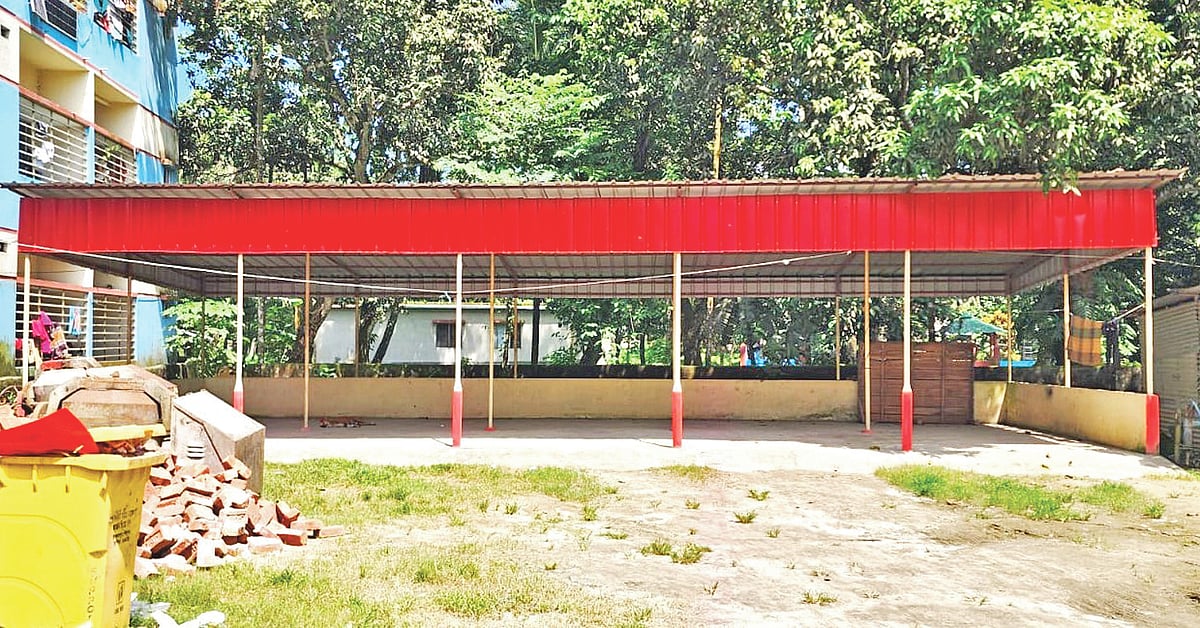
Tk 800,000 was allocated to construct a vehicle parking facility (described in the project documents as a garage) within the Islampur Upazila Parishad premises. A visit to the site during the first week of June found an open space measuring 42 feet by 18 feet, with brick walls about 2.5 feet high on three sides. Several iron pillars had been installed on the walls, supporting a corrugated tin roof capable of accommodating a maximum of five cars. The project records, however, showed that the entire Tk 800,000 had been spent.
Headteachers unaware of the allocations
Tk 5.52 million was allocated for education and social programmes in Jamalpur Sadar Upazila. The funds were for distributing bicycles to students across 15 unions, providing educational materials and equipment to educational institutions, distributing sewing machines to women along with training, organising processions, quiz and debate competitions, and conducting awareness workshops on various social issues.
To verify about the project, this correspondent visited 48 educational institutions in Jamalpur Sadar Upazila and spoke to the respective authorities. Of them, 11 schools said they had received some items. Some received a football or a few benches, while others were given a ceiling fan, several tables and some school uniforms. The remaining 35 schools said they had received no allocation at all.
MA Rashid, headteacher of Joka Bharuakhali Girls' High School in Sadar upazila, said, "Over the past several years, we have not received any money in grants from the upazila parishad. It is from you that I have learned that such amount of money was allocated under the ADP project."
Mohammad Abdullah, headteacher of Alim Uddin High School in the same upazila, said the same. "It is from you that I have learned so much had been allocated for students and the school. We have not received any of it," he said.
Taking advantage of administrative laxity
Most of the government-funded development projects across Jamalpur's seven upazilas were implemented after 5 August 2024. Following the fall of the Awami League government (whose activities are now banned), many local elected representatives went into hiding.
This created a virtual administrative vacuum at the local level. In the absence of effective oversight and accountability, the UNOs came to exercise dominant authority.
There are allegations that the then UNOs and officials of the Local Government Engineering Department (LGED) took advantage of the situation by selecting development projects according to their own preferences. In many cases, neither necessity nor priority was taken into consideration.
On condition of anonymity, at least five Union Parishad chairmen in Jamalpur claimed that, due to the absence of elected representatives, the upazila administrations effectively enjoyed unchecked authority. They also alleged that, in some cases, funds were embezzled by showing development work on paper in collusion with Union Parishad members and secretaries.
Jahangir Selim, general secretary of the Jamalpur District Anti-Corruption Prevention Committee, told Prothom Alo that irregularities occur when there is a lack of accountability and weak supervision.
He said an impartial and thorough investigation is needed to determine whether government allocations were properly spent at the local level. After 5 August 2024, power became concentrated in the hands of the UNOs. We have been hearing about various irregularities in local development allocations. If the allegations are found to be true, strict action must be taken against those responsible, he added.