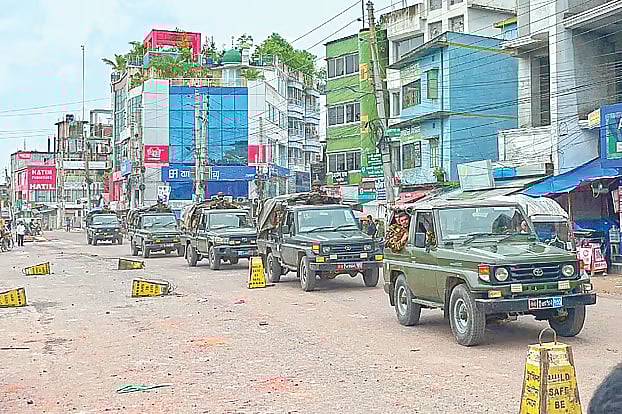
Gopalganj clash: Clear signs of attack ignored, questions raised over security measures
Preparations for an attack on the National Citizens’ Party’s (NCP) July rally in Gopalganj had been underway for several days. Leaders and activists from the Awami League (activities suspended) and its banned student wing, Chhatra League, had arrived from different areas and were stationed in alleys across Gopalganj town. In the days leading up to the rally, threats circulated widely on social media.
According to individuals involved in analysing the week’s events in Gopalganj and the related social media activity, the warning signs of violence surrounding the NCP’s rally were unmistakable. Even at the local level, there were concerns that Awami League activists would resort to violence, which had also been conveyed to the district police by NCP’s local leadership. Despite these warnings, law enforcement failed to take adequate security measures.
Yesterday, Thursday, Prothom Alo spoke with at least 18 people, including eyewitnesses, local journalists, and members of the law enforcement. They described how local Awami League and Chhatra League leaders had been working for days to thwart the NCP’s rally, bringing in activists from various regions to Gopalganj. They even planned to obstruct roads by cutting down trees and creating blockades.
Locals reported that along with the mobilisation of party members, Awami League activists also stirred up local sentiment via social media. A key narrative was that the NCP intended to attack the Mausoleum of Bangabandhu Sheikh Mujibur Rahman in Tungipara under the guise of the rally.
A local village police officer, speaking on condition of anonymity, told Prothom Alo, “There was a pre-planned attempt to detain and assault NCP leaders and activists. People from the villages had come in groups and spread out across the alleys of the town.”
At a press briefing held yesterday at the Gopalganj Deputy Commissioner’s Office, Dhaka Divisional Commissioner Sharaf Uddin Ahmed Chowdhury said in response to a question, “We have intelligence that some miscreants came from outside the district. They are still hiding in Gopalganj. We’re trying to identify them and closely monitoring the situation.”
Locals reported that along with the mobilisation of party members, Awami League activists also stirred up local sentiment via social media. A key narrative was that the NCP intended to attack the Mausoleum of Bangabandhu Sheikh Mujibur Rahman in Tungipara under the guise of the rally.
Additionally, rumours were spread that individuals linked with the NCP and the anti-discrimination student movement wanted to change the name of Gopalganj district or merge it with neighbouring ones—claims that angered many local residents and contributed to the tension and violence.
To mark the anniversary of the mass uprising that led to the fall of the Sheikh Hasina government, the NCP launched a month-long “July March” campaign across the country, with Gopalganj scheduled for last Wednesday. The day before the rally, the NCP initiated a campaign titled “March to Gopalganj,” which intensified the rumours regarding an attack on Tungipara or plans to rename the district.
Despite the aggressive social media campaigns and visible tension on the ground, questions have been raised as to why the police and security forces failed to prevent repeated attacks on the day of the rally. Why wasn’t the administration alarmed by the influx of people from neighbouring districts in advance? Why weren’t sufficient law enforcement personnel deployed?
Analysts argue that such preparation does not even require secret intelligence. Field-level administrators usually have an idea of potential trouble spots, especially when previous incidents provide clear warnings. After the fall of the Hasina government, Awami League activists were in hiding nationwide, but in Gopalganj they had attacked army personnel. Given this history, Gopalganj warranted extra precaution and intelligence gathering.
Moreover, police were attacked, and their vehicle torched at 9:30 am on Wednesday in Khatiagor Charpara, Gopalganj Sadar. The NCP rally was attacked four hours later. This window of time could have allowed reinforcements from neighbouring areas like Madaripur.
When asked, Rezaul Karim Mallik, Deputy Inspector General (DIG) of Dhaka Range Police, told Prothom Alo, “It’s not accurate to say there was no security preparation. Police personnel were deployed. However, if any lapses are identified, action will be taken following an investigation.”
Lax security even after the attack
Despite repeated attacks, security remained inadequate. At 9:30 am on Wednesday, police officers were assaulted in Khatiagor Charpara and their vehicle set ablaze. While returning after inspecting the scene, the Upazila Nirbahi Officer (UNO) M Rakibul Hasan came under attack around 11:30 am. Yet, no significant increase in security was observed afterward.
According to local sources, around 1:45 pm, 200–300 leaders and activists from Awami League, Jubo League, and Chhatra League launched an armed assault shouting “Joy Bangla,” using homemade weapons, cocktails, and crude bombs. Police present at the scene, along with NCP members, had to flee into the nearby court premises. Additional police forces later arrived and dispersed the attackers.
At 2:05 pm, NCP’s central leaders reached the rally site, but were forced to conclude the programme in just 35 minutes due to the tense environment. As they were leaving, another round of attacks occurred. This time, the violence intensified, and clashes broke out between attackers and law enforcement. Subsequently, Awami League and Chhatra League members vandalised and set fire to several locations, including the Deputy Commissioner’s residence, the district prison compound, and surrounding areas.
A senior police official, requesting anonymity, told Prothom Alo, “Considering the sequence of events starting from Wednesday morning, immediate action could have been taken. But by the time extra forces were deployed in the afternoon and evening, the attacks had escalated into bloody conflict. This was a clear case of operational failure.”
The government’s own high-ranking officials have admitted to shortcomings in security preparedness and intelligence gathering. Asked whether sufficient intelligence was available, Home Affairs Adviser Lt Gen (Retd) Md Jahangir Alam Chowdhury told the media yesterday, “Yes, there was intelligence. But perhaps it did not reflect the full scale of what actually occurred.”
However, at an event in Dhaka yesterday, Youth and Sports Ministry adviser Asif Mahmud Shojib Bhuiyain stated, “From what I’ve seen, the security forces in Gopalganj did a good job. They successfully ensured everyone’s safe return.”
What we found in Gopalganj
On the day after the attack and clashes around the NCP rally, Prothom Alo interviewed local residents to understand the underlying causes. They confirmed that the morning attacks on police and the UNO had created panic at the rally site, raising fears about the arrival of NCP leaders. The NCP urged the administration to act, but still, no additional security was arranged.
Ariful Daria, the chief coordinator for NCP in Gopalganj, told Prothom Alo yesterday afternoon, “We had indications that an attack might occur. Local Awami League and its affiliated groups had been gathering for days. We shared this information with local police and intelligence agencies, who dismissed our concerns. Even when the stage was attacked before the rally began, the law enforcement present didn’t take effective action.”
Locals said that even after the rally, the NCP motorcade was obstructed. It was attacked again at Ghonapara intersection with stones, sticks, and roadblocks made of tree trunks and bamboo. From the afternoon, these kinds of obstacles were seen all over the town’s alleys and on the Gopalganj–Patgati Road.
Yesterday afternoon, Prothom Alo spoke with a young eyewitness near the Gopalganj launch terminal bridge. Under condition of anonymity, he said, “People here cannot tolerate insults toward Bangabandhu. They (NCP) should not have held the rally here. Then none of this would have happened, and those people wouldn’t have died.”
Several other locals said that the main goal of the attackers was to prevent the NCP rally altogether. However, so many people turned up that the NCP barely managed to leave Gopalganj unharmed. At one point, attackers had even surrounded the police from all sides.
Asked about the role of law enforcement, former Inspector General of Police (IGP) Md Nurul Huda told Prothom Alo, “There shouldn’t have been an intelligence failure in Gopalganj. Open intelligence was readily available. The incident clearly shows a lack of action from those responsible, despite knowing the ground reality.”