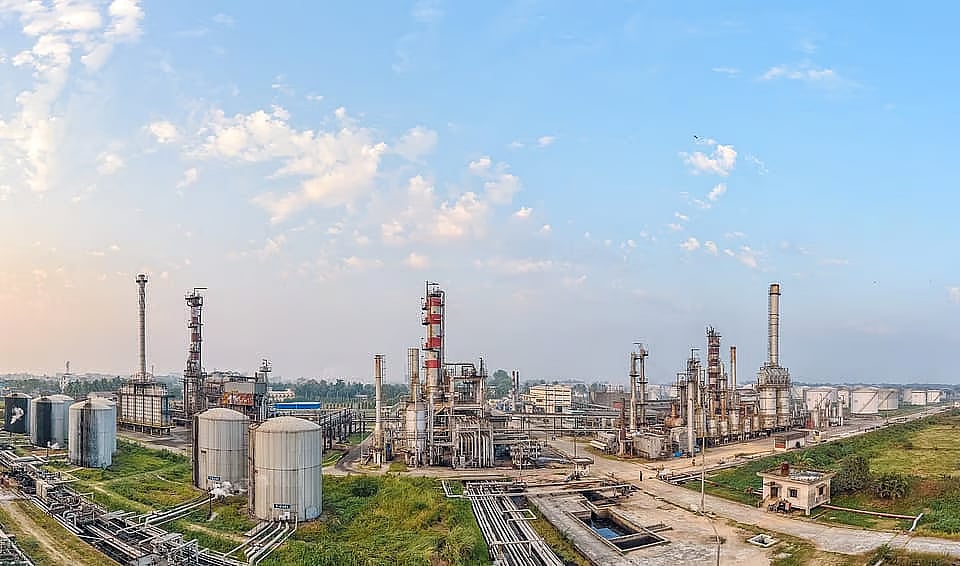
How much crude oil is in stock, how long can petrol and octane production continue?
Eastern Refinery PLC in Chattogram currently has around 100,000 tonnes of crude oil in stock. Based on its daily refining capacity, production can continue for another 20 to 22 days with this reserve. However, energy sector insiders fear that if new shipments do not arrive on time, pressure could mount on the production system of the country’s only state-owned refinery.
The ongoing war situation in the Middle East along with rising tensions in the Strait of Hormuz has created uncertainty over the movement of crude oil tankers. The situation has become more uncertain after a vessel carrying crude oil from Saudi Arabia’s Ras Tanura terminal was forced to halt its journey.
Sources at the Bangladesh Petroleum Corporation (BPC) said the vessel, Nordic Pollux, loaded crude oil on 3 March. Although it initially set sail, it had to return to Ras Tanura due to unfavourable conditions and is currently stationed there.
Eastern Refinery PLC in Chattogram is the country’s only state-owned oil refinery. Imported crude oil is refined here to produce diesel, petrol, octane, furnace oil, naphtha and other fuel products. These are later supplied to consumers through Padma, Meghna, Jamuna and Standard Asiatic oil companies.
Refinery sources said the facility has a total storage capacity of about 225,000 tonnes, while the current stock stands at about 100,000 tonnes. The refinery can process around 4,500 tonnes of crude oil per day.
When contacted, Eastern Refinery’s managing director Md Sharif Hasnat told Prothom Alo, “Major portion of the crude oil comes through the Strait of Hormuz, where tensions are currently high. With the oil we have in stock, production can continue for about 20 to 22 days. If no new shipment arrives within that time, pressure may arise in production.”
However, he added that Bangladesh’s fuel supply does not rely solely on crude oil. “Around 80 per cent of total imports are refined fuel, so there is no immediate risk of a shortage. Still, the arrival of a new shipment would make the situation more comfortable.”
According to refinery sources, the existing crude oil stock could produce around 40,000 tonnes of diesel, 15,000 to 20,000 tonnes of petrol and octane, with about 30,000 tonnes of furnace oil.
Sources from the Eastern Refinery, the country's only state-owned oil refinery, said the facility has a total storage capacity of about 225,000 tonnes, while the current stock stands at about 100,000 tonnes. The refinery can process around 4,500 tonnes of crude oil per day.
Uncertainty over tanker schedules
The current Middle East conflict began on 28 February, when the United States and Israel launched strikes in Iran. Iran’s retaliatory attacks quickly escalated tensions in the region.
At the centre of this conflict is the Strait of Hormuz, a vital maritime route in the Persian Gulf. Nearly 20 per cent of the world’s oil and gas is transported through this route. Any military tension there can therefore disrupt global energy supply chains.
The route is crucial for Bangladesh as well, because a large share of the crude oil imported from the Middle East passes through it.
According to BPC sources, Bangladesh imports 700,000 to 800,000 tonnes of Arabian Light crude oil each year from Saudi Arabia’s state-owned company Aramco. The oil is usually loaded onto vessels at the Ras Tanura terminal.
Meanwhile, roughly the same amount of Murban crude oil is supplied by the Abu Dhabi National Oil Company (ADNOC) of the United Arab Emirates. This oil can sometimes be shipped through the Fujairah port, which does not require passing through the Strait of Hormuz.
According to BPC’s import schedule, six more vessels carrying about 600,000 tonnes of crude oil are expected to arrive from Ras Tanura in April, June, July, September, October and December this year. However, if the conflict persists, uncertainty remains over whether these shipments will arrive on schedule.
Energy sector insiders say prolonged disruption in crude oil supply could affect the production of the domestic refinery, particularly that of petrol and octane.
Almost all petrol used in Bangladesh and a large portion of octane are produced domestically through refinery operations and condensate processing. A drop in crude supply could therefore impact production of these fuels as well.
However, officials from the refinery and BPC say refined fuel continues to arrive from multiple international sources, so there is currently no risk of a major shortage.
About 20 per cent of total imports are crude oil, while 80 per cent are refined fuel. Bangladesh is now importing fuel from various sources. Supplies are also coming from countries such as Singapore, Malaysia, India and China. Therefore, there is no immediate concern about a major fuel shortage.Anindya Islam, state minister for power, energy and mineral resources
Refined fuel makes up the bulk of imports
Bangladesh mainly imports two types of fuel: refined fuel and crude oil. About 80 per cent of imports are refined fuel, which can be used directly. These are imported from countries including Malaysia, the United Arab Emirates, China, Indonesia, Thailand, India, Oman and Kuwait.
According to BPC data, during the 2024-25 fiscal year, Bangladesh imported 4.7 million tonnes of refined fuel at a cost of about Tk 396.92 billion.
During the same period, 1.51 million tonnes of crude oil were imported at a cost of about Tk 105.03 billion, mainly from Saudi Arabia and the United Arab Emirates.
Some fuel is also produced by processing condensate derived from local gas fields. In total, Eastern Refinery produced about 1.496 million tonnes of petroleum products in the last fiscal year, including around 750,000 tonnes of diesel.
When contacted, state minister for power, energy and mineral resources Anindya Islam said about 20 per cent of total imports are crude oil, while 80 per cent are refined fuel.
“Bangladesh is now importing fuel from various sources. Supplies are also coming from countries such as Singapore, Malaysia, India and China. Therefore, there is no immediate concern about a major fuel shortage,” he said.
The state minister added that initiatives have also been taken to import fuel from alternative sources. As part of this effort, the process has begun to import about 120,000 tonnes of oil from Brunei.
“As a result, even if crude oil shipments are delayed, the country is not facing an immediate crisis,” he said.